


Dissertation Project Timeline Report With Task Status




Try Before you Buy Download Free Sample Product
 Impress Your
 Audience
 100%
100% Editable
 Save Hours
 of Time


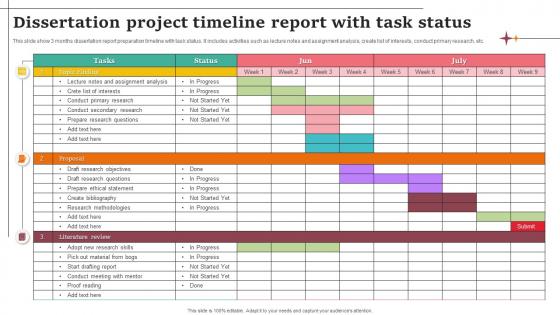
This slide show 3 months dissertation report preparation timeline with task status. It includes activities such as lecture notes and assignment analysis, create list of interests, conduct primary research, etc.
People who downloaded this PowerPoint presentation also viewed the following :
Dissertation Project Timeline Report With Task Status with all 6 slides:
Use our Dissertation Project Timeline Report With Task Status to effectively help you save your valuable time. They are readymade to fit into any presentation structure.






FAQs for Dissertation Project Timeline Report
So the basic timeline goes: pick your topic and get proposal approved, finish lit review, design methodology, collect data, analyze and write, then defend. Proposal should be done by end of year two, data collection in year three - but seriously, add like 6 months to whatever timeline you're thinking because research is messy. Committee meetings are your lifeline for staying on track. Oh and definitely have that awkward conversation with your advisor early about what they actually expect, since every department has their own weird deadlines that nobody tells you about upfront.
Okay so first thing - figure out your big deadlines like committee meetings and defense dates. Those can't move, so they're your anchor points. Work backwards from there to see what depends on what. Writing always takes way longer than you think (learned this the hard way lol). Don't try to juggle everything at once - pick one major thing and focus on that. Even 30 minutes of writing daily beats those crazy all-nighters that leave you dead for a week. Consistency is everything here. The small daily stuff really adds up, trust me.
Okay so first thing - break that monster into tiny pieces. Like "finish lit review for chapter 2" instead of just "work on chapter 2." Then track how long stuff actually takes you for a week or so. My first timeline was completely delusional lol. You'll need buffer time because your advisor will 100% have notes. Also those "quick edits" always take forever for some reason? Set up regular check-ins with yourself to tweak things as you go. Being flexible beats trying to stick to some perfect plan that doesn't work anyway.
Okay so preliminary research is literally the foundation of your whole timeline - skip it and you're screwed. It shows you what you're actually working with before you commit to crazy deadlines. You'll figure out how much literature exists, if your methods actually work, whether you need special permissions. I've watched people add MONTHS after realizing their "easy" survey needed IRB approval - ugh, the worst. Plus you'll catch seasonal stuff like when schools close or archives shut down. Do 2-3 weeks of digging upfront. Then build in buffer time for every phase based on what you discover.
Honestly, you've gotta bake buffer time right into your schedule from day one. I learned this the hard way - feedback is never as straightforward as you think it'll be. Block out actual "revision weeks" between milestones instead of hoping you can squeeze changes in later. Plan for 2-3 rounds per chapter minimum, with at least a week to digest and fix each round. The game-changer for me was treating revisions like their own separate project phase. Set real deadlines for when drafts go out and when you need comments back. Then actually stick to them - otherwise you'll be scrambling at the end like everyone else.
Ugh, the time thing will absolutely destroy you if you're not careful. Everything takes like 3x longer than expected - that's just dissertation law or whatever. Your advisor's gonna want major revisions too, so factor that in. Life also has this annoying habit of happening while you're trying to write. You'll get the flu, your car breaks down, someone gets married. Back-loading everything is suicide. I learned that one the hard way! Write messy drafts early. Set mini-deadlines for each chapter instead of one massive "be done" date.
Ugh, this question hits close to home lol. So lit review and proposal? You're looking at 6-8 months easy - learning to think like a researcher is weirdly hard. Data collection usually eats up 8-12 months, though survey people get lucky sometimes. Writing takes forever - I'd say 6 months minimum. Your advisor will probably murder your drafts with red ink anyway. Oh, and add buffer time because something always goes wrong. I budgeted 2.5 years total and barely made it. Trust me on the buffer thing.
Honestly, just pick whatever tool you'll actually stick with - Trello, Asana, or even Excel if that's your thing. I'm weirdly obsessed with Notion right now, it's like having everything in one place. Google Calendar is clutch for blocking out actual writing time. Map out your big deadlines first, then just work backwards into smaller weekly chunks. Oh, and maybe keep a backup paper planner? My laptop crashed last month and I almost had a breakdown lol. The whole "manageable pieces" thing sounds cliché but it really does work.
Okay so first - don't freak out and throw your whole timeline in the trash. Take a step back and figure out what's actually make-or-break versus what just feels urgent right now. Most of the time you can push non-essential stuff back or trim some scope without destroying your main argument. Hit up your advisor immediately about adjusting things. They've literally seen every possible disaster, trust me. Protect the big milestones first - proposal defense, data collection deadlines, that kind of thing. Then just work backwards from there. Oh and going forward? Build in some cushion time so you're not losing your mind every time something goes wrong (because it will).
Honestly, treat your dissertation like a part-time job right from the start. Don't fall into the "I'll deal with it later" trap like I did freshman year - ugh, what a mess that was! Even during heavy coursework, block out 5-10 hours weekly for dissertation stuff. Literature reviews are perfect for this since they don't need massive time chunks. Your courses can actually feed into your research if you're smart about it. Gradually bump up those dissertation hours as classes wind down. Set small deadlines for yourself too. Otherwise you'll hit senior year with nothing done and totally panic.
Oh totally, you need chapter deadlines or you'll be tweaking chapter one until you're 90. I've watched so many people get trapped in that endless editing spiral - it's honestly painful to witness. Your deadlines don't need to be perfect, just realistic enough that you won't hate yourself. Missing by a week? Whatever. The point is having something to aim for so you actually keep moving forward instead of polishing the same paragraph for months. Work backward from your defense date and build in some cushion time for when everything inevitably takes longer than expected.
Really depends on your topic and how much is out there already. New research areas? You'll be digging forever just to find decent sources. Established fields are almost worse though - you'll drown in papers. I always underestimate how long the actual reading takes, plus you need time to organize everything thematically or whatever. Budget at least 2-3 months, but honestly add extra time because you'll keep finding new stuff that sends you down random rabbit holes. My prof always said start wide then narrow down. Oh, and save time for revisions - you'll definitely spot gaps later that'll bug you.
Dude, get people involved - it'll save you so much time. Your advisor stops you from chasing random rabbit holes for months. Writing groups are clutch too because other people catch the logical holes you're blind to. I swear, peer feedback is like having extra eyes on your work. Monthly check-ins create fake deadlines that actually work - no more disappearing for weeks without progress. Plus you need people who get why Chapter 3 is the literal worst. The accountability thing is real. Flying solo just means you'll spin your wheels longer than necessary.
Honestly, I just use a simple spreadsheet to track word counts and deadlines - nothing fancy. Breaking chapters into weekly chunks is a game changer though. You get that satisfying checkbox moment way more often. Trello's pretty good if you're more visual, or even Google Sheets works fine. I tried Asana once but got distracted setting up all the colors and features (classic procrastination move). The real trick? Pick whatever you'll actually use consistently. Doesn't matter how perfect your system looks if you forget about it after a week.
Honestly, qualitative dissertations are just brutal time-wise - expect like 6-12 months longer than quant ones. The data collection is where it gets you. Quantitative? You run surveys, crunch numbers, done. But qualitative means months of interviews and observations, then transcribing everything (ugh, the worst part). Analysis takes forever too since you're constantly revisiting themes and refining stuff. I learned this the hard way - thought I'd be done way sooner. Don't make my mistake and underestimate how long coding all that messy data actually takes. Plan extra time, seriously.
-
Out of the box and creative design.
-
Nothing beats the well-formatted and professionally designed templates offered. Kudos to SlideTeam for their amazing collection of PPT slides.