

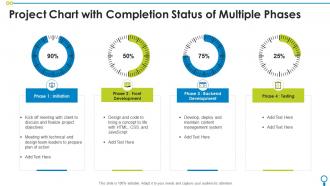
Project Chart With Completion Status Of Multiple Phases





Try Before you Buy Download Free Sample Product
 Impress Your
Audience
 100%
Editable
 Save Hours
of Time


Our Project Chart With Completion Status Of Multiple Phases are topically designed to provide an attractive backdrop to any subject. Use them to look like a presentation pro.
People who downloaded this PowerPoint presentation also viewed the following :
Project Chart With Completion Status Of Multiple Phases with all 7 slides:
Use our Project Chart With Completion Status Of Multiple Phases to effectively help you save your valuable time. They are readymade to fit into any presentation structure.






FAQs for Project Chart With Completion Status
Okay so there are five main phases but honestly they blend together way more than textbooks make it seem. Start with initiation - that's just figuring out what you're actually doing and who cares about it. Planning comes next where you map timelines, resources, all that stuff. Then execution kicks in, which is the real work happening. But here's what's weird - you're constantly bouncing between doing the work, checking how it's going, and tweaking your plans. It's super iterative, not some straight line! Monitoring runs alongside everything else so you catch problems early. Closure wraps it up with lessons learned. Focus on connecting these phases instead of treating them like separate boxes.
Honestly, good communication is what saves you from those awful "wait, who's doing what?" moments. Set up regular check-ins so everyone actually knows what's going on. I can't tell you how many projects I've watched crash just because people made assumptions about who knew what. The other thing - and this might sound obvious but people forget - make sure your team feels okay speaking up when stuff goes sideways. You'll catch problems way earlier that way. Start with something simple like a weekly meeting where everyone can reach each other quickly when things get messy.
Oh man, stakeholder management can totally make or break your project. I've watched perfectly executed projects crash and burn just because someone didn't loop in the right people - it's wild how that happens. You want to figure out who actually has influence early on, then understand what they care about. Regular check-ins are huge, not just that initial kickoff meeting everyone does. When stakeholders feel informed and bought-in throughout, you dodge those awful last-minute requirement changes. Trust me, map out your key people from day one and keep talking to them. It's basically relationship maintenance but for work projects.
Don't just do risk planning once and forget about it - weave it throughout your whole project. Get your team together early to brainstorm what could go wrong. Keep a risk list that you actually update (I can't tell you how many dead spreadsheets I've seen gathering digital dust). Rate each risk by how likely it is and how much damage it'd cause. Build backup plans for the scary ones. Here's what really works: make risk review a regular thing in your team meetings. You'll catch new problems before they bite you. Set up warning signs so you know when to pull the trigger on those backup plans.
Honestly, scope creep is brutal if you don't tackle it early. Write down exactly what you're doing (and what you're NOT doing) before anything starts. Make everyone sign off on it - trust me on this one. Set up some kind of formal process for changes. Like, if someone wants to add something new, it has to go through proper approval with budget adjustments and all that. I got burned on this before because I thought I could just roll with requests as they came up... big mistake. Regular check-ins are your friend here. Catch stuff before it spirals. And honestly? You've gotta be comfortable saying "nope, that's outside what we agreed on." Keep a list of their future ideas though so they don't feel totally shut down.
So Agile basically chops your project into these short 2-4 week chunks instead of doing the whole waterfall thing where you plan everything upfront. Way more flexibility when stuff inevitably changes - and trust me, it always does. You're constantly getting feedback and can actually pivot instead of being stuck with some rigid plan from six months ago. Traditional methods are more like "map it all out first, then execute" while Agile is "let's figure it out as we go and deliver pieces along the way." Perfect for messy projects with tons of unknowns.
Oh definitely track your schedule and budget first - those are the obvious ones. Quality metrics matter too, but honestly? Stakeholder happiness can totally save a project even if other stuff goes sideways. I'd add team productivity and maybe resource utilization if you're running multiple things at once. Don't go overboard though - pick like 4-5 that actually apply to your situation. Set up something simple to track them, maybe just a basic dashboard. We do weekly check-ins and it works pretty well. Way better than drowning in data you'll never use.
Honestly, you need to break everything down into small work packages first - gives you way better visibility than just guessing at the big picture. Pull historical data from similar projects to check your numbers because let's be real, we're all terrible at estimating initially. Add 10-20% buffer for the inevitable surprises. Weekly budget check-ins are crucial, not monthly ones where problems get buried. Oh and don't be stubborn about moving money around - if one area's under budget while another's drowning, shift resources fast. Simple dashboards help catch drift early before you're explaining budget disasters to your boss.
Okay so first grab a project management thing - Asana's pretty solid, or Monday if you want something flashier. Slack is basically mandatory for team chat these days. Zoom for video calls obviously. You'll need somewhere to dump all your docs too - Notion's great for this, way better than trying to organize everything in email chains. Google Drive handles file sharing fine. Oh and get Toggl or something similar for time tracking, trust me on this one. Don't go crazy installing everything at once though. Pick one tool per category and actually learn it first.
Oh man, cultural stuff can totally derail projects if you're not ready for it. Some teams are super hierarchical while others are flat. Meeting styles vary wildly too - like, certain cultures give really indirect feedback versus others who'll just tell you straight up your idea sucks. Work-life balance expectations are all over the map. Honestly, I learned this the hard way on my last project. Do yourself a favor and research everyone's backgrounds early on. Set communication rules from day one. Also? Build in extra time because there will be confusion while people figure each other out.
Honestly, I'd start with talking to each person separately first - way less drama that way. Get them to actually listen to each other instead of just waiting for their turn to argue. Once you've done that, bring everyone together but keep it focused on work stuff, not who said what to whom (that rabbit hole never ends well). Sometimes you gotta get creative - maybe switch up roles temporarily if certain people just can't work together. The main thing is don't let it fester because that poison spreads fast. Oh, and write down whatever you all agree on so nobody can conveniently "forget" later.
Set clear expectations from the start, then actually stick to them. Everyone needs to know exactly what they're doing and when - vague stuff just kills accountability completely. Do regular check-ins where people report on what they committed to, not just random updates. Address it directly when someone messes up, but don't be a dick about it. Here's the thing though - you have to model it first. Say you'll finish something Friday? Get it done Friday. Actually, try starting your next meeting by having everyone state one thing they'll own this week.
Honestly, the three things that kill projects every time: crazy deadlines, people adding random stuff halfway through, and terrible communication. Always pad your timeline - I can't stress this enough, shit just takes longer than expected. Get everyone to agree on exactly what you're building before you start, then make people fill out actual forms when they want changes (trust me on this one). Oh and talk to your stakeholders constantly, even when you think you're being annoying. Better to overcommunicate than have someone freak out later because they had no clue what was happening.
Honestly, forget waterfall - it's dead in fast-paced industries. You'll want to go agile with short sprints and daily standups. Two-week cycles beat six-month timelines every time. Yeah, it feels chaotic initially but you adapt quick. Stakeholders will definitely change requirements mid-project (ugh, always happens), so pick flexible frameworks like Scrum or Kanban. Regular check-ins are crucial. Sometimes you just ship "good enough" and iterate later - perfectionism kills speed. The whole thing's about pivoting fast when needed.
Build quality checks into every step instead of just checking at the end. Define what "good" looks like with your team upfront - saves so much headache later. I do mini-reviews at 25%, 50%, and 75% completion now. Waiting until the end is brutal, trust me on this one. Document problems as they pop up and track fixes. Catching stuff early is way cheaper than fixing it later. Oh, and create a simple checklist for each deliverable. Sounds boring but it works. Stick to it every time.
-
Very well designed and informative templates.
-
Visually stunning presentation, love the content.