

Current issues in information technology ppt




Try Before you Buy Download Free Sample Product
 Impress Your
 Audience
 100%
100% Editable
 Save Hours
 of Time


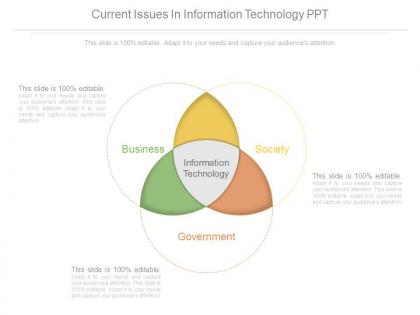
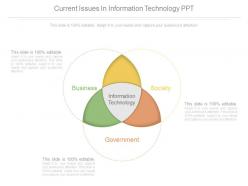
It is evident that these days Information technology and business are getting inextricably interwoven. These two have affected each other in a way that the nonexistence on one can hugely effect the working of another, therefore, considering this our team has created a current issue’s in technology PPT slides to display how the society, business and the government are connected with technology and the numerous problems that are persisting these days. The solutions to these existing problems are vital for smooth functioning of organisations and the society as a whole. Apart from this, these templates will portray a clear picture of the current scenario and how these technological issues are affecting different phases of life. Moreover, these illustrations can be easily merged with your presentations without generating any errors. Also, these layouts have time-saving capabilities. Overall, if you are keen to represent the present issues in IT to your audience in a way that it puts an everlasting impact on them then without any doubt simply download these tremendous looking patterns and be a presentation pro.Our Current Issues In Information Technology Ppt exemplify entertaining education. Folks find it interesting.
People who downloaded this PowerPoint presentation also viewed the following :
Current issues in information technology ppt with all 7 slides:
Gain from the advantages our Current Issues In Information Technology Ppt afford you. They allow you to make hay.




FAQs for Current issues in
Honestly, ransomware's the scariest thing out there right now - they'll lock down your whole network and hold it hostage. Phishing's gotten crazy good too, like AI makes these fake emails that fool even smart people. Oh, and supply chain attacks where hackers sneak in through your vendors? That's becoming huge. Everyone's moving stuff to the cloud but screwing up the security settings in the process. I keep telling people this but - train your employees first. Most hacks still happen because someone clicked the wrong thing or fell for a scam.
So AI handles all the boring repetitive stuff while making things more personal for customers. Chatbots answer basic questions around the clock, predictive tools figure out what people need before they ask, and sentiment analysis catches when someone's pissed off so a real person can step in. Honestly, it's pretty smart - filters out the mundane tickets so your team tackles actual complex problems instead of "how do I reset my password" for the millionth time. If you're starting out, just do simple FAQ bots first then build up to fancier routing systems later.
Ugh, GDPR and CCPA are such a pain. Your compliance costs will skyrocket - you'll need whole teams just handling data requests and deletion stuff. The fines are scary (we're talking millions), but honestly the day-to-day operational nightmare is worse. Product teams have to rebuild everything with consent flows and data portability built right in. Plus every feature needs "privacy-by-design" thinking now, which slows development way down. Different regions have different rules too, so that's fun. First thing though? Figure out what personal data you're actually collecting and where it all lives. That audit alone will probably surprise you.
Dude, you should really look into cloud computing if you haven't already. Most companies run everything through it now instead of dealing with physical servers. The best part? You only pay for what you actually use, and you can scale up when things get crazy busy. Your team can work from literally anywhere too - which honestly saved everyone's ass during COVID. I mean, disaster recovery is way better than anything you'd set up locally. Unless you love burning money and being stuck with whatever hardware you bought last year, I'd start moving some non-critical stuff over first. Way less headache than maintaining your own setup.
So blockchain's actually changing how supply chains work - you can trace stuff from where it started all the way to the customer. Pretty cool for food and pharma companies who need to prove their products are legit. The records can't be tampered with, which is nice, but honestly some old-school industries are dragging their feet on adopting it. Smart contracts handle payments and compliance automatically too, so less paperwork headaches. If you're dealing with supply chain stuff, might be worth checking out how it could help with tracking products and vetting vendors.
Dude, facial recognition has some seriously sketchy issues. Privacy's the big one - they can track you everywhere without asking. Plus it's way worse at identifying women and people of color, which is messed up. False positives happen all the time too, so innocent people get flagged or even arrested. Companies and governments basically have constant surveillance now - kinda gives me Black Mirror vibes honestly. Your biometric data could also get hacked since it's stored somewhere. If you're dealing with this tech, you'll need proper consent forms, regular bias testing, and don't keep the data forever.
So most companies now bake privacy protections right into products from the start - way smarter than trying to fix things later. They're throwing money at fancy tech like differential privacy (sounds complicated but it's pretty cool) and federated learning to keep user data safe while still innovating. Honestly, being upfront about data practices has become a huge selling point. Users actually trust you more! The trick is getting your legal team, engineers, and product people talking early on. Don't treat privacy like some annoying box to check at the end.
Honestly, hybrid tools are where everything's headed right now. Companies are throwing money at anything that makes remote/in-office collaboration less painful - better video calls, whiteboards that actually work, async stuff. AI integration is everywhere too. Meeting summaries, smart scheduling, all that. Oh and heads up - employee monitoring software is getting big (sketchy but whatever). Cloud security's huge since people work from random places now. I'd definitely get comfortable with Miro or Notion if I were you. Your company's probably already looking at something similar anyway.
So IoT is basically making cities super connected - everything talks to everything else now. Traffic lights adjust automatically when there's congestion, water pipes have sensors that catch leaks early (saves cities tons of money), and parking meters help you find spots through apps. Even trash cans are smart now, which honestly still blows my mind a little. The real magic happens with predictive maintenance though. Instead of waiting for stuff to break, cities can actually fix problems before they happen. If you're doing any urban tech stuff, definitely think about using that data to get ahead of issues rather than just putting out fires all the time.
Honestly, cost is the killer - and people absolutely hate change. Your team will fight you on new systems because they finally figured out the old ones (fair enough, right?). Integration is a nightmare when nothing talks to each other. Security freaks everyone out too, especially moving stuff to the cloud. Training takes forever and costs a fortune. My take? Do small pilot programs first. Way easier to get buy-in when you can show it actually works before asking for the big budget. Plus you'll catch problems early instead of bombing company-wide.
So basically, big companies are doing a bunch of stuff to close the digital gap. Microsoft and Google are throwing money at rural internet projects. They're also partnering with governments to build better broadband infrastructure. Low-income families can get discounted devices and internet through various programs. There's tons of digital literacy training happening too - which honestly makes sense since having the tech is useless if you don't know how to use it. Schools are getting help with laptops for students. Community tech centers are popping up in underserved areas. If your company wants to get involved, just find local digital equity groups - they're always looking for partners and funding.
So basically, quantum computers are gonna demolish all our current encryption - your credit cards, passwords, everything. RSA and that whole family of security? Toast. Honestly kinda wild to think about. Thing is, we're probably still a few years out from this being a real problem. Security teams are already scrambling to build "quantum-resistant" stuff though. You might wanna check what your company's doing about post-quantum crypto planning. This shift's happening whether we like it or not, and nobody wants to be caught with their pants down when it does.
Honestly, most jobs just change instead of vanishing completely. Like HR people become data analysts, marketers focus more on metrics, that kind of thing. Less grunt work, more problem-solving with tech tools. Sure, some old-school roles go away but new ones pop up too - it's weird how that works. The manual stuff gets automated but you end up doing more strategic thinking. My advice? Just pick up some basic digital skills in your area. Even knowing Excel better or understanding simple automation can make a huge difference. Stay curious about the tech side of whatever you do.
Dude, 5G is gonna be insane for mobile apps. We're talking download speeds 100x faster than 4G - your apps will basically load instantly. The latency is so low that stuff like real-time AR/VR and cloud gaming actually becomes viable now. What's really cool though is edge computing. Instead of sending data to some server halfway across the country, apps can process things locally. I mean, I'm still waiting for decent 5G coverage in my area but whatever. The tech is rolling out everywhere so you should definitely start thinking about how to use these features in your projects.
Honestly, it's wild how much tech is changing education right now. AI tutors are getting scary good at personalizing lessons for each kid. VR classrooms are actually a thing now - though probably still expensive as hell for most schools. The whole remote learning boom made everything way more accessible, even if we're all tired of video calls by now. Schools are trying everything from game-based learning to blockchain diplomas (still not sure about that one). But here's the thing - most places are struggling hard with actually integrating all this new stuff. The one-size-fits-all approach is basically dead. If you're working in EdTech, that's where the real opportunity is.
-
Excellent design and quick turnaround.
-
Thanks for all your great templates they have saved me lots of time and accelerate my presentations. Great product, keep them up!