

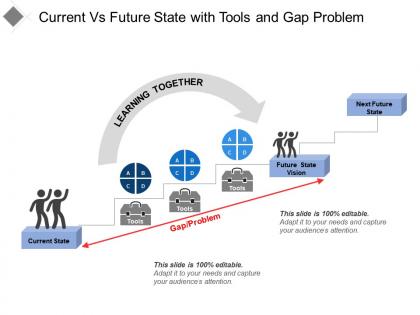
Current vs future state with tools and gap problem





Try Before you Buy Download Free Sample Product
 Impress Your
 Audience
 100%
100% Editable
 Save Hours
 of Time


Maintain the advantage with our Current Vs Future State With Tools And Gap Problem. They give you that extra heads up.
People who downloaded this PowerPoint presentation also viewed the following :
Current vs future state with tools and gap problem with all 5 slides:
Your demands get automatically fulfilled with our Current Vs Future State With Tools And Gap Problem. They enable a degree of automation.
FAQs for Current vs future state with tools
Basically you're trying to figure out where you are now vs where you want to be. Gap analysis helps you spot exactly what's not working - could be your processes, skills, tech, whatever. Think of it like getting a physical but for your business (weird analogy but it works lol). Once you know what's broken, you can actually prioritize fixes instead of just throwing money at random problems. Don't try to analyze everything at once though - pick one area first or you'll go crazy. The whole point is getting real data so you're not just guessing what needs work.
Think of gap analysis like GPS for your business - it shows where you are now vs where you want to be. Super helpful for figuring out priorities and what to focus on first. You'll see exactly what capabilities or resources you're missing, which makes budget conversations way easier (trust me on this one). It helps you allocate resources smarter and set realistic timelines instead of just guessing. The whole point is identifying those critical gaps so you can decide whether to invest internally, find partners, or whatever makes sense. Keeps everyone on the same page too.
Ok so four main things you need: current state, where you wanna be, what's missing between them, and your action plan. Always throw in timelines too - trust me on this one, without deadlines nothing happens. Be super specific with your metrics for both sides. The gaps part? Don't sugarcoat it. Missing skills, broken processes, whatever - call it out. Then prioritize your action items and actually assign people to own them. I've seen so many of these things just die in someone's email because nobody was responsible for following through.
So gap analysis totally depends on your industry. Finance people obsess over risk gaps and compliance stuff - makes sense given all the regulations. Healthcare is way more intense though, like you're literally dealing with patient safety and outcomes. Education focuses on student achievement and whether curricula actually work. The basic process is the same everywhere, but what you measure and care about? Completely different. Your timelines change, stakeholders freak out about different things. Oh, and figure out what "success" actually means in your field first - that's probably the most important part. Otherwise you're just analyzing random stuff.
Start with 3-5 metrics that actually tie to what you're trying to achieve - don't overthink it. Percentage variance between where you are vs where you want to be is solid. Time-to-close gaps and impact severity scores work well too. Before/after measurements are obvious but super useful. I'd also track milestone achievement rates and do some basic trend analysis over time. Skip the fancy formulas initially - simple gap calculations get you 90% there. Oh, and stick with your chosen metrics for at least a few quarters instead of switching constantly (learned that one the hard way).
Tech can totally speed up gap analysis and make it way more accurate. Data analytics tools automatically compare your current performance against benchmarks. Project management platforms track progress and spot bottlenecks in real-time - which honestly saves so much headache. Survey tools make gathering feedback super easy too, no more hunting people down for responses! AI dashboards can even predict gaps before they become actual problems. Just make sure whatever tools you pick actually play nice with your existing systems. Otherwise you'll end up creating more work instead of less, which defeats the whole point.
Dude, you absolutely need those stakeholder interviews for your gap analysis. They'll tell you what's actually happening vs what the documentation claims. I've watched analyses bomb because people just relied on surveys and process maps - big mistake. Talk to frontline people first though, they spot stuff management completely misses. You'll find all these weird workarounds nobody wants to admit exist. Plus you get the why behind problems, not just what's broken. The conversations also reveal why certain gaps stick around forever. Get those interviews scheduled early or you'll be scrambling later.
Honestly, just do a basic impact vs effort grid - it's super simple but works every time. Map out each gap by how much fixing it would help your business vs how much work/money it'll take. Start with the high-impact, easy wins because those build momentum fast. After that, hit the high-impact but expensive ones since those are usually your real game-changers. Low-impact stuff? Skip it unless you're swimming in budget (which, let's be real, who is?). Make a timeline with clear owners so nothing gets forgotten.
Don't be vague about your targets - you need actual numbers or you'll end up with mushy results that don't help anyone. Also, skip analyzing stuff your team already knows is broken (total waste of time). Talk to the right people, not just whoever responds to your emails first. Oh, and here's the thing - I see this constantly - teams get stuck in analysis mode forever. Just pick a deadline, grab your data, find maybe 3-5 real gaps, then actually do something about it. You'll learn more from trying than from another spreadsheet.
Honestly, I'd say at least once a year, but if you're in a crazy fast industry maybe every 6 months. Timing matters too - like right before big planning meetings or when competitors drop something new. Short bursts work better than these massive annual deep-dives anyway. I've watched companies get totally blindsided because they spaced these out too much. Really depends on how quickly things change in your space though. Maybe start yearly and see if that feels right? Oh and definitely put it on your calendar or you'll forget - I always do lol.
Honestly, quarterly check-ins have worked best for me. Just throw everything into a simple spreadsheet - gap, who's handling it, deadline, status. That's it. Monthly progress meetings keep everyone honest about what's actually happening. Those gaps love to sneak back when you're not paying attention, which is super annoying. Short sentences mixed with longer ones help. Don't wait until things go sideways to check in - make it routine. Oh, and definitely figure out your escalation plan upfront for when stuff inevitably falls behind. Start with one cycle, then tweak the timing based on how it goes.
Think of gap analysis as your heads-up for what could go sideways. You map out where you are now, then compare it to where you want to be - boom, you've spotted the problem areas before they smack you. Honestly, it's way better than just hoping things work out. Those gaps? They're your biggest risk signals. I always tell people to be brutally honest about their current situation - none of that wishful thinking stuff. Then you can actually prioritize which gaps might torpedo your goals and figure out how to deal with them.
Honestly, qualitative data is where you find the real story behind your numbers. Like, surveys might show low adoption rates, but interviews could reveal it's actually a trust problem, not a feature issue. That's gold right there. You'll catch emotional reactions and weird edge cases that completely fly under the radar otherwise. Focus groups help you figure out which problems actually bug people versus what just looks messy in spreadsheets. I've seen this so many times - the numbers point one way, but user stories totally flip your understanding. Just throw in 2-3 qualitative methods next time. Worth it.
Dude, visuals are game-changers for gap analysis. People get it instantly when they see charts or heat maps instead of drowning in spreadsheet hell. Before/after comparisons work really well too. Color-code by how urgent stuff is - makes the scary gaps pop right out. Keep each visual simple though, like one main point per slide or you'll lose them. Honestly, half the battle is just getting people to pay attention in meetings, and pretty graphics beat boring data dumps every time. Focus on the biggest problems first so they know what needs fixing ASAP.
Start by being totally upfront about what you're doing and why. People hate feeling like lab rats, so explain how their feedback will actually get used. Run some focus groups or surveys - whatever works for your team. I'd probably do a mix of both tbh. Give them updates as you go so they don't think their input vanished into the void. Quick wins are huge here. When people see changes happening, they'll stay engaged. The whole thing works way better when your team feels like they're helping solve problems instead of just being studied.
-
Enough space for editing and adding your own content.
-
Great designs, really helpful.