

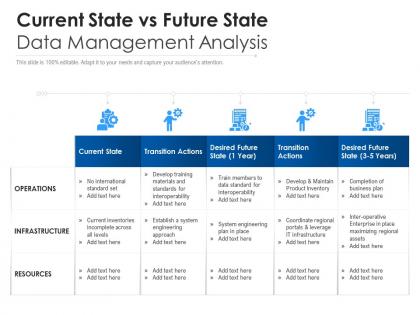
Current state vs future state data management analysis




Try Before you Buy Download Free Sample Product
 Impress Your
 Audience
 100%
100% Editable
 Save Hours
 of Time


Our Current State Vs Future State Data Management Analysis are topically designed to provide an attractive backdrop to any subject. Use them to look like a presentation pro.
People who downloaded this PowerPoint presentation also viewed the following :
Current state vs future state data management analysis with all 2 slides:
Use our Current State Vs Future State Data Management Analysis to effectively help you save your valuable time. They are readymade to fit into any presentation structure.
FAQs for Current state vs future state
Honestly, it's all about accuracy, accessibility, security, and governance - though that last one sounds way more boring than it actually is. Your data needs to be clean and consistent, plus people have to actually find it when they need it. Security's massive too - access controls, GDPR compliance, all that fun stuff. I can't tell you how many projects I've watched crash because three different teams were using three different "official" datasets. Governance basically means someone owns the data, processes are standardized, and you're checking quality regularly. Oh, and definitely start by mapping what data you have and who's responsible for what. You'll be shocked at the gaps.
Honestly, start with data governance right away - don't wait. Pick one dataset that's super critical and nail down your standards there first. Bad data will bite you later, trust me on this one. Set up validation rules and automated monitoring so you catch weird stuff early instead of dealing with a mess down the road. You'll want proper backups and version control too. Document who owns what data (people love to play hot potato with responsibility). Oh, and regular audits help catch things you missed. Once you've got it working smoothly, just copy that process everywhere else.
So data governance is like setting up traffic rules for all your company's data. You're basically creating a framework that controls who gets access to what, how everything gets stored, and making sure the quality stays consistent. Without it? Total mess - people end up working with different versions of the same dataset and making decisions off completely wrong info. Plus it keeps you compliant with stuff like GDPR, which honestly can be a nightmare if you're not prepared. Best place to start is figuring out what your most critical data is, then set up clear ownership and access rules from there.
Honestly, good data management is a game changer - you'll actually know what's happening instead of flying blind. You can spot trends early and catch issues before they become disasters. No more digging through five different spreadsheets wondering which one has the right numbers (we've all been there). Your team needs to trust the data and find it easily. I'd start with cleaning up what you have now. Pick one source for your most important metrics - like revenue or whatever matters most to your business. Makes decision-making so much less stressful.
Ugh, data quality issues are the worst - plus security holes and storage costs that just keep climbing. Poor integration is brutal too, like when your systems literally can't communicate. Been down that road before. Start small though, maybe pick your most critical data first instead of going crazy trying to fix everything. Set up some automated validation rules and decent backup systems. Oh, and regular audits actually catch stuff before it gets messy. Clear governance policies help too, even though they're kind of boring to set up. Honestly way easier to tackle one piece at a time than burn yourself out.
Dude, AI is seriously changing the data game right now. It catches problems before they blow up - which honestly has saved my butt more times than I can count. Real-time anomaly detection is pretty wild, and the automated quality checks are huge time savers. Plus it handles all that boring classification stuff and tracks where your data comes from. The coolest part? It actually predicts what data you'll need next. Though I still don't totally trust it sometimes lol. Look at whatever manual data task you're doing most and try automating that first - easiest win.
Think of a data management plan as your game plan for organizing research data. You'll thank yourself later when you're not drowning in files named "data_final_FINAL_v2.docx" - been there, done that. Most funding agencies require them anyway, so might as well make it useful. It keeps your team on the same page about where stuff lives and how to access it. Security becomes less of a nightmare too. Honestly, the earlier you draft one during your proposal, the smoother everything runs later. Your future stressed-out self will appreciate the organization.
Frameworks are pretty flexible, honestly. You just adapt the core stuff to whatever industry you're in. Healthcare? You're obsessed with HIPAA and patient privacy. Finance is all about transaction data and regulatory headaches. Manufacturing cares more about supply chain info and sensor data from machines - which is actually kind of cool when you think about it. The trick is figuring out what data actually moves the needle for your business. Then you build your governance and security around that. I'd start by just mapping out what data you have now and where it goes. Sounds boring but it's worth it.
Ok so three big things helped me out: get your naming system down and stick to folders that actually make sense, use indexing so you're not waiting forever for searches, and put your most-used stuff on the fastest drives. Seriously though, being consistent with labels from the start saves SO much headache later. Automated backups are a must - I learned that one the hard way. Cloud storage's great for when things grow. Oh and write down how your data connects to other data, because trust me, you'll forget and then spend forever trying to figure it out again.
Dude, GDPR totally flipped everything on its head. No more grabbing whatever data you want - now you need actual consent for collection and solid retention policies. Plus people can demand you delete their stuff, which is fair but annoying to implement. Data mapping becomes your best friend because you gotta know what you have and where it lives. The real kicker? Privacy can't be an afterthought anymore - has to be baked in from the start or you're screwed. Oh and document everything, obviously. I'd start by figuring out what data you're hoarding and actually ask yourself if you need it all.
Start with data governance - boring but necessary. Then standardize your formats and get consistent APIs talking between systems. ETL processes handle the actual syncing, either real-time or batch depending on what you need. The mapping piece is honestly where everything goes to hell, but once you figure out your schema relationships it's smooth sailing. Validate data quality at every point and log everything so you can actually debug later. Oh, and definitely start with just two systems first. I made the mistake of trying to integrate everything at once and it was a nightmare when stuff broke.
Honestly, good data management is like your security blanket. Map out what data you actually have first - I know it sounds boring but you'll be shocked at the random stuff sitting around. Once you know what's what, you can set up proper access controls so only the right people see sensitive info. Clean out old data regularly too because less data means way less risk if something goes wrong. The whole classification thing helps you know exactly where personal info lives, which is clutch when someone wants their data deleted. That visibility piece alone will show you where your biggest holes are.
Honestly, for massive datasets I'd go with Apache Spark or Hadoop - they're total game changers when you're drowning in terabytes. Python with pandas handles the smaller stuff really well (gigabytes range). PostgreSQL might surprise you though - it can chew through way more data than most people think. Oh, and cloud stuff like AWS S3 with Athena or BigQuery is pretty sweet if you hate managing servers. My take? Don't overthink it. Start with whatever your team already knows instead of chasing the shiniest new toy.
First things first - get your data house in order. Clean datasets, decent tools, proper governance so people can actually find what they need. Train everyone on basic data literacy because let's be real, most folks get freaked out by spreadsheets and dashboards. Here's what really works though: celebrate wins when teams use data well. Show how those insights led to actual results. People need to see the payoff, you know? And honestly, if your leadership isn't pulling up charts in meetings, forget it - nobody else will bother either.
Track both technical stuff (data quality, uptime, processing speed, error rates) and business impact. But honestly? Business metrics are way more important than people realize. Your boss doesn't give a damn if your pipeline runs faster unless it actually saves money or helps decisions get made quicker. I'd say pick like 3-4 metrics that connect to what your company actually cares about. Then just build some simple dashboards to check monthly. Customer satisfaction improvements, cost savings from automation - that's the stuff that matters. Technical metrics are fine but they're more for you than leadership.
-
I discovered this website through a google search, the services matched my needs perfectly and the pricing was very reasonable. I was thrilled with the product and the customer service. I will definitely use their slides again for my presentations and recommend them to other colleagues.
-
Easily Understandable slides.
-
Great product with highly impressive and engaging designs.