

 0 Comment
 Customer Reviews

Organizations that survive in the data-driven environment of today result in better strategies and wiser judgments. The thorough strategy known as the Data Analytics Lifecycle, which guides teams from raw data collecting to practical insights and major choices, is crucial to this change. Whatever your role—that of instructor, business intelligence specialist, or data analyst—clearly presenting the analytics process might be difficult. Here, good visual aids become quite essential.
Our Top 10 Data Analytics Lifecycle PowerPoint Templates are designed to communicate difficult ideas, therefore helping teachers and professionals both. These designs and practical case studies enable you to negotiate every critical phase of the analytics life: Discovery, Data Preparation, Model Planning, Model Building, Evaluation, Deployment, and beyond.
Access our “Top 10 Data Analytics Proposal Templates with Samples and Examples” by clicking on the link provided.
Every design is 100% flexible so you may change symbols, colors, charts, and text to fit your branding and presentation objectives. Our slides offer the ideal setting for showcasing predictive models for e-commerce, data cleansing techniques, or how deployment ties with corporate processes.
These models let you craft a gripping narrative that will move your audience from anarchy to clarity, so surpassing basic data presentation. These top 10 templates are your visual friend in letting data speak louder than before whether your presentation is to executives, mentoring a team of analysts, or teaching students the basics of analytics.
Get ready to make your presentations better with strategic awareness and deft design.
Get your hands on our “Top 10 Big Data Analytics Presentation PPT Templates with Examples And Samples” by clicking on the link provided.
Template 1: Data Analytics Lifecycle PPT Slides
This slide consists of six primary phases: Discovery, Data Preparation, Model Planning, Model Building, Communicate Results, and Operationalize. Part of the Discovery phase involves identifying corporate goals, tools, and problem framing. Data preparation covers data collecting, cleaning, and formatting. Planning a model includes selecting appropriate instruments and approaches of modeling. Mostly, model building is focused on producing and verifying analytical models. Share Results emphasizes the need of evaluating model results and connecting ideas with business objectives. Using the model, monitoring performance, and adding it into business processes called operationalizing. Using a linear flow including photos and short subtitles, the presentation shows every phase of the life cycle.
[product_image id=1395975]
Template 2: Data Analytics Lifecycle PPT PowerPoint
Important concepts such as Business Intelligence, which uses statistical methodologies to foresee patterns, thereby defining the data analytics lifecycle, are introduced in this PPT. It clarifies fundamental aspects including data visualization for stakeholder interaction, data analysis for pattern discovery, and data collecting from multiple sources. Two issue statements—evaluating how customer turnover in subscription models and marketing strategy impacts on conversion rates—are under analysis. The session also addresses data collecting methods including distributed online questionnaires for demographic representation and web scraping tools for ordered data extraction.
[product_image id=1395976]
Template 3: Data Analytics Lifecycle PPT PowerPoint
This product addresses an obviously defined issue that a target user group faces. Driven by quantifiable consumer pain issues, it offers a unique value proposition by tackling a particular job-to- be-done. While market size confirms growth possibility, the business model specifies how the product earns income. Differentiators help to distinguish the product from current substitutes. Important characteristics are meant to satisfy basic needs of the users. Go-to-market plans call for channel, positioning, and messaging. Adoption rate, engagement, retention, and monetization are among success benchmarks. Timelines and development benchmarks guide execution. Team roles correspond with deliverables. Identified for mitigating and testing are risks and assumptions.
[product_image id=1404717]
Template 4: Exploratory Data Analysis (EDA) Techniques
This module presents approaches for exploratory data analysis by use of strategies to investigate and analyze data. Graphs in data visualization help find trends and patterns. Calculating central tendencies including mean, median, and mode in statistical summary Variable associations are evaluated in correlation analysis to find dependencies. Outlier identification is to identify and control unusual data points potentially distorting perception. New variables produced via feature engineering help to increase the predictive model performance. These methods support data-driven decision-making procedures in later analysis phases and provide the basis for knowledge of data behavior before modeling.

Template 5: Data Management Analytics Project Lifecycle Process
Six main phases fundamental for managing analytics projects are described in this Template. It starts with business understanding, that outlines project objectives in line with organizational requirements. The Slide follows from data collecting and quality evaluation. To guarantee usability, data preparation cleans and converts it. Applied statistical and machine learning methods, exploratory analysis and modeling seeks trends. At last, Visualization and Presentation provides insights via reports and dashboards, therefore supporting smart decision-making. This strategy guarantees a methodical approach to manage data analytics initiatives all through.

Template 6: Data Analytics Project Plan Lifecycle Data Analysis and Processing Toolkit
Managing data projects detailed in this template deck consists in seven parts. Starting with the formulation of goals, scope, and expected results in line with corporate objectives in the business case development, it moves through Finding relevant analysis data sources follows second: data identification. Data collection and integration combines obtained data into one system. Methods of modeling and data analysis enable the identification of patterns and insight extraction. Data refining and validation of correctness guarantees accuracy and increases the analytical quality. In data visualization, reporting and visual tools support result presentation. Finally, implementation of outcomes makes use of insights to support company decisions and fulfill project objectives.

Template 7: Phases Of Big Data Analytics Lifecycle
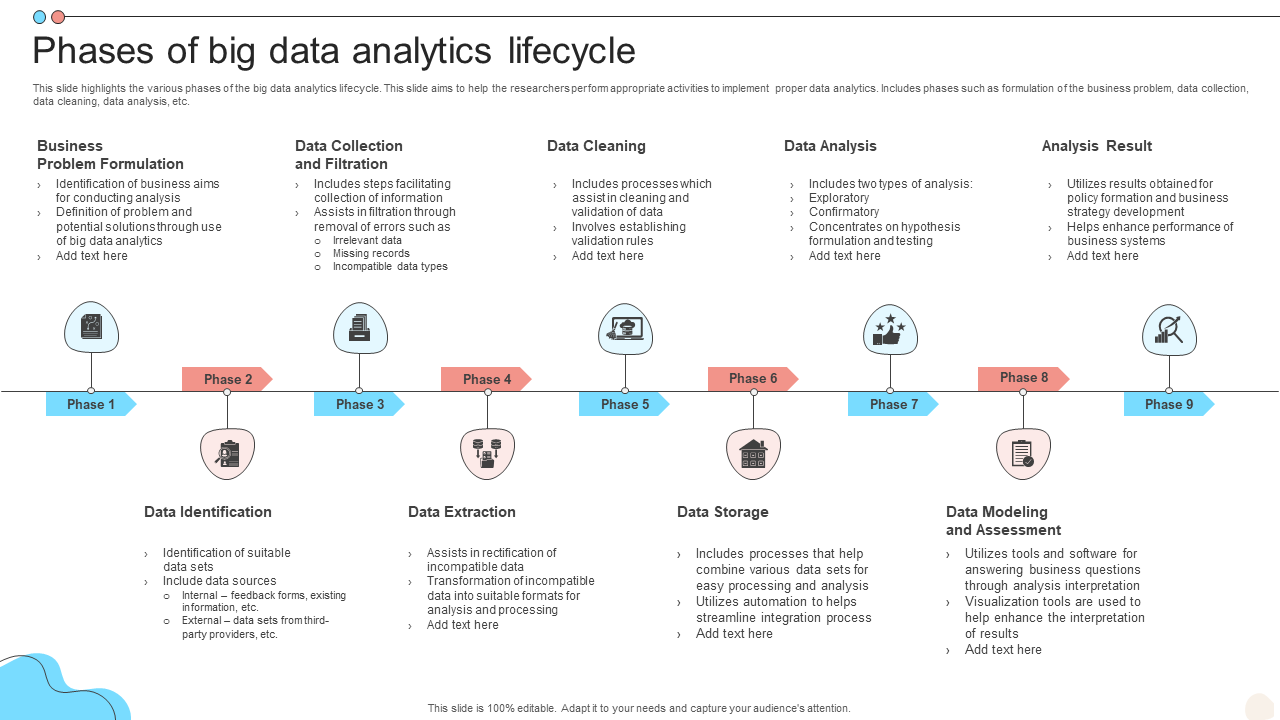
This slide presents six phases. It starts with Business Problem Formulation, where the problem is defined and aligned with organizational goals. Data Collection and Preparation follows, involving gathering data from multiple sources, cleaning, and transforming it for analysis. Data Exploration and Analysis applies techniques to identify patterns and extract insights. Model Building and Evaluation develops and tests models using algorithms, refining them for accuracy. Deployment and Monitoring places models into production and tracks their performance. Feedback and Iteration collects stakeholder input and repeats the process to improve models and results.
Template 8: Project Life Cycle Phases of Data Analytics
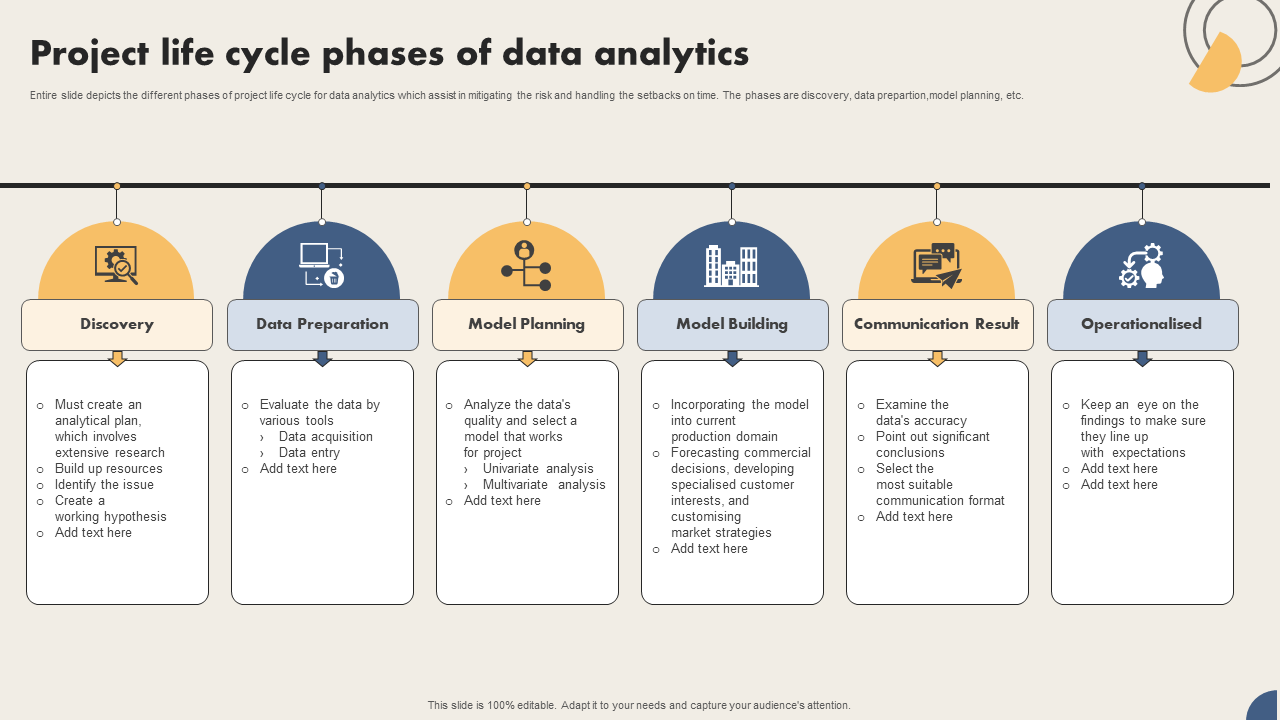
This slide presents a disciplined method for handling data analytics initiatives. It starts with Problem Definition, where the scope and goals of the project are quite evident. Data collecting comes next and entails compiling pertinent information from many sources. The gathered data is cleaned and converted in data preparation to guarantee consistency and quality. Data analysis uses computational and statistical methods to derive significant understanding. The modeling phase creates predictive models grounded in the examined data. Performance and accuracy of the models are evaluated. At last, deployment puts the ideas into action in the operational surroundings.
Template 9: Analytics Implementation Challenges in Data Lifecycle Data Analysis
Key data lifecycle challenges in this Analytics Implementation Slides are It notes that business alignment is absolutely necessary to make sure analytics satisfy company objectives. Constant improvement of procedures and results depends on iteration. Transparency and repeatability are supported in great detail. Teamwork enhances integration and efficiency. Infrastructure spending offers analytics the tools and platforms it needs. Adoption is mostly focused on user approval and good implementation requires training. Ethical issues touch data security, privacy, and ethical use. Together, these components solve problems in applying analytics throughout the data lifecycle, therefore guaranteeing a methodical way to remove shared obstacles in data initiatives.

Template 10: Stages Of Big Data Analytics Life Cycle
The slide presents a methodical way for running large data analytics initiatives. It starts with Data Definition, when the aims and extent of the project are decided upon. Relevant data is acquired in the phase of data acquisition from many sources. Data munging is the process of organizing and converting gathered data such that consistency and quality are assured. The step of data analysis uses analytical methods to derive important understanding. Data visualization shows the examined data in a visual manner to help grasp. At last, application of analysis results uses the acquired insights to guide corporate decisions and generate results.

Wrapping it Up!
Top 10 Data Analytics Lifecycle PPT Templates provide a whole framework for managing industry-wide data analytics projects. Every template covers basic procedures like data collecting, preparation, analysis, modeling, assessment, deployment, and result application. First comes the definition of a problem. Real-world examples, unambiguous graphics, and disciplined design enable users to negotiate difficult analytics processes such CRISP-DM and large data management. These models relate analytics to corporate goals, support teamwork, and assist to address implementation challenges. Perfectly versatile, they let experts and educators to effectively convey data-driven insights from healthcare to retail, therefore supporting different use cases and informed decision-making.
FAQs on Data Analytics Lifecycle
1. What are the key phases of the data analytics lifecycle?
The main phases include problem formulation, data collecting, data preparation, data analysis, model development, assessment, implementation, and result use. Every phase develops on the one before turning unprocessed data into useful insights. In analytics initiatives, this method guarantees efficiency and clarity.
2. How does the data preparation stage impact the success of the analytics process?
Data preparation includes data cleaning, data transformation, and data organization meant to guarantee consistency and quality. Correct preparation removes mistakes and discrepancies that could distort research. This phase directly influences the precision of models and the generated insights from the data.
3. What role does model evaluation play in ensuring reliable data analytics outcomes?
Model evaluation studies analytical model correctness and efficacy against actual data. It points up areas of strength and weakness, enabling improvement before release. This stage guarantees models produce reliable and practical outcomes.