

Big Data Analytics Powerpoint Presentation Slide





Try Before you Buy Download Free Sample Product
 Impress Your
 Audience
 100%
100% Editable
 Save Hours
 of Time


If it’s that time to make analysis for the predicament of the management system or simply to present deafening data in front of your qualified team then you have reached the right match. SlideTeam presents you classy and eternally approaching PowerPoint slides for big data analytics. Data analysis agendas and big data plans are shown through captivating icons and subheadings for a precise and interesting approach. This unique PPT slide is useful for studying business and marketing related topics, approaching the correct conclusions and keeping a track on business growth. Make an outstanding presentation for your viewers with this unique PPT slide and deliver your message in an effective manner using Big data analytics Powerpoint Presentation slide and make your pathways more defining. Most of the elements of the slide are highly customizable. The text boxes help you in adding more information about the point mentioned and its associated icon. Every detail in our Big Data Analytics Powerpoint Presentation Slide is doubly cross checked. You can be certain of it's authenticity.
People who downloaded this PowerPoint presentation also viewed the following :
Content of this Powerpoint Presentation
Analyzing and interpreting complex data sets is the core of an organization’s success in today’s data-driven world!
In a world of technology, organizations often seek to derive information from the large chunk of data around the internet to make valuable decisions. Big data analytics play a crucial role in uncovering the correlations and trends to enhance the overall performance of their products or services.
Ever thought about Turning Big Data Analytics to Knowledge? Explore our PPT slides to dig deep about this and its benefits!
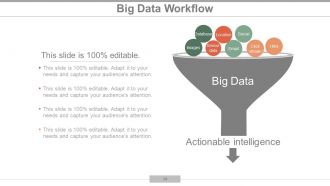
Every company analyzes the data in today’s landscape and needs to interpret it to make data-driven decisions. Through our customizable PPT slides, you can easily demonstrate the sources of big data, differentiate between big data and small data, big data technologies and workflow, phases of big data, forms of big data, data analytics process, and impact of big data.
Data analysis is a complex and dynamic process, and keeping tabs on different online platforms is essential to derive the desired analysis. Cleansing, aggregating, and manipulating data is an overwrought process, and SlideTeam’s PPT Templates will help you differentiate and analyze the data more effectively and efficiently.
Click to get all Big Data Analytics templates demonstrating the latest trends and challenges!!
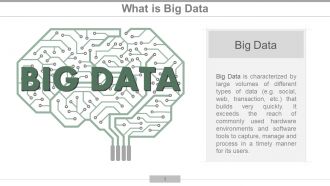
Template 1: What is Big Data?
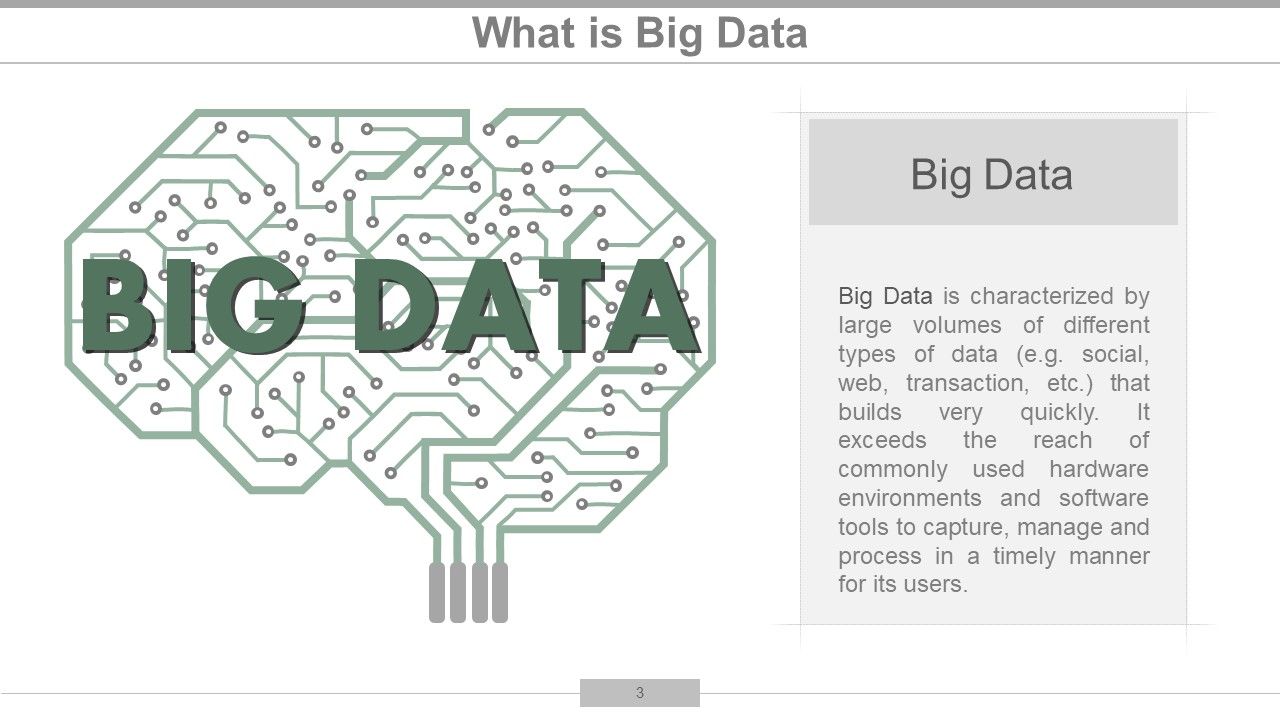
This introductory slide will help the organizations provide an overview of big data. As mentioned before, big data analytics plays a crucial role in the decision-making process of various organizations, and having customizable PowerPoint Templates to demonstrate the status of the analytics report is a significant time-saving asset. It includes captivating graphics and additional space to add information to describe big data.
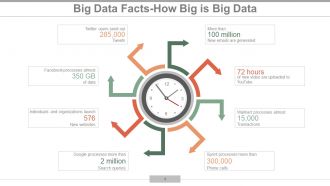
Template 2: Big Data Facts-How Big is Big Data
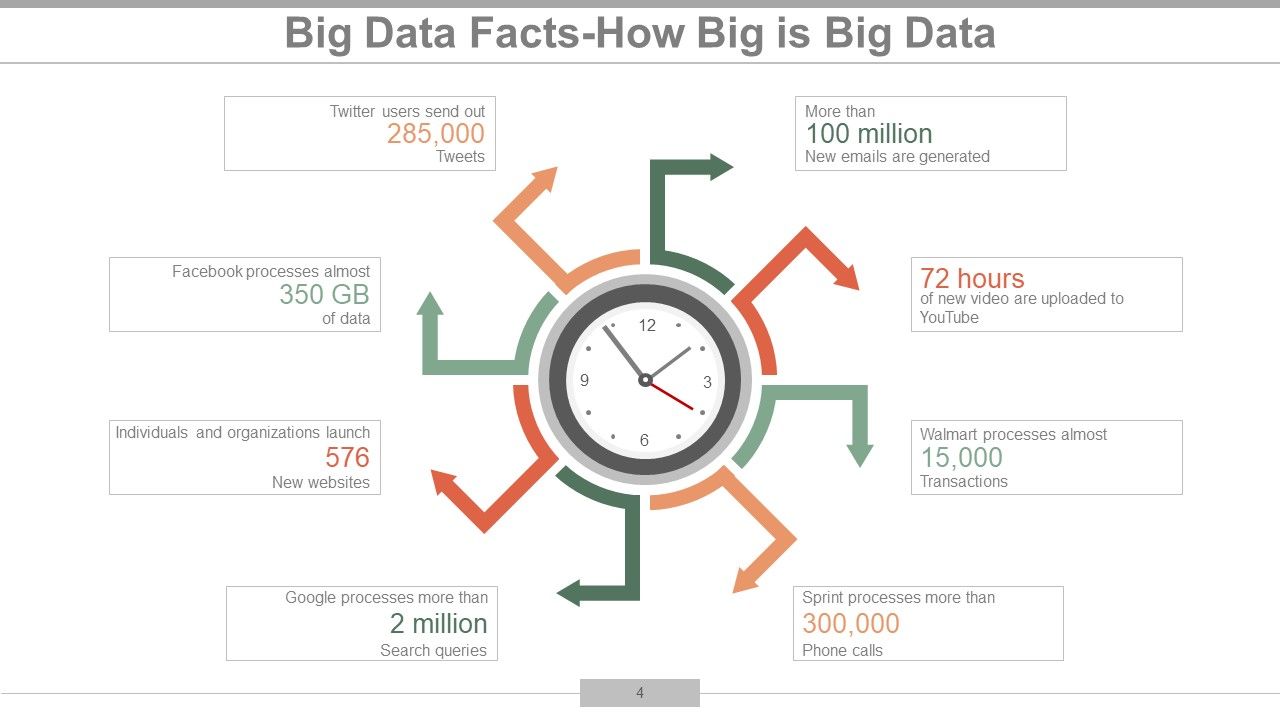
Closing monitoring of the various platforms is one of the critical steps in analyzing data. This template will help you provide an overview of multiple platforms, such as Google, Facebook, Twitter, Walmart, Youtube, Email, and others on which the business depends. You can also mention the number of queries generated and tweets sent with creative graphics. Tracking the numbers plays a significant role while analyzing big data, and these templates will help you get an accessible overview.
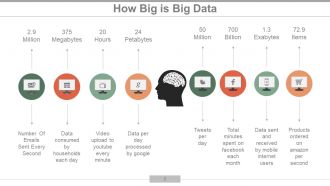
Template 3: How big is Big Data

Regular surveillance is deeply intricate at the core of extensive data analytics surveillance. The total number of emails sent every second, data consumed by households each day, video uploaded to YouTube every minute, data per day processed by Google, Tweets per day, total minutes spent on Facebook each month, data sent and received by mobile users, and products ordered on amazon per second can be highlighted through the creative graphics through this template.
Template 4: Sources of Big Data
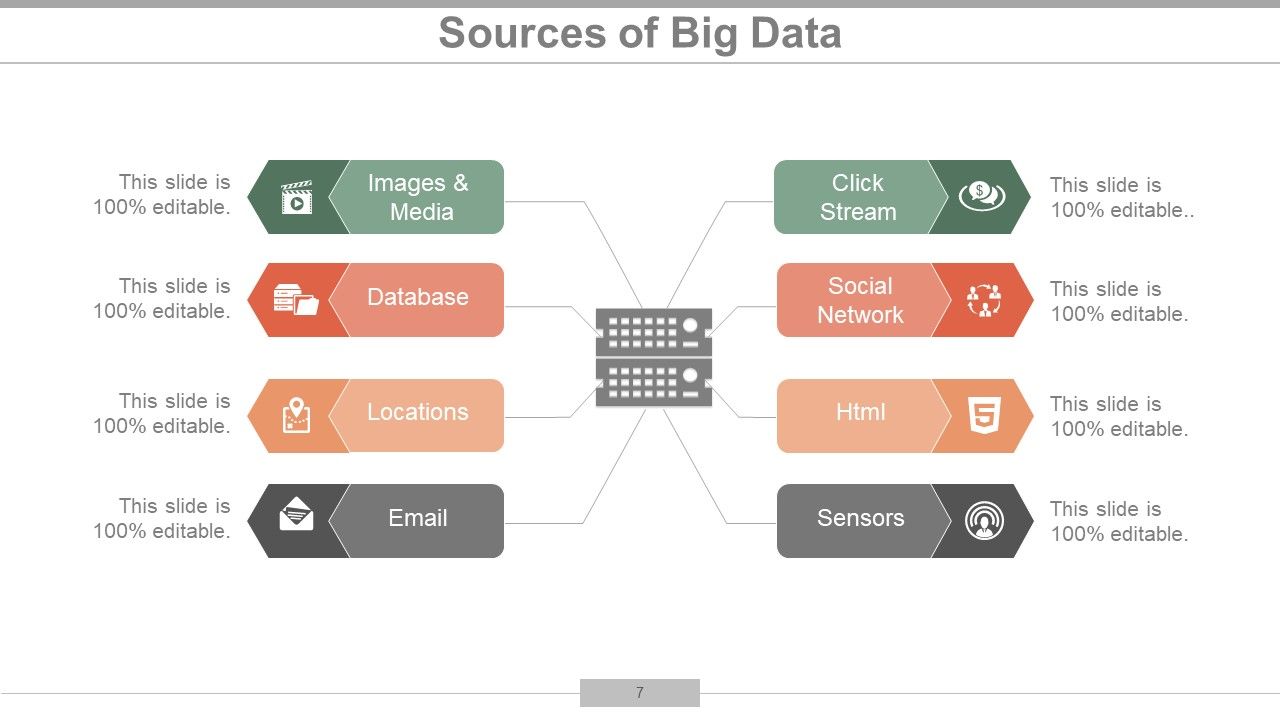
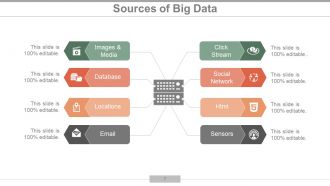
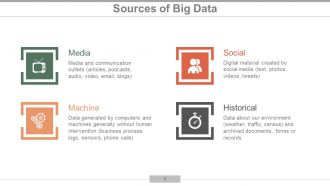
Mentioning the sources of big data also helps you create the best extensive data analytics report. This template allows you to add sources like Email, Sensors, HTML, Networks, Locations, ClickStream, Images & Media, Social Networks, Databases, and Images & Media. The color scheme and innovative icons help to make this template attractive.
Template 5: 3 Vs of Big Data
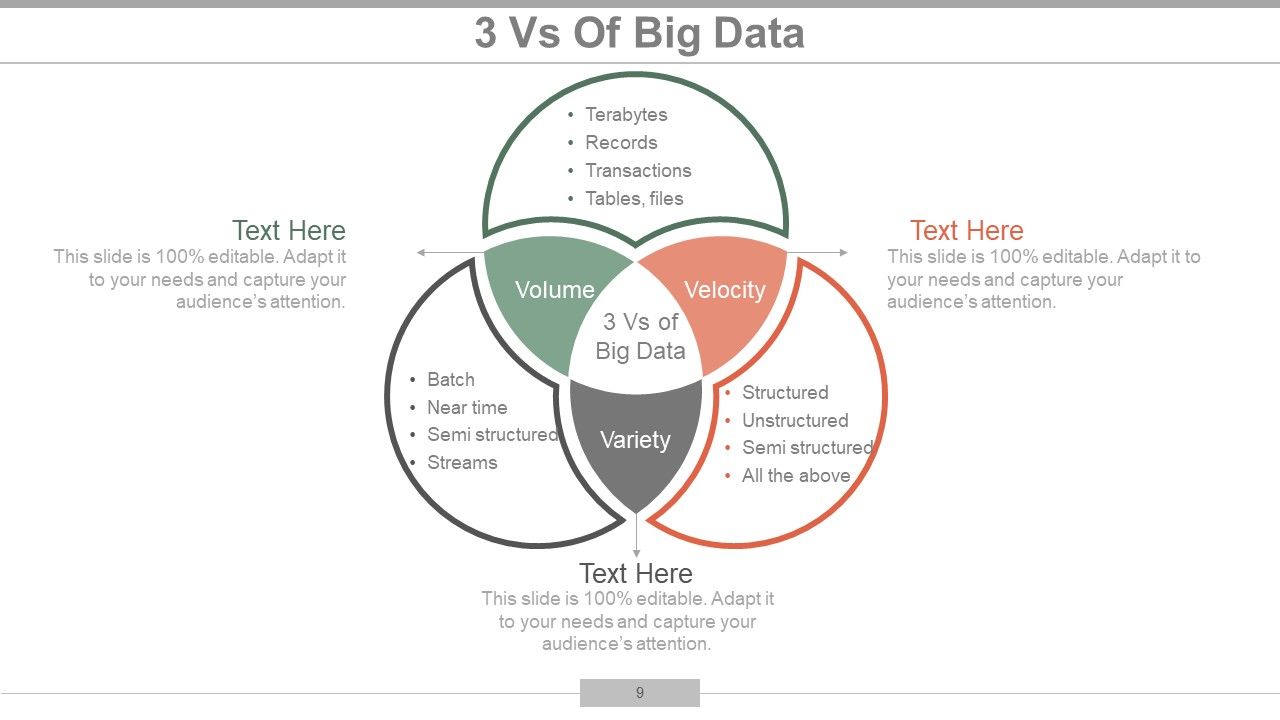
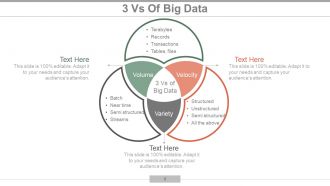
Volume, Velocity, and Variety are the three important Vs of Big Data. This slide demonstrates the sub-parts of them, such as terabytes, records, transactions, tables, files, batch, near time, streams, structured, unstructured, and semi-structured. Careful thought has been given to making the template visually attractive and attention-grabbing.
Template 6: 5 Vs of Big Data
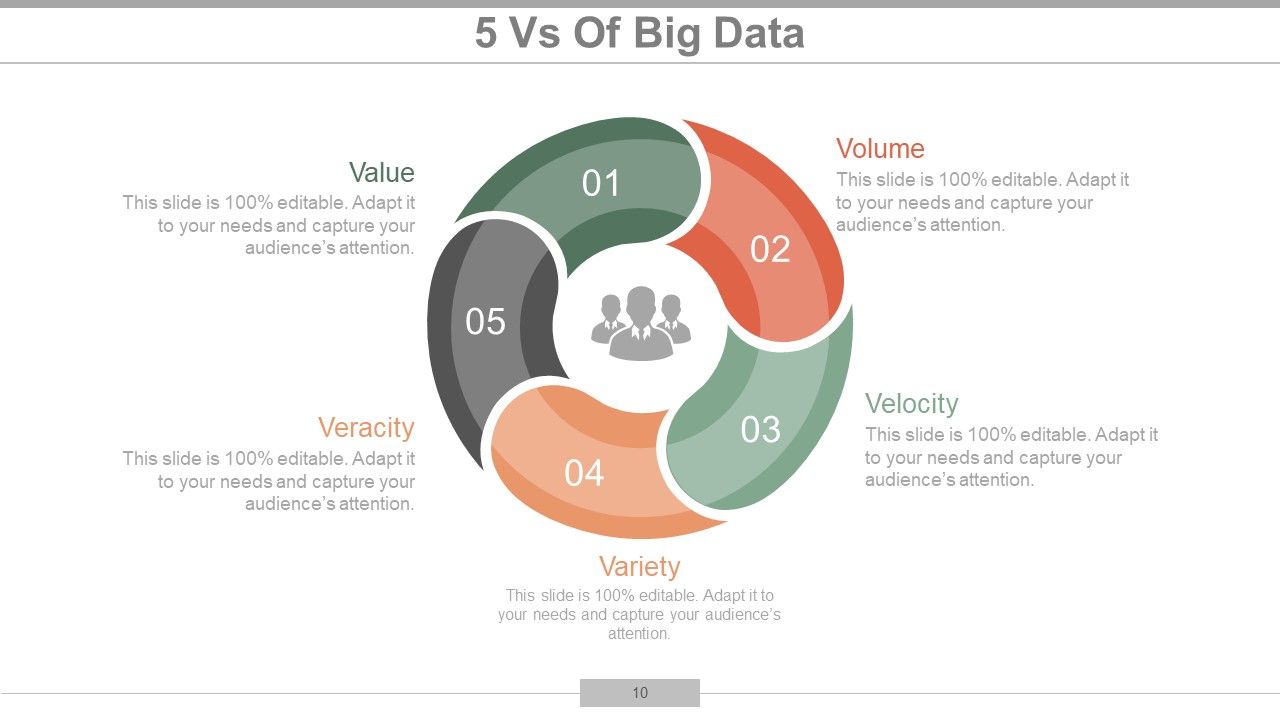
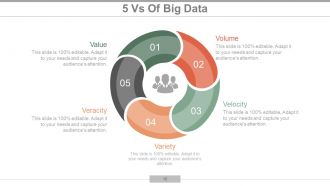
This template helps you demonstrate the 5Vs of Big Data to easily understand its big challenges. It helps you represent Value, Volume, Veracity, Velocity, and Variety. Understanding the 5Vs is important for further discussing strategies and technologies so that organizations can implement steps to get information from online data to grow their business.
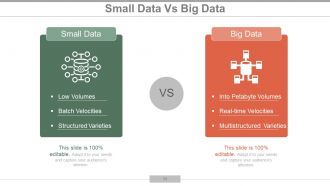
Template 7: Small Data Vs Big Data
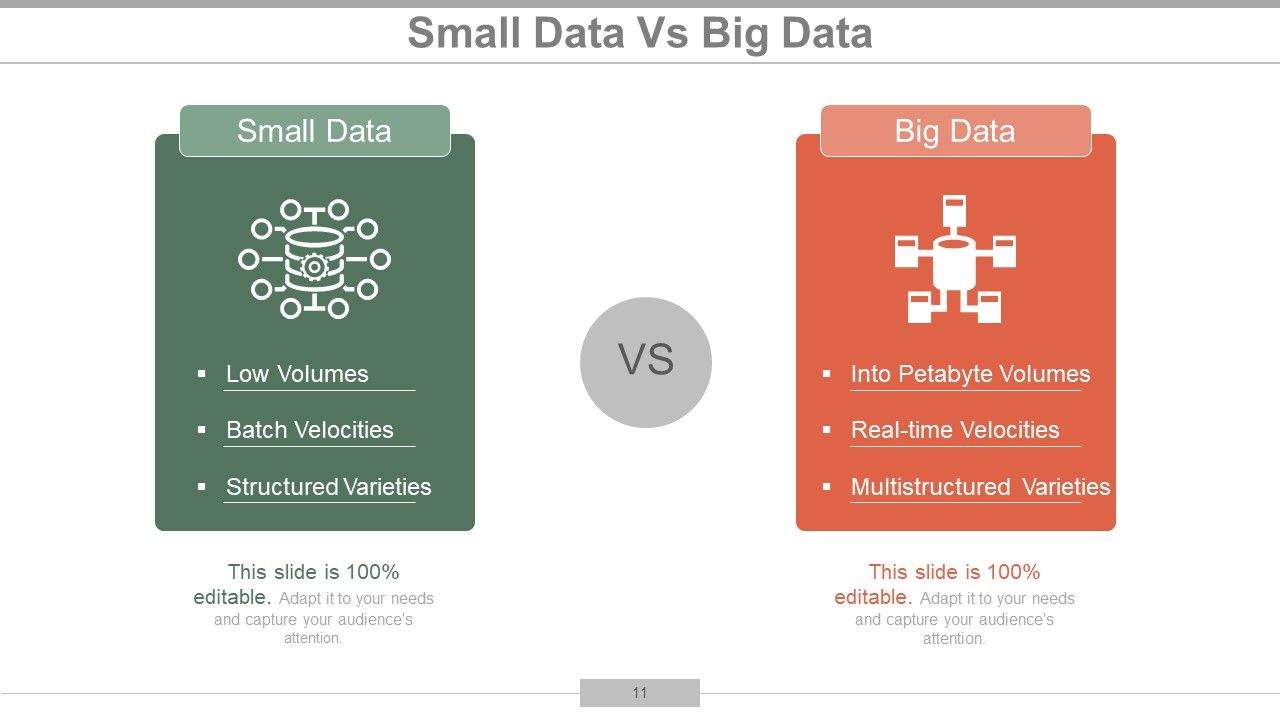
Understanding the difference between small and big data is crucial to extracting valuable insights online and making informed decisions. This template will certainly help. You can perfectly explain the difference between big and small data. This PPT slide easily explains the key differences, challenges, and opportunities.
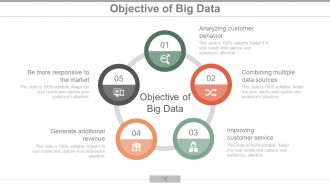
Template 8: Objectives of Big Data
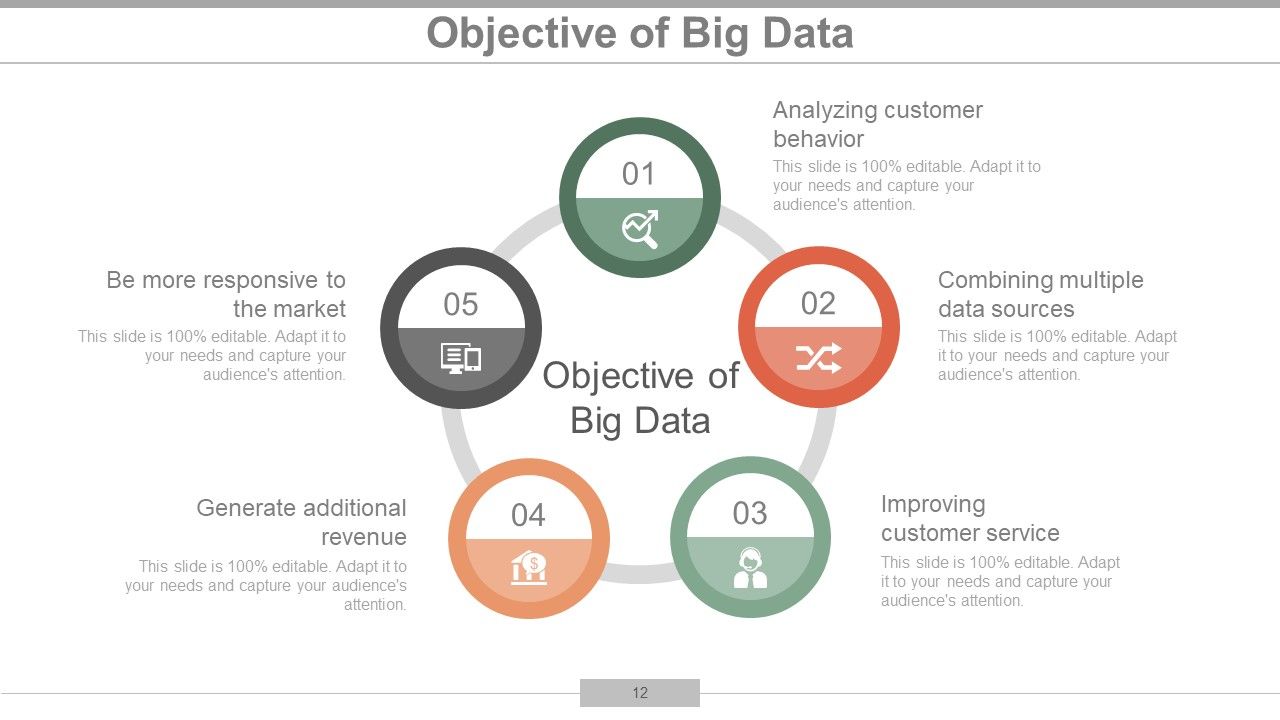
The objectives of big data are multifaceted, and this template will help you understand from analyzing customer behavior, combining multiple data sources, improving customer service, generating additional revenue, and being more responsive to the market with impressive icons for each objective. Use it to understand data analytics objectives better, ultimately leading to improved decision-making, enhancing operational efficiency, identifying trends and patterns, and driving innovation.
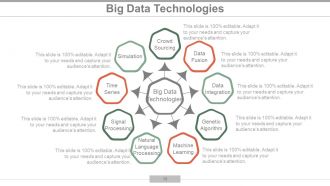
Template 9: Big Data Technologies
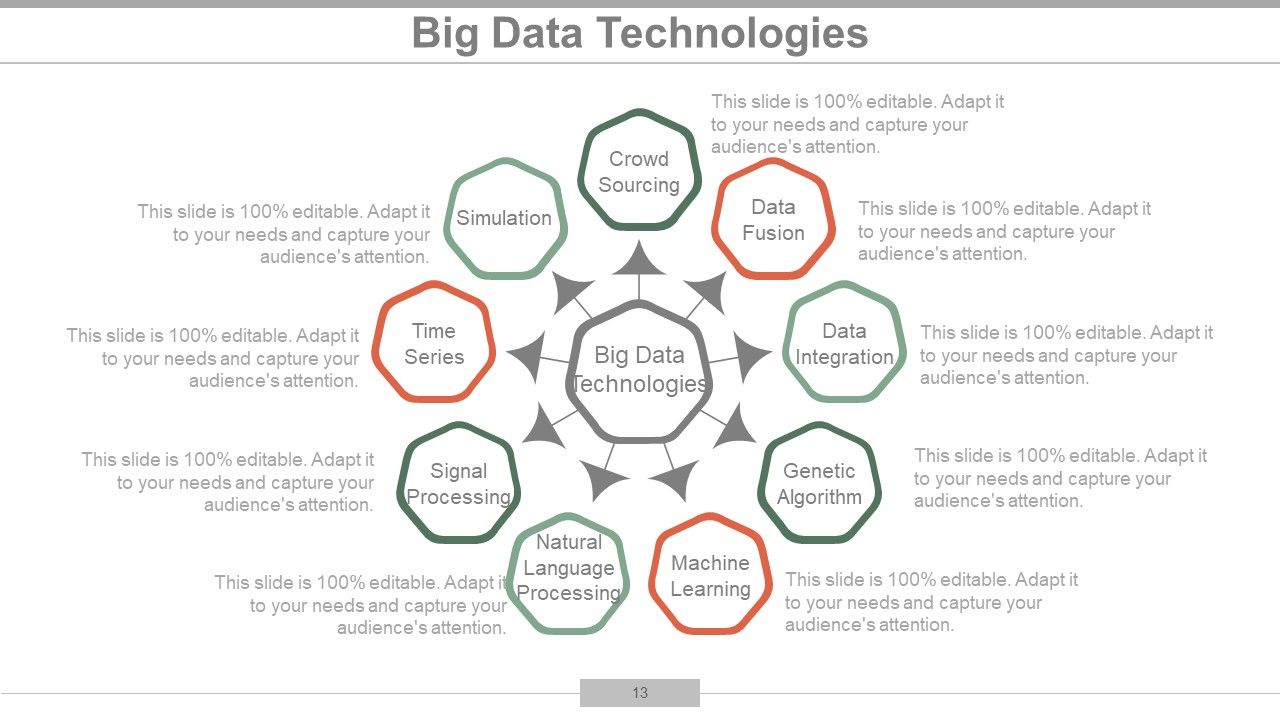
In our era, organizations are turning to big data technologies to derive information to widen their business's audience. Through this template, you can easily demonstrate big data technologies, including data integration, genetic algorithms, machine learning, natural language processing, signal processing, time series, simulation, and crowd-sourcing.
Template 10: Forms/ Type of Big Data
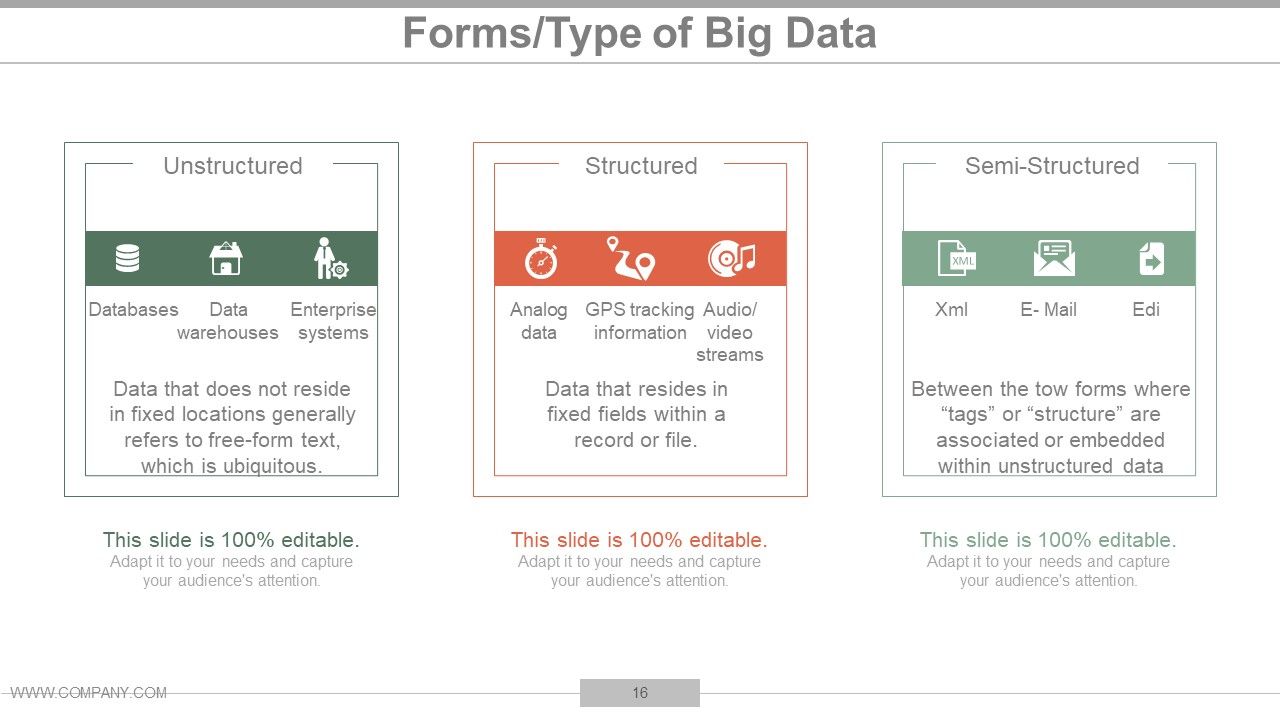
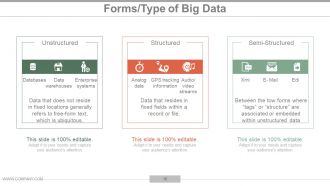
Closely explain the forms of significant data types with this template. Three columns are designed for each kind: unstructured, structured, and semi-structured. The creative icons will help to easily define the work and functions of each type. For instance, unstructured types include databases, data warehouses, and enterprise systems. Similarly, the structured type comprises analog data, audio/video streams, and GPS tracking information. As these are editable templates, you can easily add information according to your requirements.
Big Data Analysis is a powerful tool that drives an organization or business toward success. As industries enjoy the benefits of this analysis, demand is growing. It will be better for companies to derive useful information from Big Data Analytics and keep track of them. That’s when our customizable PPT templates come into the picture. These ready-to-use PPT slides will undoubtedly give you an understanding of Big Data Analytics and valuable insights to enhance decision-making and improve operational efficiency.
P.S. Click to explore the whole bundle of templates for Project Proposals for Big Data Analytics!!
Big Data Analytics Powerpoint Presentation Slide with all 50 slides:
Equip folks for the journey with our Big Data Analytics Powerpoint Presentation Slide. Jot down all the items to carry.






FAQs for Big Data Analytics
So you'll need five things to get this right. Data governance first - garbage data gives you garbage insights, obviously. Your tech stack has to actually handle the volume you're throwing at it. Finding good data scientists is brutal right now but you need that talent. Oh, and don't just analyze random stuff - pick specific business problems you want to solve. Security can't be an afterthought either since breaches will end careers fast. I'd start by figuring out what data you already have, then tackle one clear problem first.
Catch problems right when data comes in - don't let bad stuff flow downstream. Set up automated checks for duplicates, missing values, weird anomalies. Track where your data comes from so you can actually find the source when things break (and they will break). I'd start with whatever datasets are most critical to your business first. Daily quality reports help a lot. But honestly? The real win is fixing issues at the source instead of constantly cleaning up messes. Create those feedback loops with whoever's sending you data.
Honestly, data quality will drive you nuts - it's always messier than you expect. Infrastructure costs add up fast too, especially storage and processing power. Good luck finding people who actually know this stuff well, the talent pool is pretty thin. Oh and departments hoard their data like crazy, makes integration such a pain. There's also way too many tech options to pick from, which is overwhelming. Security compliance makes everything more complicated, particularly with sensitive info. I'd definitely start with something small first - figure out where you're actually struggling before going big.
Honestly, big data is pretty wild when you think about it. You can find patterns in huge datasets that no human could ever spot manually. Companies use it to predict what customers will do next, catch equipment problems before they break, spot diseases early - that kind of stuff. Way better than just going with your gut, you know? I'd say start small though. Pick one annoying problem at work and see what data you've already got sitting around. Sometimes the answer's already there, just buried in spreadsheets nobody looks at.
Honestly, think of machine learning as what makes all that data actually worth something. Without it, you're just hoarding tons of information that sits there doing nothing. ML finds patterns you'd never catch - like predicting what customers will buy, spotting fraud, or automating decisions when you've got millions of data points flying around. The real-time stuff is pretty wild too. I'd say start with something simple like grouping your customers, then build from there once you see it working. Way less overwhelming that way.
Oh totally! Real-time analytics is like having superpowers honestly. Netflix suggesting the perfect show right when you're browsing? That's real-time magic. Meanwhile your competitors are stuck analyzing last week's data like dinosaurs. You can catch trends before anyone else, react to what customers are actually doing right now, and tweak things instantly. Amazon does this with pricing - kinda scary how fast they adjust. My advice? Pick one thing that really bugs you about your business and start there. Don't try to boil the ocean on day one.
Honestly, the big ones are privacy and consent - people didn't sign up for their data being used in ways they never agreed to. Algorithmic bias is huge too. Your models can end up screwing over certain groups without you even knowing it's happening. I've seen this go really wrong before. Be upfront about what data you're actually using. Get consent when you can (though let's be real, that's not always straightforward). And definitely audit your algorithms regularly because bias creeps in more than you'd think.
Honestly, don't blow your budget on fancy enterprise stuff right away. Google Analytics and Facebook Insights are free and pretty decent if you know what you're looking for. Excel works too - I know it's not sexy but it gets the job done. Cloud platforms like AWS or Google Cloud are actually amazing now since you only pay for what you use. Way better than the old server days, trust me. Pick one specific problem first though, like cart abandonment rates or whatever's bugging you most. You'll go crazy trying to analyze everything at once. Just start with data you've already got.
Spark's gonna be your go-to for processing - handles both batch and streaming pretty smoothly. Storage-wise, you've got Hadoop HDFS or cloud stuff like S3. Honestly? Cloud's way less of a pain if you can swing the cost. Python with pandas/scikit-learn works great for analysis, R too if that's more your thing. Tableau and Power BI are decent for visualizations. Oh, and MongoDB or Cassandra if you need NoSQL databases. My advice? Pick one tool per area first. I made the mistake of trying to learn everything simultaneously and it was a nightmare.
GDPR and CCPA basically flipped everything upside down for data analytics. Now you need explicit consent before collecting most data, plus users can demand you delete their info - total pain for historical datasets, trust me. Data minimization is mandatory too, so you can't just hoover up everything anymore. Only grab what you actually need for your specific analytics goals. Oh, and document every single thing about how you process data. Seriously though, bake privacy compliance into your pipeline from the start. Trying to fix it afterward? That's a headache you don't want.
Netflix is probably the best example - their algorithm drives like 80% of what people actually watch. Amazon's doing it everywhere, from predicting your next purchase to getting packages to you same-day (which honestly still blows my mind). Walmart gets ahead of hurricanes by tracking social media and weather patterns to stock up stores beforehand. And Spotify? Their Discover Weekly nails it using your listening history. When you're pitching these projects at work, focus on the money stuff - better customer experience, cutting costs, boosting revenue. Those examples make it real.
Honestly, visualization is a game changer for big data stuff. Your brain just eats up visual info way faster than scrolling through endless spreadsheets - it's not even close. Heat maps show you exactly where issues are clustering, scatter plots reveal correlations you'd totally miss otherwise, and time series charts catch seasonal patterns. I always tell people to start simple though - basic bar charts and line graphs first. Once your team's bought in, then you can get all fancy with the interactive dashboards and whatnot. The trick is matching the right chart type to what story you're trying to tell.
Finance, healthcare, retail, and tech are crushing it right now - they've been doing this for ages. Banks catch fraud and manage risk with it. Healthcare dives into patient data for better treatments. Amazon basically runs on data analytics (which is terrifying tbh). Manufacturing and telecom are finally getting their act together too, especially with all those IoT sensors everywhere. Oh, and if you want to see what you should be doing, just peek at whatever the big dogs in your industry are up to with their data stuff.
So predictive analytics is basically looking at what customers did before to guess what they'll do next. You can spot who's about to bail and hit them with a discount, or find people ready to spend more and target them. It uses purchase history, browsing habits, all that stuff to personalize recommendations and nail your timing. Honestly, it's pretty wild how accurate it gets. The trick is making it feel helpful instead of creepy - nobody wants to feel like you're stalking their every move, you know?
Dude, AI tools are getting so much easier to use - like actual drag-and-drop stuff instead of needing to be some coding genius. Dashboards update instantly now instead of that annoying overnight lag we're all used to. Edge computing is blowing up because companies want data analyzed right where it happens. Your marketing people could literally be running their own predictive models soon, which is kind of wild if you think about it. I'd honestly just start messing around with these tools now before you're scrambling to catch up later.
-
Out of the box and creative design.
-
Unique design & color.