


Big Data Characteristics And Process Powerpoint Presentation Slides





Try Before you Buy Download Free Sample Product
 Impress Your
 Audience
 100%
100% Editable
 Save Hours
 of Time


We present you content-ready big data characteristics and process PowerPoint presentation that can be used to present content management techniques. It can be presented by IT consulting and analytics firms to their clients or company’s management. This relational database management PPT design comprises of 53 slides including introduction, facts, how big is big data, market forecast, sources, 3Vs and 5Vs small Vs big data, objective, technologies, workflow, four phases, types, information analytics process, impact, benefits, future, opportunities and challenges etc. Our data transformation PowerPoint templates are apt to present various topics such as information management concepts and technologies, transforming facts with intelligence, data analysis framework, data mining, technology platforms, data transfer and visualization, content management, Internet of things, data storage and analysis, information infrastructure, datasets, technology and cloud computing. Download big data characteristics and process PPT graphics to make an impressive presentation. Develop greater goodwill with our Big Data Characteristics And Process Powerpoint Presentation Slides. Folks feel friendlier towards you.
People who downloaded this PowerPoint presentation also viewed the following :
Content of this Powerpoint Presentation
Slide 1: This slide introduces Big Data Characteristics and Process. State Your Company Name and get started.
Slide 2: This is an Agenda slide. Showcase your agendas here.
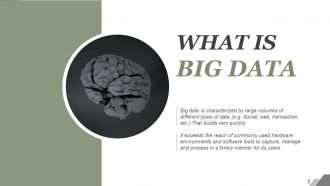
Slide 3: This slide presents What is Big Data and its definition.
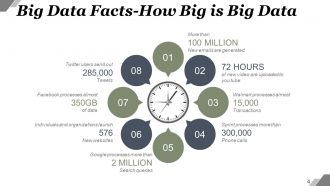
Slide 4: This slide showcases Big Data Facts-How Big is Big Data and so on.
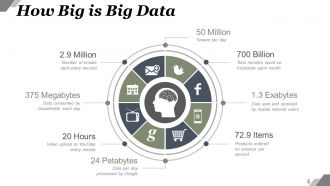
Slide 5: This slide shows How Big is Big Data in terms of data, numbers etc.
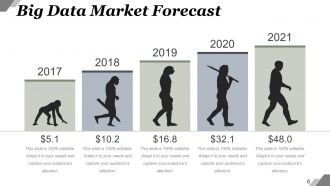
Slide 6: This slide showcases Big Data Market Forecast in a creative graph form.
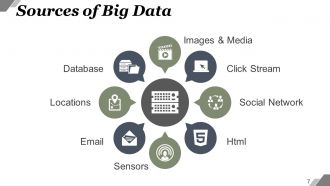
Slide 7: This slide showcases Sources of Big Data. The sources are- Images & Media, Database, Locations, Email, Click Stream, Social Network, Html. Sensors
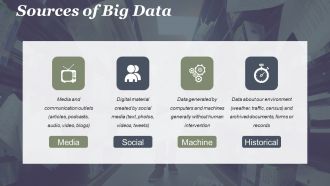
Slide 8: This slide showcases Sources of Big Data categorized as- Media (Media and communication outlets (articles, podcasts, audio, video, email, blogs)} Machine (Data generated by computers and machines generally without human intervention (business process logs, sensors, phone calls)} Social {Digital material created by social media (text, photos, videos, tweets)} Historical (Data about our environment (weather, traffic, census) and archived documents, forms or records)
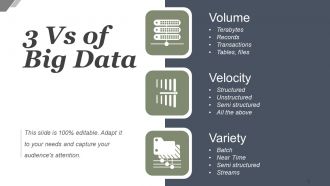
Slide 9: This slide showcases 3 Vs Of Big Data. They are- Variety, Velocity, Volume.
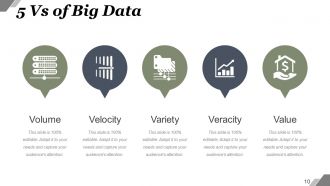
Slide 10: This slide presents 5 Vs Of Big Data Variety, Volume, Velocity, Value, Veracity.
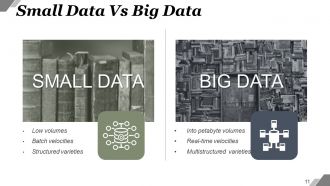
Slide 11: This slide showcase comparison Small Data (Low Volumes, Batch Velocities, Structured Varieties) Vs Big Data (Into Petabyte Volumes, Real-time Velocities, Multistructured Varieties).
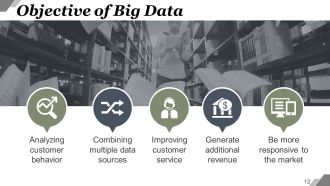
Slide 12: This slide presents Objective of Big Data- Analyzing customer behavior, Combining multiple data sources, Improving customer service, Generate additional revenue.
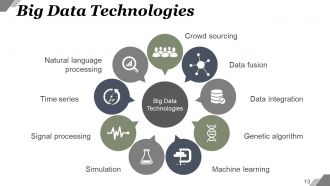
Slide 13: This slide showcases Big Data Technologies. Listed ones are- Data Integration, Genetic Algorithm, Machine Learning, Natural Language, Processing, Signal Processing, Time Series, Simulation, Crowd Sourcing, Data Fusion.
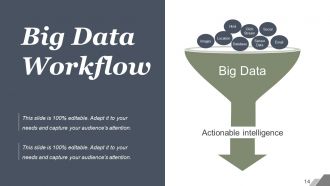
Slide 14: This slide presents Big Data Workflow in funnel form displaying- Actionable intelligence, Email, Click stream, Html, Social, Location, Database, Sensor data, Images.
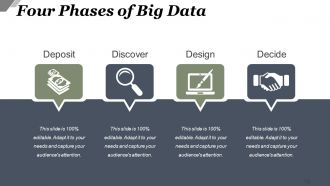
Slide 15: This slide showcases Four Phases of Big Data- Deposit, Discover, Decide, Design.
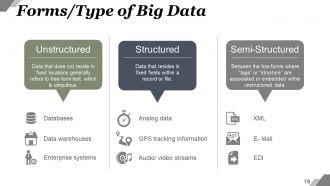
Slide 16: This slide shows Forms/Type of Big Data- Semi-Structured, Unstructured, Structured.
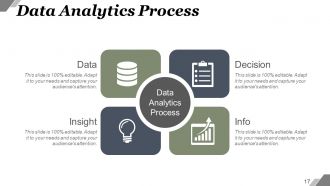
Slide 17: This slide presents Data Analytics Process divided into- Data, Info, Decision, Insight.
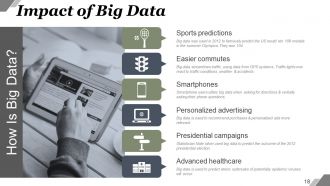
Slide 18: This slide showcases Impact of Big Data. Examples are- Sports predictions, Easier commutes, Smartphones, Advanced healthcare, Presidential campaigns, Personalized advertising.
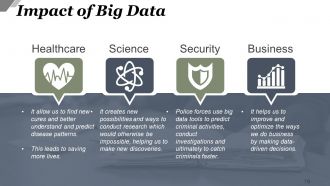
Slide 19: This slide shows Impact of Big Data used in- Healthcare, Science, Security, Business.
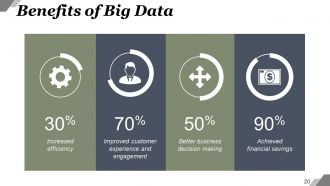
Slide 20: This slide showcases Benefits of Big Data such as- Increased Efficiency, Better Business Decision Making, Improved customer experience and engagement, Achieved financial savings.
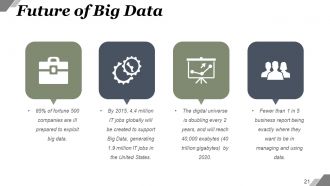
Slide 21: This slide presents Future of Big Data. You can add your own examples here.
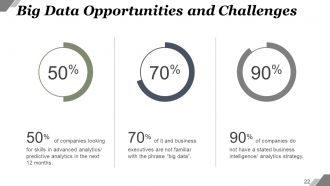
Slide 22: This slide displays Big Data Opportunities and Challenges. State them here.
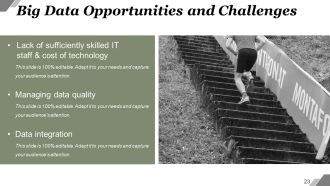
Slide 23: This slide displays Big Data Opportunities and Challenges. Examples given are- Lack Of Sufficiently Skilled IT Staff & Cost Of Technology, Managing Data Quality, Integration.
Slide 24: This is Big Data Characteristics Icons Set slide. You may use the icons as per need.
Slide 25: This slide is titled Additional Slides to move forward. You can change the slide content as per need.
Slide 26: This is Our Mission slide. State it here.
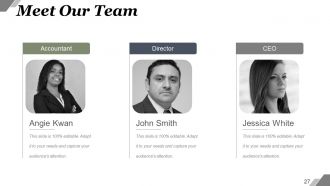
Slide 27: This is Meet Our Team slide with names, designation and image boxes to fill information.
Slide 28: This is an About Us slide. State company/team specifications here.
Slide 29: This is Our Goal slide. State them here.
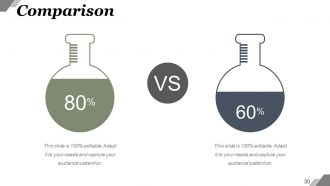
Slide 30: This slide shows Comparison in flash imagery. State comparison aspects etc. here.
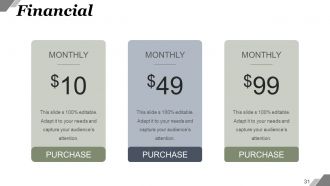
Slide 31: This is a Financial score slide. State financial aspects here.
Slide 32: This slide shows Quotes. Display your message, beliefs etc. here.
Slide 33: This slide displays Dashboard with imagery and text boxes.
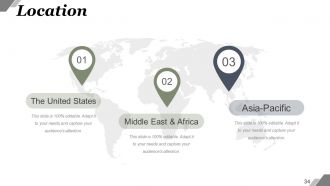
Slide 34: This slide showcases Location in world map image. Show global presence, growth etc. here.
Slide 35: This is a Timeline slide. Show milestones, achievements, growth, journey etc. here.
Slide 36: This is a Post It slide to mark reminders, events etc.
Slide 37: This is a Newspaper image slide to show events, highlights etc.
Slide 38: This is a Puzzle image slide to show information, specification etc.
Slide 39: This slide showcases Target. State them here.
Slide 40: This is a Circular image slide. State information, specification etc. here.
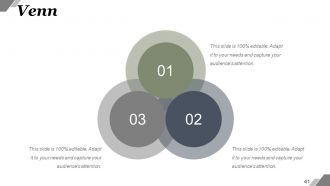
Slide 41: This is a Venn diagram slide. State information, specification etc. here.
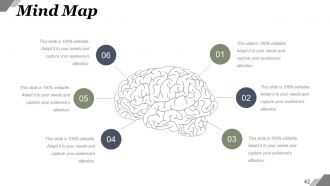
Slide 42: This is a Mind map slide. State information, specification etc. here.
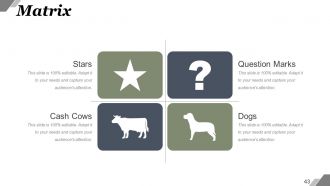
Slide 43: This is a Matrix slide. State information, specification etc. here.
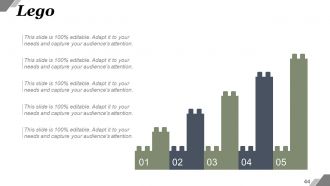
Slide 44: This is a Lego Box slide. State information, specification etc. here.
Slide 45: This slide shows Silhouettes with text boxes. State people related information, specifications etc. here.
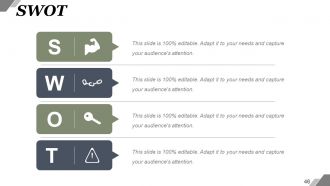
Slide 46: This is a SWOT Analsyis slide.
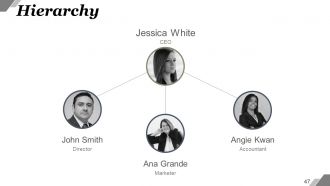
Slide 47: This is a Hierarchy slide. State information, organization structure specification etc. here.
Slide 48: This is Generate Idea slide. State information, specification, innovative aspects etc. here.
Slide 49: This is a Magnifying glass image slide. State information, specification, scoping aspects etc. here.
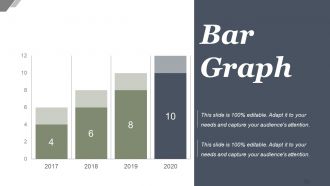
Slide 50: This is a Bar graph slide to show product/entity information, specification, comparison etc. here.
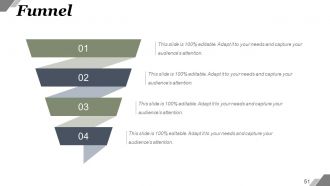
Slide 51: This is a Funnel image slide. State information, specification, funneling aspect/nuances here.
Slide 52: This is a Contact Us slide with Address # street number, city, state, Contact Numbers, Email Address.
Slide 53: This is a Thank You slide for acknowledgement.
Big Data Characteristics And Process Powerpoint Presentation Slides with all 53 slides:
Get them gushing with our Big Data Characteristics And Process Powerpoint Presentation Slides. They will soon be fawning over you.







FAQs for Big Data Characteristics And Process
Honestly, storage costs will bite you first - that stuff scales way faster than anyone warns you about. Data quality is another headache since everything's messy and from different sources that hate each other. Finding decent data people is brutal right now too, everyone's fighting over the same talent pool. Oh, and they're not cheap either. I'd definitely test things out with something small first. Figure out what's actually gonna break before you go all-in on some expensive platform or start hiring a whole team. Trust me on this one.
Honestly, big data is just taking all the random info your company has lying around and turning it into stuff you can actually use. You know how you usually make decisions based on hunches or those quarterly reports that are already outdated? This lets you see what customers are really doing, catch trends before they blow up, and figure out where you're bleeding money. It's pretty wild – like having a decent crystal ball that actually works. My advice? Don't overthink it. Pick one problem that's bugging you, throw some data at it, and see what patterns pop up. Way better than guessing.
So you know how big data is just... overwhelming? ML is what actually makes it useful. It spots patterns humans would never catch manually - like, we're talking massive datasets here. You can classify stuff automatically, predict what's coming next, catch weird anomalies. Honestly, without it you're just staring at spreadsheets forever (been there, not fun). Traditional analytics completely falls apart at this scale. If you're just starting out, try basic clustering first - you'll see results fast and it won't melt your brain right away.
First thing - do a data inventory so you actually know what sensitive stuff you're collecting. Build encryption and access controls into your architecture from the start, don't tack them on later. Set up governance policies for who gets access to what data. The regulatory stuff (GDPR, CCPA, etc.) changes constantly and honestly it's a pain, but you can't ignore it. Regular audits will save your butt before small issues turn into massive headaches. Data anonymization is clutch too - probably should've mentioned that earlier.
Heat maps and interactive dashboards are your best bet - they let people click around and actually explore the data. Scatter plots are solid for showing correlations, and treemaps work well when you've got hierarchical stuff to display. But honestly? I see so many messy charts that just overwhelm people. Start with the big picture, then let users dig deeper if they want to. Oh, and Tableau or Power BI can handle most of this without making you code everything from scratch. The whole point is telling a story, not cramming every data point onto one screen.
Honestly, you don't need a huge budget for this stuff. Google Analytics is free and shows you tons about how people use your site. Same with Facebook Insights - I'm always surprised how detailed it gets about who's actually seeing your posts. Start collecting emails and track what people buy using something basic like HubSpot's free version. The trick is working with what you've got first, then adding fancier tools later when you're making more money. Maybe just pick one thing to track this week and see what happens?
So machine learning is everywhere in big data now - pattern recognition, predictive stuff, you name it. Edge computing's really taking off too because it handles data right where it starts instead of sending everything to some distant server. Most companies are ditching their on-premise setups for cloud tools (honestly can't blame them). Real-time streaming analytics is pretty standard now. Even quantum computing's starting to creep in for the really complex calculations, though that's still pretty niche. You should definitely pick up one of the major cloud platforms - AWS, Azure, whatever. Makes scaling so much less of a nightmare when you're dealing with huge datasets.
So basically, big data helps you figure out what customers actually want by looking at their behavior and purchase history. You can predict their needs before they do - which honestly feels a bit creepy but works really well. It's great for targeted marketing and those product recommendations that make people think "how did they know?" You'll also spot where customers get frustrated in their journey. Oh, and it helps predict when you're gonna get slammed with support tickets. The trick is moving fast on these insights so customers feel like you actually understand them.
Honestly, it's wild how companies are basically mind-reading their customers now. Retailers track your buying habits to guess what you'll want next. Banks scan transactions to spot fraud before you even notice. Healthcare is probably the coolest though - they dig through patient data to find disease patterns and create better treatments. Manufacturing plants use sensors to fix machines before they break down (saves them tons). Oh, and airlines? They're constantly tweaking prices based on demand. Most businesses already have the data sitting there - they just don't realize how much they could do with it.
Honestly, start with figuring out how much data you're dealing with and how fast it's coming in - that'll narrow down your options real quick. Budget matters too because these systems can get expensive if you're not careful. Does your team actually know how to work with whatever you pick? There's no shame in choosing something simpler that people can actually manage. Real-time vs batch processing is a big decision point. Oh, and definitely think about security stuff if you're in healthcare or finance or whatever. I'd say run a small test first before going all-in on anything major.
Start with defining who owns what data and set up classification standards. Honestly, creating policies for data quality and access controls is harder than it sounds when you're dealing with massive datasets. Automated monitoring tools are your friend for tracking compliance - trust me on this one. Set up regular audits too. Oh, and make sure your governance committees include both tech people and business folks, otherwise you'll just talk past each other. My advice? Pick one important dataset first and build from there instead of trying to boil the ocean.
Honestly, the big stuff you gotta worry about is privacy violations and consent - like, companies are grabbing people's data without really asking properly. Then there's algorithmic bias, which is huge. They'll say "oh we're just making things better for users" but really they're being super invasive. People have basically zero control once their info gets collected. Discrimination happens when biased algorithms make decisions about jobs, loans, whatever. My advice? Set up solid data governance from day one. Also audit your algorithms regularly - catch that bias before it screws people over. It's way easier to fix upfront than deal with the mess later.
So real-time processing flips your data game completely - you're getting insights as stuff actually happens instead of waiting around for reports. Banking fraud detection is a perfect example where milliseconds matter. You can catch trends and weird patterns right when they pop up, not days later when it's too late. Honestly, going from reactive to proactive is night and day for customer experience. Your team stops playing catch-up all the time. I'd pick one solid use case first though - something where you'll see clear business results to show it's worth the investment.
You'll want Python and SQL first - those are like your bread and butter. Statistical knowledge is huge too since you need to actually understand what the numbers mean. Big data tools like Hadoop or Spark are good to know, though honestly the landscape changes every five minutes so don't stress about learning everything at once. Visualization stuff like Tableau helps when you're presenting to people who hate spreadsheets. Oh, and R is solid for stats work if you're into that. I'd just focus on Python/SQL basics first, then see what your job actually needs. Way easier than trying to learn everything upfront.
Get your baseline numbers locked down first - that's crucial. Then pick 2-3 KPIs that actually matter to your business goals and obsess over tracking them. Processing time, customer retention, cost reductions - whatever makes sense for you. Honestly, the hardest part isn't the measuring itself. It's figuring out what improvements came from your big data project vs everything else happening at your company (there's always something else, right?). Don't wait until the end to check progress - set regular checkpoints so you can course-correct if needed.
-
Excellent work done on template design and graphics.
-
Very well designed and informative templates.