


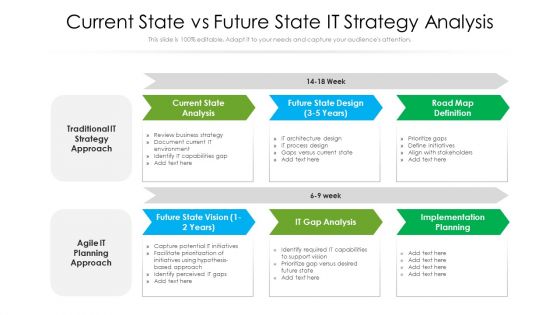
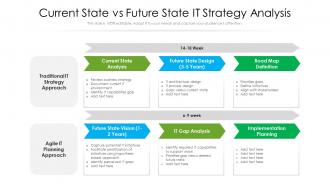
Current state vs future state it strategy analysis




Try Before you Buy Download Free Sample Product
 Impress Your
 Audience
 100%
100% Editable
 Save Hours
 of Time


Our Current State Vs Future State It Strategy Analysis are topically designed to provide an attractive backdrop to any subject. Use them to look like a presentation pro.
People who downloaded this PowerPoint presentation also viewed the following :
Current state vs future state it strategy analysis with all 2 slides:
Use our Current State Vs Future State It Strategy Analysis to effectively help you save your valuable time. They are readymade to fit into any presentation structure.
FAQs for Current state vs future state
Look, you need five things for solid IT strategy. Business alignment comes first - your tech has to actually match what the company's trying to do. Then figure out what you've got right now (current state), where you want to end up (future vision), plus a roadmap that won't bankrupt you. Governance keeps it all from going sideways. Risk management too because stuff always breaks at the worst times. Honestly though? Most people screw up by chasing whatever's trendy instead of fixing real problems. Map your current setup against business goals first, then tackle the gaps that are genuinely hurting you.
Dude, first thing - actually talk to the business leaders regularly. Don't just guess what they want because I've watched IT teams waste months building cool stuff nobody uses (painful to see). Map your tech projects to real business goals. Company expanding globally? Focus on cloud stuff that scales across regions. Business metrics should drive your success measurements, not just whether the servers are running smoothly. Oh and set up those quarterly check-ins - when priorities shift (and they will), you'll want to pivot fast instead of being stuck with outdated plans.
Dude, stakeholder engagement makes or breaks your whole IT strategy. Without it, you're basically creating fancy paperwork that nobody will use. Get people involved from day one - different departments, various levels, not just your usual crowd. Their input helps you understand what's actually broken and what needs fixing first. Plus you need their buy-in to get resources and political backing later. I've watched so many smart strategies crash and burn because IT teams worked in a bubble. Oh, and don't just focus on the obvious stakeholders - sometimes the most valuable feedback comes from unexpected places. Bottom line: involve people early or watch your brilliant plan collect dust.
Ugh, honestly it's like playing whack-a-mole with tech trends. New stuff constantly pops up - AI, cloud tools, automation whatever - and suddenly everyone expects you to be using it yesterday. Your whole IT plan gets thrown out the window. I'd say start small though. Pick one or two technologies that actually make sense for what you're doing, not just the shiny new thing everyone's talking about. Run some tiny pilot projects first before you blow your budget. The trick is staying flexible so you can switch gears fast when something truly game-changing hits. Otherwise you'll just burn out trying to chase every trend.
Track both business and tech stuff - ROI, cost savings, system uptime, security incidents, that kind of thing. User satisfaction scores are clutch too since happy users = less headaches for you. But seriously, don't go overboard with metrics or you'll spend more time reporting than actually doing anything. I'd stick to maybe 5-7 that your boss actually cares about. Focus on outcomes, not just busy work activities. Set up a basic dashboard you can check monthly. Nothing fancy - just something that shows if you're moving in the right direction or need to pivot your approach.
Don't treat risk assessment like something you tack on later - weave it into every phase upfront. Map out what could go wrong with your main goals: cyberattacks, systems crashing, vendor issues, whatever keeps you up at night. Figure out probability vs impact for each one. Honestly, this step saves you from scrambling later when things inevitably get messy. Build your mitigation strategies right into the plan itself. Set up regular check-ins too since stuff changes fast in IT.
Biggest mistakes I see? Planning without talking to the actual business people first - that's a disaster waiting to happen. Also being super vague about what you're trying to achieve and totally underestimating how much people hate change. Start with the business problem, then figure out the tech. Get everyone involved from day one. Set actual deadlines and numbers you can measure. Build in checkpoints because stuff will definitely go sideways. Oh, and stop chasing every new tool just because it sounds cool - you need real ROI justification or you'll blow your budget on nothing.
Honestly, don't wait until you're scrambling to think about scaling - build it in from the start. Figure out your current limits and where you'll be in 3-5 years. Cloud solutions are your friend here since they're way less painful to expand than physical servers. Focus on your customer-facing stuff and data storage first - that's where you'll feel the crunch hardest. Design everything modular so you can add pieces without tearing down what works. Oh, and set up monitoring dashboards now. Trust me, you want to see problems coming before your users start complaining. Short bursts of planning beats months of firefighting later.
Honestly, data governance is like the foundation of your whole IT strategy. You're basically mapping out how you collect, store, and protect all your company's data. Without it? Good luck making any smart tech decisions because you won't trust what you're looking at. I learned this the hard way when compliance audits became absolute hell. A decent governance framework helps you figure out which systems are worth investing in and spots where you're missing crucial data. Plus it stops your IT investments from turning into more disconnected silos. First step is just documenting what data you actually have and who's responsible for it.
So cloud computing basically flips everything - you're not buying servers anymore, you're just using what you need. Capacity planning becomes way easier since stuff scales automatically. I'd start by looking at your current setup and figuring out what parts assume you own all the hardware. The big shifts are around managing vendors, keeping data secure when it's all over the place, and honestly? You can actually plan ahead instead of scrambling when things break. It's pretty much moving from "we own this rack" to "we consume these services." Game changer for sure.
Honestly, you can't just slap security on later - it needs to be part of everything from the start. When you're picking new software or moving to the cloud, always think about how it affects your defenses. I've watched so many companies get burned because they treated cybersecurity like some nice-to-have feature. Bad move. You should weigh security risks right alongside costs and performance for every project. Get your security folks in those early strategy meetings too. It's basically like your company's immune system - ignore it and you'll definitely regret it when things go sideways.
Honestly, modular systems are your best friend here - build everything like Legos instead of one giant unmovable thing. Go cloud-first and dodge vendor lock-in like it's the plague. I'd do quarterly reviews to see what's actually working (spoiler: probably less than you think). Can't tell you how many companies I've watched get burned by those massive 5-year plans that die within months. Oh, and keep your team learning new stuff constantly or you'll fall behind fast. Start by figuring out what's already flexible in your setup versus what's basically holding you hostage, then tackle the worst offenders first.
Regulations are basically non-negotiable guardrails for your whole IT strategy. They directly hit your tech choices, data processes, security setup, and budget. HIPAA for healthcare, SOX for finance, GDPR if you're dealing with EU stuff - honestly, compliance gets pricey quick. But here's what I've learned: don't treat these as roadblocks. Build compliance thinking into your planning from day one. That way you can find solutions that actually check the boxes without killing your business goals. Way better than scrambling to retrofit everything later.
Oh man, culture totally makes or breaks IT rollouts. Risk-averse places? Good luck getting anyone to touch new tech. But companies that dig innovation usually jump on board way faster. You've gotta think about how your team communicates and handles hierarchy too. Honestly, I've watched solid strategies crash because nobody thought about the people side of things - it's brutal. My advice? Test the waters first. See who's change-ready and start with your early adopters before going company-wide.
SWOT analysis is probably your best starting point - gets you grounded in where you actually are right now. For the architecture stuff, TOGAF or Zachman work well, though honestly they can be overkill depending on your company size. Business Model Canvas is solid for connecting IT back to business goals. McKinsey's Three Horizons model is clutch for figuring out what to tackle first. Porter's Five Forces covers competitive analysis pretty thoroughly. Heat maps are super visual for showing capability gaps to executives - they love that stuff. Don't go crazy trying to use all of these though. Pick maybe 2-3 that match where your organization is maturity-wise.
-
Awesomely designed templates, Easy to understand.
-
Content of slide is easy to understand and edit.
-
Awesome presentation, really professional and easy to edit.
-
Wonderful templates design to use in business meetings.