


Current state vs future state with gap analysis





Try Before you Buy Download Free Sample Product
 Impress Your
 Audience
 100%
100% Editable
 Save Hours
 of Time


Are you in search of a pre-designed slide which can represent the state of your business processes in an eye pleasing manner? Use our current state vs future state with gap analysis PowerPoint template and create a high-class Presentation slideshow. With our current state vs future state PPT graphic you can compare your business performance in an easy and understandable way. Any business firm needs to have a direction and a goal in mind before starting its operations. You have to understand that where your business is at the present and where do you see yourself in future. With our current future state comparison PPT template, you can represent a clear picture of where you want your business to be in the future with the available resources, efforts and time given to your team members. You can make a list of the advantages and disadvantages of each method and then take necessary actions in the future. Give a boost to your competence with our Current State Vs Future State With Gap Analysis. Get that extra edge to your capability.
People who downloaded this PowerPoint presentation also viewed the following :
Content of this Powerpoint Presentation
Description:
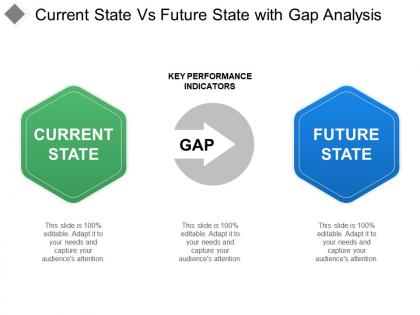
The image illustrates a conceptual framework used for gap analysis in business presentations or strategic meetings. It compares the "Current State" of a project, business, or process with the envisioned "Future State," identifying the "GAP" between them through "Key Performance Indicators" (KPIs). The hexagon shapes emphasize the two states, with the "Current State" highlighted in green and the "Future State" in blue, symbolizing growth and forward movement. The gray arrow labeled "GAP" represents the path or analysis needed to move from the current to the future state, and the importance of KPIs to measure progress.
Use Cases:
This type of slide layout can be broadly used in various industries for different strategic objectives:
1. Management Consulting:
Use: To showcase strategic plans and gap analysis during client presentations.
Presenter: Management Consultant
Audience: Corporate Clients
2. Information Technology:
Use: For illustrating the transformation journey in digital strategy and IT infrastructure upgrades.
Presenter: IT Project Manager/CTO
Audience: Stakeholders/Project Teams
3. Healthcare:
Use: Discussing improvements in patient care services or healthcare delivery models.
Presenter: Healthcare Administrator
Audience: Medical Staff and Board Members
4. Education:
Use: Presenting the evolution of educational programs or institution improvement plans.
Presenter: Academic Director
Audience: Faculty and Educational Stakeholders
5. Manufacturing:
Use: Demonstrating production process optimization or future state mapping for lean management.
Presenter: Operations Manager
Audience: Operations Team and Stakeholders
6. Retail:
Use: For strategic planning in customer experience enhancement or store performance.
Presenter: Retail Strategist
Audience: Retail Managers and Employees
7. Finance:
Use: To depict financial performance goals and strategies for growth or efficiency.
Presenter: Financial Analyst
Audience: Investors and Executive Management
Current state vs future state with gap analysis with all 5 slides:
Get endorsed by experts with our Current State Vs Future State With Gap Analysis. The best will back your every idea.
FAQs for Current state vs future state
So you need to figure out three main things. First, get real data on where you're actually at right now - not where you think you are, because trust me, there's usually a gap there. Then nail down your target goals with concrete numbers you can measure. Compare those two states to see what's missing - could be skills, resources, whatever. Oh and prioritize which gaps to hit first based on what'll have the biggest impact. Honestly, the hardest part is just being brutally honest about your starting point, but that's where the magic happens.
You need real data first - not guesses about what's happening. Dig into metrics, run surveys, interview people, actually watch your processes in action. Map out performance and resources as they exist right now. Honestly, this step catches most people off guard because reality rarely matches what we assume! Then flip it - start with your strategic goals and work backwards. Define exactly what success looks like with measurable outcomes. The trick is being brutally honest about today while staying crystal clear on tomorrow. Document everything before you compare the two states.
SWOT analysis and fishbone diagrams are your best bet for gap analysis. Performance dashboards work great too. McKinsey's 7S framework is pretty solid if you're dealing with organizational stuff, but honestly? Simple before/after comparison matrices do the trick for most projects - no need to get fancy. Lucidchart's decent for visual mapping, or just use Excel if you're feeling cheap. Your team actually has to want to use whatever you pick though. I'd start with basic current vs. desired state comparison first. Then dive into root cause analysis once you spot the obvious gaps.
Honestly, start by figuring out where your team is now versus where you need to be. Map out skills, processes, resources - the whole thing. Most teams think they know their weak spots but haven't actually measured anything (classic mistake). Once you've identified the real gaps, pick the ones that'll move the needle most on productivity. Then build specific action plans - could be training, new tools, whatever fits. Oh, and tackle the easy wins first. You'll get momentum going, which is half the battle with team changes.
Dude, stakeholder feedback is everything for gap analysis. These people deal with the problems every single day - they'll catch stuff you totally missed or call you out when you're overcomplicating something super basic. Get their input early and often, not just at the end when you dump some fancy report on their desk. They need to actually believe in your solutions or nothing's gonna happen. I learned this the hard way on a project last year... anyway, their reality check is what separates useful analysis from something that just gets filed away forever. Don't skip this step.
Gap analysis is basically comparing what customers want vs. what you're actually giving them. Survey people about their priorities first, then be brutally honest about where you're falling short. Those gaps become your fix-it list - could be response times, features, whatever. Companies get tunnel vision about what they think is important and totally miss the mark. I'd focus on the biggest gaps that you can realistically tackle. Oh, and don't forget to track if you're actually making progress - resurvey later to see if you're closing those gaps or just spinning your wheels.
Honestly, it totally depends on what you're trying to figure out, but I'd start with the basics - revenue, costs, ROI for the money side. Then look at how smoothly things are running: cycle times, error rates, productivity stuff. Customer metrics matter too - satisfaction scores, retention rates. Quality is huge in my experience. Don't sleep on employee KPIs either if you're looking at organizational gaps - turnover rates can tell you a lot. But here's the thing: pick maybe 5-7 that actually relate to your goals. I've seen people try to track everything and it becomes useless noise. Figure out what success looks like first, then find the numbers that'll show you're heading there.
So gap analysis is basically the same everywhere - you're just comparing where you are vs where you want to be. But what you actually focus on? Totally different. Healthcare teams obsess over patient outcomes and compliance stuff. Finance people care about risk and profit margins. Tech companies - well, they're all about features and user experience gaps. The process doesn't change, but the metrics and people involved do completely. Oh, and start by figuring out what "winning" looks like in your industry first. Then you can spot the gaps way easier.
Honestly, the two worst things you can do are being super vague about where you're starting from and setting completely unrealistic goals. I've watched teams spin their wheels for weeks because nobody defined what "success" actually meant upfront. Don't try fixing everything at once either - that's just chaos. Oh, and here's something people always mess up: they only ask the executives what they think instead of talking to the folks actually doing the work every day. Get specific about your current situation first, then bring in the right people to double-check you're not missing something obvious.
Honestly, just score each gap on two things: impact and how doable it actually is. Business impact could be revenue, cost cuts, beating competitors - whatever your company cares about most. Then figure out if you can realistically fix it with your current resources and timeline. I'm obsessed with those simple 2x2 grids - plot impact vs feasibility, high to low on both sides. Quick wins are obvious (high impact, easy to do). After those, go for the high-impact stuff that's harder. Map it all out based on what depends on what and how much time your team actually has.
Pick your battles - go after the big wins that won't take forever to fix. That's where you'll get traction fast. Break the monster problems into bite-sized pieces your team can actually handle. And honestly? Nothing happens without clear owners and deadlines, otherwise this stuff just sits there. Monthly check-ins keep everyone honest about progress. Oh, and don't forget to celebrate the wins as you go - people need to see this is working. I'd say start with your top 3 gaps this week and see how it goes.
Think of gap analysis as your GPS for change management - shows you where you're at vs where you need to go. Super helpful for figuring out which processes or skills need work first. Honestly beats just throwing resources at random problems and hoping something sticks. The trick is being real about your current situation (no sugarcoating) then chopping that big scary gap into smaller pieces your team can handle. You'll want to rank everything by what'll make the biggest difference and what's actually doable. Makes the whole thing way less intimidating than trying to fix everything at once.
So gap analysis is like the starting point for Six Sigma stuff. It shows you where you're missing the mark vs where you want to be. Then Six Sigma gives you the actual roadmap to fix things. One tells you what's wrong, the other tells you how to make it right - honestly, they're pretty perfect together. The trick is making sure your gap analysis has real data behind it, not just gut feelings. Otherwise you're basically guessing at solutions. I'd map out your current situation first, then figure out your target. Don't jump straight into improvement mode without that foundation.
Gap analysis works great for spotting your biggest vulnerabilities. Once you see what's missing between where you are and where you want to be, those gaps become your risk hotspots. I do this combo constantly - honestly it's one of my go-to moves. Score each gap by how much damage it could do to your goals, then tackle the scary ones first. Each gap is basically a ticking time bomb if you think about it. Try running your next analysis through this risk filter and you'll probably be surprised what pops up as your real threats.
Look, gap analysis is basically your roadmap for training that doesn't suck. You map out what skills your team actually has versus what they need for their roles. No more throwing random courses at people and hoping something sticks. It's honestly the difference between shooting in the dark and having actual direction. You'll spot the real performance gaps, build training around those specific needs, and actually see if it's working. Plus you stop burning budget on programs nobody cares about - which happens way too often. Start with comparing current skills to what each role actually requires.
-
Nice and innovative design.
-
Really like the color and design of the presentation.