


Curriculum Vitae Powerpoint Presentation Slides




Try Before you Buy Download Free Sample Product
 Impress Your
 Audience
 100%
100% Editable
 Save Hours
 of Time


Illustrate your working experience to the company and grab more opportunities using this Curriculum Vitae PowerPoint Presentation Slides. A bad PowerPoint presentation can ruin your prestige. Use professionally designed Curriculum Vitae templates to tell an impressive visual history of your academics. Our professionally designed career progression slides come with relevant analysis and planning. This unique career timeline deck is here to help you to formulate, plan and outline the topic with clear understanding. Display your employment history, qualifications, volunteer work, skills, abilities, strengths, education and some personal information using our visual resume PowerPoint presentation. Introduce your achievements and professional background with the help of this resume presentation slides for an inclusive presentation for the business. You can change the emphasis of the information according to the particular designation or position by using this resume builder PPT. Highlight and present your goals and objectives with the help of this curriculum vitae presentation slides. Explain how greater horsepower is generated with our Curriculum Vitae Powerpoint Presentation Slides. Illustrate the innards of the engine.
People who downloaded this PowerPoint presentation also viewed the following :
Content of this Powerpoint Presentation
Slide 1: This slide introduces Curriculum Vitae. State Your Company Name and begin.
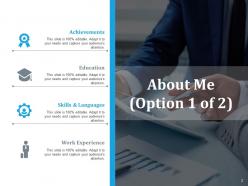
Slide 2: This is About Me slide to describe- Achievements, Education, Skills & Languages, Work Experience.
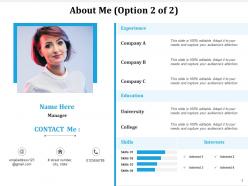
Slide 3: This is another slide for About Me with names, designation, experience, expertise etc.
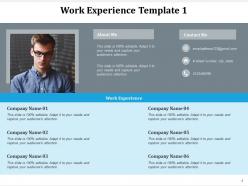
Slide 4: This slide presents Work Experience Template 1 with name, designation, work experience, contact information etc.
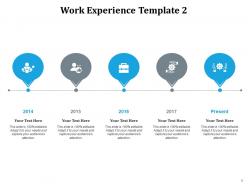
Slide 5: This slide displays Work Experience Template 2 in a timeline form.
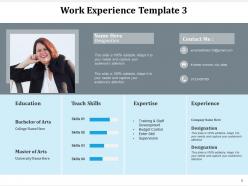
Slide 6: This slide showcases Work Experience Template 3 with name, designation, education etc. of employee.
Slide 7: This slide is titled as Additional Slides for moving forward.
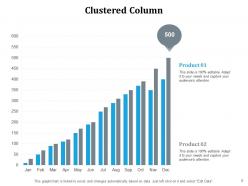
Slide 8: This slide shows Clustered Column chart with two products comparison.
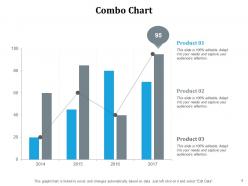
Slide 9: This slide displays Combo Chart with three products comparison.
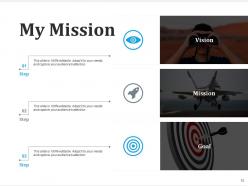
Slide 10: This is My Mission slide with related imagery.
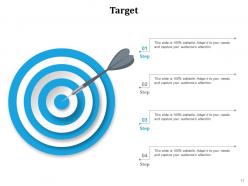
Slide 11: This is a Target slide. Define your targets here.
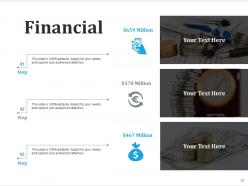
Slide 12: This is a Financial slide. Show your finance related stuff here.
Slide 13: This is a Bulb Idea slide to state a new idea or highlight information, specifications etc.
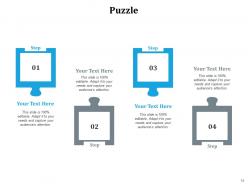
Slide 14: This is a Puzzle slide with text boxes to show information.
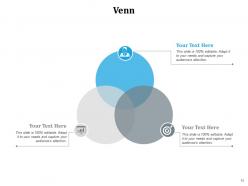
Slide 15: This is a Venn slide with text boxes to show information.
Slide 16: This is a Thank You slide with address, contact numbers and email address.
Curriculum Vitae Powerpoint Presentation Slides with all 16 slides:
Use our Curriculum Vitae Powerpoint Presentation Slides to effectively help you save your valuable time. They are readymade to fit into any presentation structure.
FAQs for Curriculum Vitae
Honestly, just focus on the basics first - contact info, a short summary, work history, education, and skills. Start with your most recent job and work backwards. Nobody cares about fancy fonts or whatever, but they do want to see actual numbers and accomplishments when you can swing it. Throw in any certifications or cool projects you've done. Education can be super brief unless you literally just graduated. Here's the thing though - you'll need to tweak it for each job application. I know it's annoying, but it works. Oh, and proofread that thing twice minimum.
Honestly, visual stuff makes such a difference - your CV won't just blend into the pile. Clean fonts and some white space help recruiters scan faster. Maybe throw in subtle colors or icons to show skill levels? Charts work great for achievements too. Just don't get too crazy with graphics since those ATS systems can be picky (learned that the hard way). I'd actually make two versions if I were you. One super plain for online apps, another with more visual elements for when you're networking or handing it directly to someone. Breaks up all that boring text.
So basically, a resume is that 1-2 page thing you tailor for each job - just the relevant stuff. CVs? Way longer. They're like your entire life story - every job, publication, award, random conference you attended in 2019. Use resumes for most corporate gigs in the US. CVs are more for academic jobs, research positions, or if you're applying internationally (Europe's obsessed with them for some reason). Honestly, just check what they ask for in the posting. If it says CV, send a CV. Otherwise, stick with a resume - it's safer for business roles and won't overwhelm anyone.
Okay so basically you gotta switch up your keywords depending on the job. Going from marketing to tech? Don't lead with creative stuff - put your data analysis and digital tools right at the top instead. I always reorder my bullet points so the good stuff hits first. It's honestly such a pain to customize every single one, but whatever, it actually works. Your summary section needs to match how they talk too. Finance people eat up words like "strategic" and "optimization." Startups? They want "growth" and "scrappy." I keep like three different template versions saved so I don't have to start from scratch each time.
Okay so keywords are actually super important for getting past those stupid ATS systems that scan your resume before any human sees it. Match their exact language - like if they say "project management," write that instead of "managed projects" or whatever. I know it's ridiculous we have to play these games but here we are. When hiring managers finally do look at your resume, they're scanning for the same terms anyway since they're flying through tons of applications. Sprinkle those industry words throughout your bullet points naturally though - don't just randomly stuff them in there because it'll sound weird.
Make a separate "Academic Achievements" section and list everything in reverse order - degrees, honors, scholarships, the works. If your GPA is 3.5 or higher, definitely include it. Dean's List, thesis titles (if they're relevant), academic competitions, publications - throw it all in there. Don't be shy about this stuff! It actually matters more than people think. Use specifics like "magna cum laude" instead of just saying you did well. Oh, and pick which achievements to highlight based on what job you're going for. No point bragging about your chemistry thesis for a marketing role, you know?
Start with your most recent job and work backwards. List job title, company, dates, then 3-4 bullet points showing what you actually accomplished - not just your job description. Nobody cares that you "managed daily operations" or whatever. What did you achieve? Include numbers if you've got them. Bullet points are your friend here - way better than paragraph blocks that recruiters won't read. Oh, and definitely tweak those bullets to match whatever job you're going for. I learned this the hard way after sending out like 50 generic resumes with zero responses.
Honestly, your CV template matters way more than you'd think. Recruiters spend like 10 seconds scanning it, so a clean design makes you look current and organized. Messy or outdated templates? They'll assume you're behind the times even if your experience rocks. Good templates also pull the eye to your best stuff first - that's huge. Just don't go crazy with graphics since those automated systems can't read them properly. Pick something polished but simple, and definitely save as PDF so it doesn't get all weird formatting when they open it.
Definitely include soft skills on your CV, but don't just write "team player" - that's so generic it hurts. Show them through what you've actually done instead. Like if you're good at leading people, say something like "Managed a team of 8 and finished our project two weeks early." Way better than just claiming you're a leader, right? Your accomplishments should naturally highlight things like problem-solving or working well with others. Oh, and pick the skills that actually matter for whatever job you're going for. No point emphasizing creativity if you're applying for accounting roles.
Ugh, okay so the worst ones I see constantly - typos everywhere (seriously, how do people not spellcheck?), CVs that go on for like 4 pages, and random irrelevant stuff nobody cares about. Skip those cheesy objective statements too, they're so 2010. Make sure your email isn't something embarrassing from high school lol. Don't list every single job you've had since you were 16 - just the relevant ones. Keep it clean looking and consistent. Oh and never put actual references on there, just say they're available if asked. Honestly? Get someone else to read it over because you'll miss obvious mistakes when it's your own writing.
Absolutely put it on there! Especially if it relates to what you're applying for. I'd make a separate "Volunteer Experience" section, or just mix it in with your regular jobs if the skills are similar. Format it the same way - organization, role, dates, bullet points with your accomplishments. Try to include numbers when you can, like "raised $5,000 at fundraiser" instead of just "helped with events." Honestly? Some volunteers end up doing way more complex stuff than paid employees. Don't downplay it just because you weren't getting a paycheck - that experience totally counts.
So first thing - check if they want a photo or not. Germany expects one, but don't even think about it for US jobs. Each country has weird length preferences too - some want 1-2 pages max while others don't really care. Put your work visa status right at the top so they know upfront. Honestly, the cultural stuff is huge - try to find someone local who can look it over if you can swing it. Focus on describing your experience in ways that make sense anywhere, not just mentioning random local companies they've never heard of.
Honestly, bullet points are a game changer for CVs. Hiring managers are literally skimming through like 50+ applications - they don't have time to read walls of text about your job history. Bullet points let them quickly spot your wins and key skills without getting lost in paragraphs. Plus they force you to cut the fluff and highlight what actually matters. I learned this the hard way after sending out dense, paragraph-heavy CVs that probably never got fully read. Start each point with action words and throw in numbers when you can - makes everything way more compelling.
Stop listing boring daily tasks and start showing what you actually accomplished. Instead of "managed social media accounts," write "grew Instagram followers by 150% in 6 months, driving $50K in sales." Numbers are everything here. Recruiters spend like 10 seconds scanning your resume, so metrics grab attention way better than "responsible for blah blah." Think about what problems you solved or how you made things better at each job. Lead with your wins first, then mention how you did it if you've got room. Action words like "achieved" or "increased" work great too.
Look, color and typography literally make or break that first impression. Keep it to one or two colors max - black plus maybe a subtle blue or gray works well. Don't go crazy with the rainbow thing (you know what I mean). For fonts, stick with clean readable ones like Arial or Calibri. Comic Sans is obviously a no. Use different font sizes and bold text to create sections and make your name pop. I learned this the hard way after sending out a few terrible-looking resumes. The whole point is looking polished but not overdone. Simple beats flashy every time.
-
Top Quality presentations that are easily editable.
-
Informative presentations that are easily editable.