

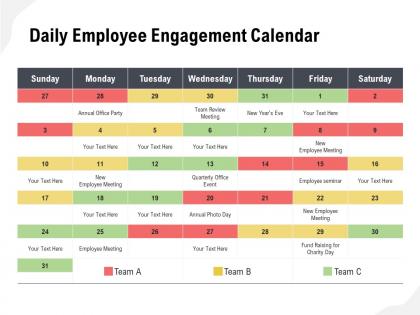
Daily employee engagement calendar




Try Before you Buy Download Free Sample Product
 Impress Your
 Audience
 100%
100% Editable
 Save Hours
 of Time


Beef up your act with our Daily Employee Engagement Calendar. They help make it dramatic.
People who downloaded this PowerPoint presentation also viewed the following :
Daily employee engagement calendar with all 2 slides:
Challenge old beliefs with our Daily Employee Engagement Calendar. They help display a contrarian approach.
FAQs for Daily
Honestly, it comes down to communication and not making remote people feel like second-class citizens. Do regular one-on-ones, create team traditions that include everyone. Trust your team to manage their own time - that whole "I need to see you at your desk" thing is such BS and kills morale instantly. Results matter way more than clocking hours. Oh, and don't forget the social stuff! Virtual coffee breaks or hybrid lunches help tons. You can't just assume remote workers will magically feel included. Be deliberate about bringing them into conversations and decisions.
Track both the numbers and the feel of things. Engagement surveys are a given, but retention rates and absenteeism tell the real story. Exit interviews are honestly my favorite - people spill everything when they're done! Also watch if people actually show up to your programs, because crickets usually means you missed the mark. Set your baselines first (super important), then check quarterly. Oh, and don't go crazy with metrics - pick maybe 3-4 solid ones and stick with them. Too much data just makes your head spin.
Honestly, leadership makes or breaks engagement - I've watched teams completely transform based on who's managing them. The good managers? They actually talk to people, not just about deadlines but like... how they're really doing. Transparency is huge too. People can smell BS from miles away, so just be straight with them. Recognition matters way more than most leaders think - don't just assume people know they're doing well. Create space where your team isn't terrified to mess up or voice opinions. Oh, and those one-on-ones everyone skips? Actually do them. Game changer.
Yeah, communication totally controls how engaged your team feels. Clear updates about where the company's headed and why their work matters? People actually care then. I've seen teams transform just from adding weekly check-ins - sounds simple but it works. The feedback part is huge too. Let people speak up and actually do something about their concerns. Nothing kills morale faster than being ignored or kept in the dark about decisions that affect them. Honestly, transparent goal-sharing alone will boost engagement way more than you'd expect. Try it for a month.
Honestly, skip the formal check-ins and try virtual coffee hangouts with zero agenda. People can just chill and chat. Set up async channels where everyone shares workspace pics or random projects they're working on - those photos are weirdly addictive to scroll through! Rotating guest stars work too. Pets, kids, quick house tours. Digital shout-out boards are solid for celebrating wins publicly. The trick? Don't force it. Connection has to feel organic or people will just... not participate. Pick one casual thing to test this week and see what happens.
Honestly, feedback systems work because people just want to feel heard. Set up a few ways for them to speak up - regular check-ins, quick surveys, maybe an anonymous box. But here's where most places screw it up: they collect all this input then do nothing with it. You've got to actually respond and tell people what you're changing based on their suggestions. Can't implement something? Just explain why - at least they know you listened. Oh, and don't overcomplicate it at first. Pick one method and promise you'll get back to them within a week.
Dude, recognition seriously works - like 60-70% boost in engagement kind of works. People just want to feel appreciated, you know? The trick is being specific about what they did well instead of those bland "thanks for your hard work" messages that mean nothing. Weekly shout-outs in meetings are gold, or set up something where teammates can recognize each other directly. Honestly, I've seen tiny acknowledgments completely flip someone's attitude about their job. It's wild how much better work gets when people actually feel seen, plus they'll stick around longer too.
Make onboarding interactive right away - don't just throw policy docs at people. Get them connecting with teammates and actually contributing something meaningful in their first few weeks. Those "first project showcases" work surprisingly well, honestly. Pair them with culture buddies (not just work mentors), and let them shadow different departments so they see how everything fits together. Oh, and definitely do regular check-ins to hear their fresh take on things. The whole point is making them feel like real contributors instead of just... I dunno, people sitting through training videos all day.
Honestly? Just talk to them first. Like actually sit down and figure out what's going on. Half the time it's because they feel invisible or don't see where they're headed career-wise. Bad managers are usually part of the problem too, not gonna lie. Give them real feedback more often, show them how their work matters to the bigger picture. One-on-ones work wonders - I swear by them. Oh, and create some growth opportunities if you can. Start small though. Pick your most checked-out person and grab coffee with them this week. Just listen.
Oh absolutely, there's a huge connection there. Happy employees treat customers way better - it's honestly that simple. They'll actually care about solving problems instead of just going through the motions. I've watched this happen at like every job I've had. Companies with engaged teams see 12% better customer satisfaction scores, which obviously boosts profits too. It's this whole domino effect, you know? Your people feel good about work, customers have better experiences, business does better. Start by figuring out where your team's checked out and work from there.
Honestly, it's mostly about uncertainty and crappy communication. People freak out when they don't know what's happening next - which makes total sense if you think about it. Your team will push back, especially if they feel like stuff's just happening TO them instead of being part of it. Trust goes out the window fast during changes too. Oh, and productivity tanks because everyone's gossiping instead of working. Talk to them way more than you think you need to. Give them timelines, let them help plan when you can, and don't pretend their worries aren't real. Over-communicate everything.
So instead of those boring annual surveys everyone ignores, try pulse tools like Culture Amp for real-time feedback. Recognition platforms are actually pretty sweet - people get weirdly motivated by instant peer shoutouts. You can gamify learning through employee apps, and analytics help catch disengagement before someone bolts. Honestly, the data-driven approach beats guessing what people want. Don't go crazy implementing everything though. Pick one tool that fixes your worst problem first, then build from there. Way more effective than the old spray-and-pray method.
Honestly, DEI makes a huge difference with engagement. People contribute way more when they actually feel like they belong - you'll notice better collaboration and folks sharing ideas instead of staying silent. Diverse teams are just better at solving problems too, which is kinda obvious when you think about it. The trick is being genuine about it, not doing some fake corporate checklist thing. Listen to what your team's actually experiencing and create that safe space where people can be themselves. Once they stop holding back, you get their best work.
Honestly, you've got to stop treating everyone the same. Break your team into actual groups - tenure, job type, age, work preferences, whatever makes sense. Survey them about what they actually want because I guarantee it's not all pizza parties. Remote folks might want virtual hangouts while office people prefer face-to-face stuff. Your HR system probably has tons of data you're not using - dig into what's working for different groups. Try small pilots first instead of rolling out company-wide initiatives that flop. Think of it like marketing but for your own employees. Nobody wants generic engagement anymore.
Different generations want totally different things, so you can't just do the same approach for everyone. Boomers love recognition and job security. Gen X is all about that work-life balance and being left alone to do their thing. Millennials need constant feedback and growth opportunities - they're hungry for it. And Gen Z? They expect everything to be digital and want their work to actually matter. Survey your people to figure out what drives them individually, then offer flexible options instead of generic perks that half your team won't even use.
No Reviews