


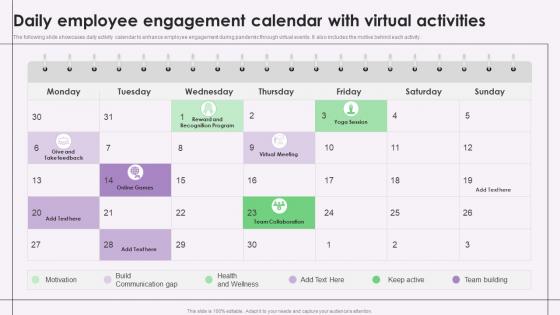
Daily Employee Engagement Calendar With Virtual Activities




Try Before you Buy Download Free Sample Product
 Impress Your
 Audience
 100%
100% Editable
 Save Hours
 of Time


The following slide showcases daily activity calendar to enhance employee engagement during pandemic through virtual events. It also includes the motive behind each activity.
People who downloaded this PowerPoint presentation also viewed the following :
Daily Employee Engagement Calendar With Virtual Activities with all 6 slides:
Use our Daily Employee Engagement Calendar With Virtual Activities to effectively help you save your valuable time. They are readymade to fit into any presentation structure.





FAQs for Daily Employee Engagement Calendar
Look for low turnover and people actually referring friends to work there - that's huge. When folks start volunteering for extra projects and speaking up in meetings, that's real engagement. The whole office energy shifts too, way more collaborative vibes. Sure, engagement surveys matter, but I honestly think watching employee referrals tells you more about what people really think. Also track who's jumping on voluntary projects. Oh, and you'll notice less complaining, more actual constructive feedback. Those behavioral things beat survey numbers every time since people can BS those pretty easily.
Look, the numbers don't lie - engaged employees are 23% more profitable and 18% more productive. When people actually give a damn about their jobs, everything improves. They're more creative, call in sick less, and you won't be constantly hiring replacements (which costs a fortune, honestly). Happy employees also become walking advertisements for your company. Better teamwork, customer service, innovation - it all flows from there. Oh, and definitely start with pulse surveys to see where you stand. Then tackle the obvious stuff like recognition programs and career development opportunities. Trust me, it's worth the effort.
Honestly, leadership makes or breaks employee engagement. Your energy sets the whole vibe for the team. People can tell when you genuinely care about their growth versus just going through the motions. Be the person who actually listens during one-on-ones - and I mean really listens, not just waiting for your turn to talk. Follow through on what you promise. Recognize good work when you see it. Create that safe space where people aren't afraid to mess up or speak up. Oh, and ask how they're doing as humans, not just work robots. Trust me, the engagement rates will follow.
Honestly, feedback works because people just want to feel like they matter at work. You know that feeling when you're talking and nobody's actually listening? That's what happens without regular check-ins. I'd start with monthly one-on-ones - maybe 15 minutes tops. Small problems don't blow up into massive drama when you catch them early. Your team gets clearer expectations, some recognition when they do good work, and they actually connect with what they're trying to achieve. Even those quick pulse surveys help. Trust me, it makes a bigger difference than you'd think.
Honestly, start with regular one-on-ones that aren't just project updates - people crave that actual face time. Set up virtual coffee chats too because remote work gets lonely without those random office conversations. Public recognition in team meetings or Slack works wonders. Give them autonomy but be clear about expectations (that balance is tricky but worth it). Oh, and here's what really works - just ask your team what they need to feel more engaged. Then actually do it. Most managers skip that last part but it's probably the most important thing you can do.
Dude, the numbers are crazy - engaged employees are like 87% less likely to quit than disengaged ones. Makes total sense though, right? People who actually give a damn about their job aren't constantly browsing LinkedIn. Here's the thing: disengaged workers already mentally checked out. They're gone the second something better comes along. But when someone feels valued and connected to the work? They'll ride out the rough patches with you instead of running. Honestly, just doing regular check-ins and actually caring about people's growth makes such a difference. Small stuff that keeps your best people from walking.
Honestly? Skip the trust falls - nobody wants that awkwardness. Escape rooms are pretty solid because people actually have to work together on something fun. Cooking classes work too, or even volunteer stuff where you're solving real problems as a team. I've seen regular team lunches do wonders since there's zero pressure and people just chat naturally. Coffee meetups are great for the same reason. You want your team discovering they both love true crime podcasts or whatever, you know? Start with something simple like a monthly lunch first. See what clicks before you go planning some elaborate retreat.
Honestly, you need both the hard numbers and the softer stuff. Track your engagement scores, turnover rates, productivity - that's your baseline data. But exit interviews and focus groups? That's where you get the real tea on what's actually happening. I'd set up some kind of monthly dashboard to watch trends - makes it way easier to catch problems early. Oh, and definitely measure before you roll out any new programs, otherwise you're just guessing if they worked. Pulse surveys are clutch too since people's feelings change fast.
Dude, recognition is huge for keeping people engaged. Like, I can't stress this enough - people just want to feel like their work actually matters, you know? Don't make it some generic "good job everyone" thing though. Be specific about what they did well. "Your research in that presentation was spot-on" hits way different than just "nice work." You don't need fancy award programs or anything expensive either. Honestly, just calling people out during your weekly team meetings works. It's wild how much difference those little moments make for morale.
Honestly, D&I works because people just want to feel like they belong at work. When someone sees their authentic self being welcomed, they'll actually speak up and share ideas instead of staying quiet. Different perspectives lead to way better problem-solving too - I've seen this firsthand. Your team starts caring more about results when they feel their contributions matter. But here's the thing: it can't be performative BS. You need real psychological safety where people won't get judged for being themselves or sharing unpopular opinions. Short version? Make people feel valued and they'll give you their best work.
Honestly? Most of the time it's bad communication from the top, zero growth opportunities, and people feeling like crap about their contributions. Oh, and when workloads are absolutely insane - that kills morale fast. Here's what actually works: have real feedback conversations regularly. Build actual career paths people can see. Celebrate stuff, even small wins matter. But here's the thing everyone misses - your team needs to understand WHY they're doing what they're doing. How does their work fit the bigger picture? Start simple though. Just ask them what's pissing them off. You'll probably hear some surprising stuff.
Honestly, work-life balance is probably the biggest thing affecting engagement. People who are constantly burned out just phone it in - I've watched entire teams turn into zombies when they're always "on call." Your brain needs actual downtime to recharge, otherwise you're just going through the motions instead of doing good work. Set real boundaries around after-hours stuff and push people to take their vacation days (seriously, some people are weird about this). Oh, and don't send emails at 9pm expecting responses - that sets a terrible precedent.
Honestly, there's so much cool stuff out there now. You can ditch those awful yearly reviews and use AI pulse surveys for real-time feedback instead. Slack or Teams work great for keeping everyone connected - especially if you've got remote people. Oh, and gamification apps actually make goal tracking fun (I'm weirdly competitive about leaderboards). Recognition platforms let people shout out wins immediately, which is huge. Learning systems help folks build skills whenever they want. Just don't go crazy - pick maybe 2-3 things that actually fit your vibe or you'll overwhelm everyone.
Honestly, you've gotta bake your values right into what people actually *do* every day. Innovation matters? Set up hackathons where they can innovate instead of just talking about it in meetings. Collaboration's your thing? Design activities that require real teamwork. I swear, half the companies I know just slap values on conference room walls and call it done. Your recognition programs should celebrate when people live these values - not just hit their numbers. Tie performance goals to value-driven stuff too. Give them chances to actually embody what you stand for, and that's when engagement becomes real instead of another corporate buzzword.
Honestly, you've got to over-communicate like crazy and be super transparent about what you know vs. what you don't. People absolutely hate being left in the dark – they'd rather hear the same update twice than wonder what's happening. Get your managers looped in early because trust me, they're already getting cornered in hallways with worried questions. Set up ways for people to actually give feedback and see you respond to it. Here's the thing though – change just sucks, period. Don't pretend it doesn't. Acknowledge that their feelings are totally valid, then give them small ways to help shape what's coming next.
-
“I required a slide for a board meeting and was so satisfied with the final result !! So much went into designing the slide and the communication was amazing! Can’t wait to have my next slide!”
-
I never had to worry about creating a business presentation from scratch. SlideTeam offered me professional, ready-made, and editable presentations that would have taken ages to design.