


HR Calendar For Employee Engagement Activities




Try Before you Buy Download Free Sample Product
 Impress Your
 Audience
 100%
100% Editable
 Save Hours
 of Time


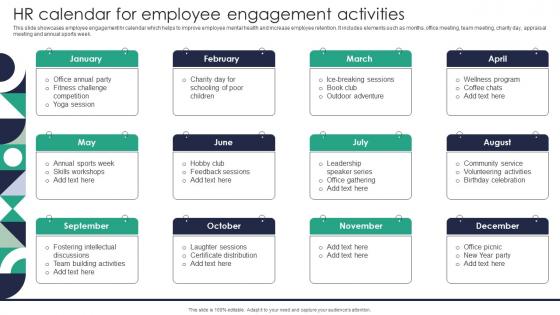
This slide showcases employee engagement hr calendar which helps to improve employee mental health and increase employee retention. It includes elements such as months, office meeting, team meeting, charity day, appraisal meeting and annual sports week.
People who downloaded this PowerPoint presentation also viewed the following :
HR Calendar For Employee Engagement Activities with all 9 slides:
Use our HR Calendar For Employee Engagement Activities to effectively help you save your valuable time. They are readymade to fit into any presentation structure.









FAQs for HR Calendar For
Honestly, start with your big annual stuff first - hiring cycles, performance reviews, comp planning, benefits enrollment. Then squeeze in the smaller things around them. I always forget about holiday coverage planning until it's too late, so definitely add that! Summer vacation blackouts too. Training schedules and compliance deadlines are crucial since those have hard dates you can't move. Company events that mess with staffing should go on there as well. The whole point is seeing everything at once so you can catch conflicts before they blow up. Makes resource planning way less stressful.
Oh this is actually brilliant! Start with your big business events first - like product launches, busy seasons, whatever. Then build your training around those. So instead of random workshops that nobody cares about, you're doing leadership prep right before crunch time hits. Performance reviews happen when they're useful for actual planning. Honestly, the visual aspect alone is worth it because you'll spot those "oh crap" moments where your team's gonna be drowning without support. It makes development feel way more purposeful instead of just checking boxes.
Honestly, just do it - compliance deadlines on your HR calendar will save your butt. No more "wait, benefits enrollment ended when??" panic attacks. Map out all your annual requirements first (EEO-1 reports, FMLA stuff, tax deadlines, whatever applies to you). Then work backwards from each due date. That way you've got buffer time built in instead of scrambling like a maniac. Your boss will actually think you have your act together for once, which is always nice. The prep work becomes way more manageable when you're not doing everything last-minute.
So basically an HR calendar puts all your important dates in one spot where everyone can see them. Performance reviews, benefits enrollment, holidays, training - it's all there. Your employees won't get blindsided by random deadlines anymore, which is honestly such a relief. Managers can actually plan around HR stuff instead of scrambling last minute. And you'll stop getting a million "when's open enrollment?" emails - trust me on that one. Just set up some automated reminders and give department heads access. Makes communication way smoother.
So basically, think of an HR calendar as your cheat sheet for not forgetting wellness stuff throughout the year. I'd start by marking all the big mental health awareness months first, then squeeze in your regular team events around those. That way nothing gets double-booked or forgotten - trust me, I've seen that disaster happen! Your team will actually appreciate seeing what's coming up too, gets them more excited to participate. Space things out so people don't get overwhelmed with back-to-back activities. Oh, and seasonal wellness challenges are pretty popular if you're looking for ideas.
Honestly, automating your HR stuff is a game changer. Start small - pick one thing like performance review reminders or PTO tracking that syncs with payroll. Most platforms now have AI that'll predict your busy seasons and suggest better timing for training or events, which is pretty cool. Custom workflows are where it gets fun though - you can auto-send onboarding checklists when someone new starts. Oh, and don't forget the simple wins like syncing everyone's birthdays and work anniversaries. I'd focus on automating just one process first instead of trying to do everything at once.
Honestly, start with whatever's causing you the biggest headache right now. Time-to-fill is huge if hiring's a mess. I'd also track your interview-to-hire rates and how many one-on-ones you actually do vs plan (that gap is always embarrassing). Employee response rates to invites tell you a lot too. Oh, and no-shows - I totally ignored tracking those until it became this whole thing. Administrative work vs strategic time is another good one if you feel like you're drowning in busy work. Training completion rates are pretty standard baseline stuff. Don't go crazy though - pick like 2-3 that'll actually move the needle for your specific situation.
Honestly, I'd say monthly if you can manage it. Quarterly at minimum though. HR stuff changes so fast - new compliance deadlines pop up, policies get updated, random company events appear out of nowhere. What I do is block 15 minutes at month-end to add everything for the next few months. Performance reviews, open enrollment, those big seasonal things need to go in way ahead of time or you'll forget. Oh and definitely set a recurring reminder for this whole review thing. Otherwise you'll be like me last year - suddenly realizing my calendar was completely worthless because I kept putting it off.
Build feedback into your planning from day one - seriously don't wait until the end. I always survey everyone in December about what sucked (or worked) from the current year before drafting anything new. Saves me so much drama later. Set up check-ins throughout the year too. Ask specific stuff like "Is March looking crazy?" instead of generic "how are things?" The key is actually doing something with their input - people get annoyed and stop helping if you just ignore what they tell you. Oh and document everything so you don't forget!
Start planning your company events 3-4 months out - trust me on this one. Don't dump everything in December like most places do. Look at when your team's stressed and throw in some fun stuff then. Busy season? Keep it simple. Slower periods are perfect for bigger celebrations when people can actually show up and enjoy themselves. I learned this the hard way at my last job. Space things around holidays and your own company milestones. Check what worked last year first, then build from there. Cultural events are great for reinforcing what you guys stand for, but timing's everything.
Honestly, the hardest part is just getting people to stop using their ancient spreadsheets and sticky notes. People are creatures of habit, you know? Start with your core team first - don't try to roll it out company-wide right away. Get your boss on board early so they're actually using it too. Integration with tools people already live in daily is huge, otherwise it just becomes another thing to ignore. Pick someone to own the updates or it'll get stale fast. And show some quick wins! Like when it saves someone from accidentally scheduling their big presentation during everyone's vacation week.
Look, an HR calendar literally saves your sanity during hiring season. Map out when you'll need people most - like holiday retail rushes or post-graduation hiring. Block those interview weeks early before your calendar gets crazy. I learned this the hard way after scrambling through three chaotic hiring cycles. You can coordinate with managers months ahead instead of panicking when positions open up. Track application deadlines, follow-ups, all that stuff. Campus recruitment dates too - those fill up fast. Honestly, just start with your messiest hiring periods and plan backwards from there.
Dude, trust me on this - visuals totally change the game. Nobody wants to stare at another boring spreadsheet, right? Color coding different events is clutch, plus little icons help people spot stuff fast. Even something simple like switching up that harsh black-on-white text makes people actually *want* to look at it. Progress bars work great for enrollment deadlines too. Oh, and infographics can break down those confusing benefits into bite-sized pieces. Honestly? Just add one thing at a time and see what your team responds to best.
Honestly, getting everyone to actually use the calendar is the hardest part. Put it somewhere they're already checking daily - like your project management tool or intranet. I'd do quarterly meetings with department heads so they can spot conflicts before they happen. Send heads-ups about big HR stuff coming down the pipeline, especially things like performance reviews that mess with everyone's schedules. The trick that actually works? Getting those department leaders to bake your deadlines into their own planning. Otherwise they just forget and you're scrambling later.
Honestly, start with what you're already using - Google Calendar or Outlook work great since your team knows them. BambooHR and Workday are awesome if you want something built for HR stuff like tracking reviews and onboarding dates. Asana's solid too. I've literally seen people crush it with just a shared Excel sheet though, which is kinda hilarious but hey, whatever works! Just pick something everyone can actually get into without wanting to scream. The integrations matter way more than you'd think.
-
The slides are remarkable with creative designs and interesting information. I am pleased to see how functional and adaptive the design is. Would highly recommend this purchase!
-
Loved the fact that SlideTeam provides clean, high-definition, and professional PowerPoint products.