

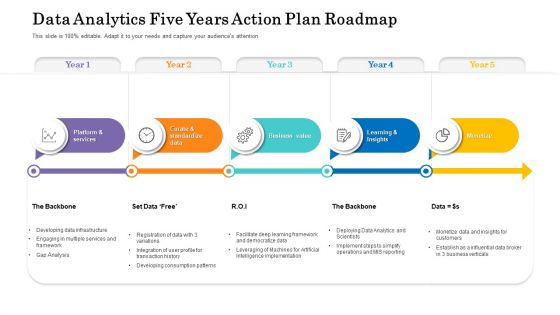
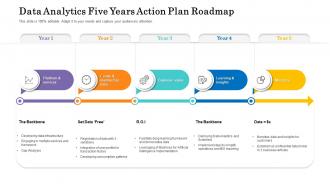
Data analytics five years action plan roadmap




Try Before you Buy Download Free Sample Product
 Impress Your
 Audience
 100%
100% Editable
 Save Hours
 of Time


Visualize your work plan and communicate your ideas impactfully with our pre designed Data Analytics Five Years Action Plan Roadmap. Showcase the detailed overview of the project, the key deliverables, and the milestones to be achieved with the help of our fully customizable PowerPoint layout. You can easily emphasize on the project goals and discuss all the activities involved in an easy to comprehend manner by utilizing our professionally designed PPT theme. This roadmap PowerPoint layout is a perfect strategic planning tool that can help in keeping the project on track. With our attractive PowerPoint theme, you can articulate the workflow, track the work progress, and have a clear vision of the goal to be achieved. Download this versatile Data Analytics Five Years Action Plan Roadmap and save your hours of work.
People who downloaded this PowerPoint presentation also viewed the following :
Data analytics five years action plan roadmap with all 2 slides:
Use our Data Analytics Five Years Action Plan Roadmap to effectively help you save your valuable time. They are readymade to fit into any presentation structure.
FAQs for Data analytics five years
Start by figuring out where you actually stand with your data right now - most companies have no clue what they're working with. Map out your business goals first, then work backwards to see what analytics you need. Find your data sources and figure out what's missing. Pick your tech stack after that, not before. Here's the thing - everyone wants to jump straight to the fancy stuff and totally skips the boring assessment part. Big mistake. Also, don't treat governance like something you'll "add later" because you won't. Plan some quick wins to keep people happy while you're building the bigger picture. Oh, and make it phased - trying to do everything at once is a recipe for disaster.
Map your analytics stuff straight to what the business actually cares about - revenue, costs, keeping customers happy, whatever. Score each project on impact vs effort (yeah, it's gonna be subjective but roll with it). Go after things that either fix urgent problems or create quick wins. Honestly, I see teams waste so much time on flashy projects that leadership couldn't care less about. Build a basic scoring matrix and be ruthless - business value first, then worry about whether you can actually pull it off technically. Skip the cool factor if it doesn't move the needle.
Start with data collection - APIs, databases, that stuff. Python or R for processing (I'm team Python but whatever works). Spark if you're dealing with massive datasets. Tableau and Power BI are solid for dashboards since executives eat that visual stuff up. Cloud-wise, AWS or Azure - both are fine honestly. Git for version control because losing code sucks. Oh, and grab scikit-learn or TensorFlow for ML work. Here's the thing though - don't try learning everything at once. Pick one tool per category first, get decent at it, then branch out.
Start with five basics: data governance, infrastructure, skills, culture, and processes. First, audit your actual data sources - are they clean, reliable, and do people trust what comes out? Most leadership thinks they're way more data-driven than they actually are (classic blind spot). Check your team's technical skills and current tools. If everything's held together with duct tape, that's a red flag. I usually make a simple 1-5 scorecard for each area. Sounds nerdy but it works - gives you a real baseline and shows where to throw money first.
Get your stakeholders involved right from the start when you're building the strategy - trust me, nobody wants data stuff forced on them. Talk their language too. Instead of getting all nerdy about algorithms (guilty as charged), focus on what they actually give a damn about: money saved, revenue up, processes that don't suck. Quick wins are huge for getting people on board early. Then keep them updated with dashboards they can actually read without a PhD. Oh, and solve their real problems instead of some generic approach that fits nobody perfectly.
Honestly, don't make the same mistake I did - build governance right into your roadmap from day one instead of scrambling to add it later. First thing? Pin down who owns what data and set your quality standards before you even look at analytics tools. Trust me on this one. Create lineage tracking and access controls as you hit each milestone. Your policies have to actually make sense for the business though, or people will find workarounds (and they always do). The whole point is making governance help your team move faster, not slow them down with red tape.
Honestly, start with what actually matters to your boss - ROI, revenue changes, cost cuts, whatever drives decisions at your company. Adoption rates are clutch too because who cares about perfect dashboards if nobody's using them? Data quality is non-negotiable (seriously, bad data will kill your credibility fast). I'd also track how much faster people can make decisions now vs before your analytics. User satisfaction surveys help, though people sometimes lie on those. Pick maybe 3-4 metrics that your stakeholders genuinely care about first. You can always add more later once you've got the basics nailed down.
Honestly, just start small with the repetitive stuff you're already doing - that's where ML shines. Look at your historical data and try some basic forecasting instead of only reporting what already happened. Don't go crazy and rebuild everything at once (I've watched teams crash and burn doing that). Get everyone comfortable with simple models first. Then maybe add some natural language processing for messy data or build recommendation engines. The whole point is making your current workflows smarter, not throwing them out. Your team will thank you for not making it feel like starting over from scratch.
Dude, data quality will make or break everything. Seriously - I've watched entire teams build these gorgeous dashboards for months, only to find out their conclusions were total garbage because the underlying data was trash. Pretty brutal wake-up call. Bad data = wrong insights = terrible decisions = everyone stops trusting your work. You'll want to start auditing your current sources and spot the biggest gaps first. Set up some validation and cleaning processes early, or you're gonna hate yourself later. Trust me on this one.
Focus on quick wins that actually build toward your bigger picture - not just random easy stuff. You want early wins that show ROI and get people excited, but they should also set you up for harder analytics down the road. Basic reporting is fine if it eventually helps you get to predictive modeling. Otherwise you're just spinning your wheels, honestly. Pick short-term projects that teach your team skills, clean up data quality, or create processes you'll need later anyway. Always ask: "Does this move us toward our 2-3 year goals or are we just checking boxes?"
Don't try mapping out every analytics project for the next three years - you'll just overwhelm everyone and set impossible expectations. Business priorities change constantly anyway. Also, never build your roadmap without talking to the actual business teams first. I've watched so many "brilliant" technical plans completely miss what people actually need. Data quality work is boring as hell but you can't skip it. Start small with stuff that shows quick wins, then tackle the bigger projects. Oh, and definitely revisit this thing every quarter because everything will shift.
Honestly, you've gotta get leadership actually using data first - otherwise it's just lip service. Skip those boring "here's Excel 101" trainings and make them role-specific instead. Marketing needs totally different stuff than operations, you know? Teach people to tell stories with data, not just make spreadsheets. Find a few data nerds in each department who can help their coworkers (way less threatening than some corporate mandate). Oh, and make sure people can actually present their findings - that's half the battle right there. It's really about making it feel collaborative rather than forced.
Honestly? Focus on business impact first, then worry about how hard it'll be to build. Find the projects that actually move the needle on revenue or save money - those get your A-team. I wasted like 3 months on this super cool ML thing that literally no one ended up using. Such a mistake. Give maybe 60-70% of your people to the high-impact stuff. Save 20-30% for the experimental projects that might pay off later. Oh, and data quality issues will eat your lunch - they always take twice as long as you think. Build a simple scoring thing: business value vs effort. Makes the tough calls way easier.
Oh man, regulations will absolutely mess with your roadmap if you're not watching. GDPR and CCPA already changed everything, and there's always something new coming down the pipeline. You basically have to build in flexibility from the start now - which honestly makes planning a total pain. My advice? Set up quarterly check-ins just for regulatory stuff and always pad your timeline for those inevitable compliance curveballs. I learned this the hard way on a project last year. Building those checkpoints into each phase saves you from scrambling later when new rules drop.
Netflix is the classic example - they ditched DVD ratings for real-time streaming data that now influences 80% of what people watch. Walmart saved billions on inventory using predictive supply chain models. Starbucks completely changed how they pick store locations with geospatial analytics (honestly genius move). Kaiser Permanente integrated patient data and actually managed to improve care while spending less. That's pretty rare in healthcare. But here's the thing - you'll get way more value looking at case studies in your specific industry. The data challenges are totally different between sectors, plus regulatory stuff varies like crazy.
-
Easily Understandable slides.
-
Presentation Design is very nice, good work with the content as well.
-
It saves your time and decrease your efforts in half.
-
Excellent template with unique design.