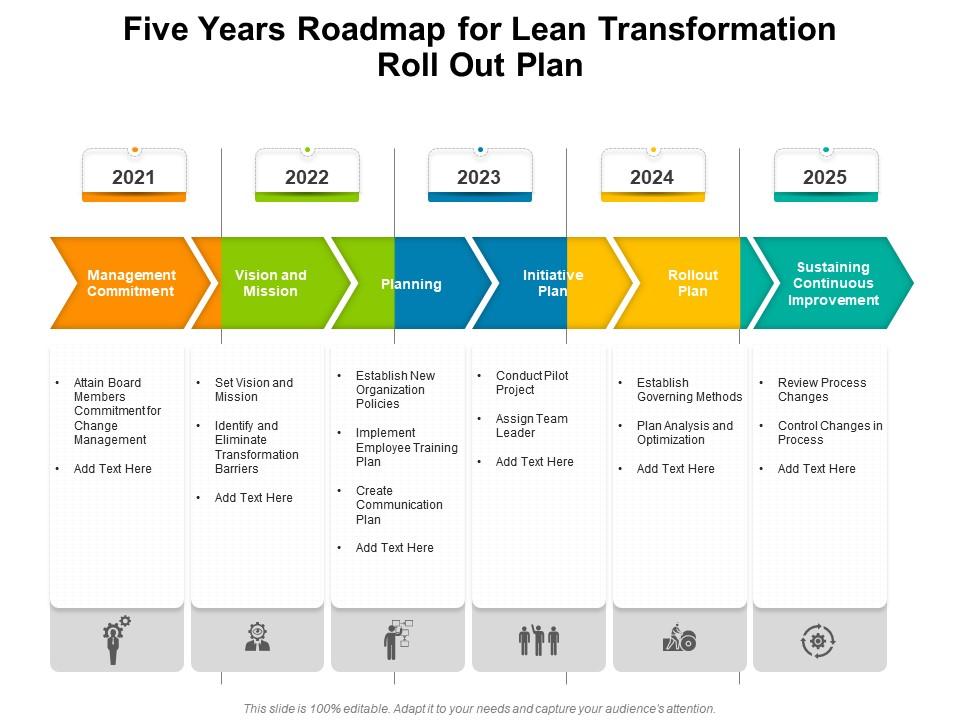
Five years roadmap for lean transformation roll out plan
Try Before you Buy Download Free Sample Product
Audience
Editable
of Time
A cohesive work plan is essential for achieving the desired target. Communicate your vision and lay a firm ground in front of your audience with our PowerPoint layout. Align your project milestones, budgets, deliverables, deadlines, and all the requisite information for a dynamic presentation by employing this amazingly designed Five Years Roadmap For Lean Transformation Roll Out Plan. Maximize team efficiency and streamline a work plan efficiently by introducing our ready made roadmap PowerPoint theme. You can quickly establish coordination between different activities across the organization and present an insight to your colleagues by utilizing this useful business tool. Color code specific tasks, prioritize, and keep a close eye on the deadlines with the help of our eye catchy PowerPoint template. Download our Five Years Roadmap For Lean Transformation Roll Out Plan for excelling at productive management.
People who downloaded this PowerPoint presentation also viewed the following :
Five years roadmap for lean transformation roll out plan with all 2 slides:
Use our Five Years Roadmap For Lean Transformation Roll Out Plan to effectively help you save your valuable time. They are readymade to fit into any presentation structure.
FAQs for Five years roadmap for lean transformation
Here's what I'd do if I were you - start with value stream mapping first. It'll show you exactly where you're wasting time and money, which honestly is pretty eye-opening. The five main things are: figure out value from your customer's view, map that value stream, create smooth flow by fixing bottlenecks, only make what people actually want (pull systems), and keep improving bit by bit. Most teams I've seen try doing everything at once and just crash and burn. Map your process first, then you'll know which area needs the most attention based on what's actually broken.
Okay so first thing - you gotta map out what's actually happening in your processes, not what you think is happening. Walk through each step with your team and document everything. Time it all, track where stuff gets stuck, measure the quality problems. Your frontline people are gold here because they see the real bottlenecks every day. I know it sounds boring but trust me, this baseline data is everything. Sometimes what you find will make you want to bang your head against the wall! Once you've got those current state maps though, the waste becomes super obvious and you can figure out what to tackle first.
Oh man, leadership makes or breaks this stuff - I can't tell you how many times I've watched lean programs just die because executives weren't really into it. Your senior folks need to actually DO the work, not just write checks and disappear. They've gotta get trained first (how can you champion something you don't get?), then jump in and show everyone what good looks like. When roadblocks pop up, leaders need to bulldoze them. And honestly? Celebrating the small wins keeps people motivated. Without real buy-in from the top, you're basically pushing a boulder uphill.
Honestly, the toughest part is dealing with people who just don't want to change - and I get it, change sucks. Your leadership needs to actually care, not just pretend they do. Teams can tell when executives are faking it. Start with small pilot projects instead of trying to flip the whole company overnight (learned that one the hard way). Get people involved in planning so they feel ownership. Training helps, but really it's about showing quick wins early on. Oh, and definitely celebrate those small victories - keeps everyone motivated when things get messy.
Track the obvious stuff first - cycle times, defect rates, inventory turns, cost savings. Leadership eats that up. But here's the thing: culture metrics matter just as much. How engaged are your people? Are they actually submitting improvement ideas? Customer satisfaction scores too, obviously. I'd honestly keep it simple - maybe 3-5 key metrics on a monthly dashboard. You don't want to get buried in spreadsheets. The real test is whether ideas are bubbling up from the shop floor, not just coming down from management.
So basically you want to nail down a few core tools first. Value stream mapping shows you what's actually happening right now - super eye-opening. Then 5S gets your workspace organized and consistent. Kaizen events are where the magic happens though, seriously those sessions can transform everything if done right. For problem-solving, fishbone diagrams and 5 Whys help you dig into root causes instead of just fixing symptoms. Kanban keeps things flowing smoothly. Oh and A3 thinking - that's your structured framework for improvement projects. But honestly? Don't go crazy trying to learn everything. Pick maybe 2-3 tools and get really good at those first.
Honestly, get your people involved in designing the change instead of just announcing it afterward. Ask frontline workers what's actually broken - they know better than anyone in the C-suite. Explain WHY you're doing this stuff, not just what's happening. Quick wins are gold, so make noise about them when they happen. Oh and training has to be hands-on. Nobody learns anything from those soul-crushing PowerPoint marathons. Basically treat your team like they're part of the solution, not some roadblock you need to bulldoze through.
Think of value stream mapping like having a GPS for fixing your processes. Map out what you're doing now first - honestly, it's wild how much waste you'll spot once everything's laid out visually. All those handoffs and delays become super obvious. Then sketch your ideal future state and figure out what projects will get you there. Way better than just randomly trying lean tools and hoping something sticks. Get your team to help with the mapping though - they always catch stuff I miss. Oh, and start with whatever process is causing you the biggest headache right now.
So tech can totally speed up your lean transformation - it digitizes those tedious manual processes and gives you real-time visibility into what's actually happening. IoT sensors let you monitor production live, digital kanban systems clean up workflow management, and analytics tools catch bottlenecks fast. The data aspect is honestly game-changing - you'll discover waste patterns that were completely invisible before. Automation takes over the repetitive stuff so your people can focus on improvement work. My advice? Start with just one process, see how it performs, then expand from there. Don't try to boil the ocean right away.
Look, you can't just do lean as a project and call it done. Build it into performance reviews and hire people who actually want to improve things. Leadership has to stay involved - seriously, the second managers stop doing gemba walks and asking "why," it all crumbles. Celebrate the small wins because they add up. Keep your visual boards updated and train every new person in lean thinking. Here's the real kicker though - people need actual time to improve processes instead of constantly putting out fires. Set up those feedback loops and stick with them. It's honestly more about changing how you think than following some rigid playbook.
So basically, traditional process improvement tackles one problem at a time - like Six Sigma fixing defects in a specific area. Quick wins, which is nice. Lean transformation is totally different though. You're rewiring your whole company culture around continuous improvement and getting everyone involved as problem-solvers instead of just bringing in outside experts. It's way more comprehensive - waste elimination and employee empowerment become part of everything you do. Honestly, I think the biggest thing is figuring out what your organization can actually handle right now before diving into either approach.
Look, first thing - figure out what rules and weird constraints your industry actually has. Healthcare's got patient safety stuff, manufacturing has those crazy equipment schedules, retail's all seasonal madness. Don't just steal Toyota's methods like everyone else does (spoiler: it never works). Pick the lean stuff that fixes YOUR biggest headaches. Software waste isn't the same as hospital waste, you know? Time your changes around when business isn't totally nuts. The whole point is bending the system to fit you, not jamming your company into some cookie-cutter approach. Start with one small area that's actually representative of your real problems.
Look, continuous improvement is what keeps lean working long-term. Without it, teams just drift back to their old ways. My last company learned this the hard way - big lean push, then nothing after six months. You've got to bake it into daily work so people are always spotting waste and testing fixes. Make improvement part of everyone's actual job, not some side project thing. Try this: grab 15 minutes weekly with your team to talk through one small change they want to test. Nothing fancy, just consistent. That's honestly what separates the companies that stick with it from the ones that backslide.
Dude, cross-functional teams are seriously where it's at for lean stuff. Finance actually talks to operations people - wild concept, right? They catch waste and bottlenecks that individual departments would totally miss because they're looking at the whole picture. Changes happen way faster too since you've got decision-makers from every area sitting right there. Here's the key though - give them real power to actually DO things, not just make suggestions. Otherwise you're stuck in meeting hell where nothing actually changes. I've seen too many "advisory" teams that were basically useless.
Yeah, lean transformation usually helps customer satisfaction a ton. You're cutting out all the waste and bottlenecks that make customers wait around or deal with quality problems. Wait times drop, issues get fixed faster, and your frontline people can actually solve problems instead of passing everything up to management - which honestly feels like common sense but whatever. The trick is tracking customer metrics like response times and first-call resolution, not just internal stuff. I'd start measuring those baseline numbers now so you can show the real impact later. Otherwise you'll have no way to prove it worked.
-
The content is very helpful from business point of view.
-
Unique design & color.
-
Very unique and reliable designs.
-
Design layout is very impressive.
-
Top Quality presentations that are easily editable.