

Five years roadmap timeline for business plan





Try Before you Buy Download Free Sample Product
 Impress Your
 Audience
 100%
100% Editable
 Save Hours
 of Time


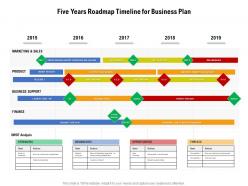
The success rate of business plans is hugely dependent on the plan of action, and this editable Five Years Roadmap Timeline For Business Plan rightly serves the purpose. Encapsulate all the information related to the project in a well structured manner to obtain maximum efficiency by incorporating our stunning PowerPoint theme. State the critical deliverable, steps involved, time frame, workforce allocation, and lots more in an easy to understand manner by utilizing this pre designed roadmap PowerPoint layout. You can also prioritize your tasks and discuss the problem areas with your colleagues by incorporating this tailor made PPT layout. Empower your work plan by employing this professionally designed PPT theme. Entrepreneurs can download Five Years Roadmap Timeline For Business Plan as a beneficial communication tool that facilitates in collaborating with different tasks and achieve targets.
People who downloaded this PowerPoint presentation also viewed the following :
Five years roadmap timeline for business plan with all 2 slides:
Use our Five Years Roadmap Timeline For Business Plan to effectively help you save your valuable time. They are readymade to fit into any presentation structure.
FAQs for Five years roadmap timeline
Okay so first thing - start with market research, that's gonna take you like 2-4 weeks. Everything else builds off that anyway. Then budget another 2-3 weeks for all the financial stuff and projections (ugh, the boring part). After that you can actually write the sections - executive summary, operations, marketing strategy, all that. But here's what people don't tell you: you absolutely need review time. Get other people to read it because you'll be way too close to catch mistakes. I'd also factor in time to hunt down supporting documents and get feedback from anyone who knows business better than you do. Realistically? 6-12 weeks total if you want it done properly. Sounds like forever but it's worth doing right.
Look, investors hate when it seems like you're just making stuff up as you go. A solid timeline with actual dates shows you've done your homework and know what you're talking about. Most people suck at this part honestly, so you'll already be ahead of like 90% of other pitches they see. They want to track when they might see returns - that's the whole point for them. Short sentences work. Longer ones that flow naturally show you understand your market timing. Don't forget to mark when you'll need more funding rounds or you'll catch them off guard later.
For your startup timeline, map out product dev phases, funding rounds, and when you'll land your first customers. Don't forget break-even projections and hiring goals. Regulatory stuff matters too if it applies to you. Honestly, everyone screws up timing - we all think things'll happen way faster than they actually do. Track both the money side (revenue, cash flow) and operations (team growth, launches). Oh, and make it visual somehow. Investors eat that up - they want clear markers to follow your progress.
Look, startups are basically flying blind at first - you'll burn 3-6 months just figuring out if anyone actually wants what you're building. That validation phase? It's brutal and feels like forever. Established businesses have it way easier since they've got real data and customers already. They can wrap up planning in like 4-8 weeks because they're not starting from zero. I learned this the hard way honestly - you gotta be realistic about where you actually are in the process, not where you think you should be. Don't rush the messy early stuff.
For mapping out your business plan timeline, I'd go with project management tools like Asana or Trello first. They're solid for breaking tasks into deadlines. Gantt charts work too if you're visual - GanttProject's free, or just use Excel honestly. My friend swears by Google Sheets though, which sounds boring but it actually gets the job done. Sometimes simple beats fancy features you'll never touch. Pick whatever doesn't make you want to procrastinate using it. That's half the battle right there.
Okay so first thing - work backwards from your big deadlines and add buffer time everywhere. I'm talking like 20-30% extra because I swear, projects always hit some random snag you didn't see coming. Break everything down into smaller tasks that you can actually measure, then be brutally honest about how long stuff will take. Don't use your team's best-case scenario productivity - use their real-world speed. Oh and check dependencies between tasks! That's where things usually get messy. Look at similar projects you've done before for a reality check on timing.
Honestly, the worst thing you can do is be super optimistic about timing - like, I've literally never seen a project finish early. Always pad your schedule for the random stuff that comes up. Permits take forever, good people are hard to find, and if you're doing anything construction-related, weather will screw you over at least once. Your milestones need to be specific too, not just "phase one complete" or whatever. Make sure they actually match what you can afford and pull off. Having a backup plan isn't being negative, it's just smart.
Look, I'd say monthly if you can manage it, but quarterly at bare minimum. Business moves way too fast these days - one week your supplier's great, next week they've ghosted you completely. Monthly check-ins help you catch stuff before it snowballs. Set a calendar reminder and actually stick to it (I'm terrible at this myself). Don't just skim through either. Compare where you actually are vs where you thought you'd be. Then tweak your next few milestones based on reality, not whatever overly optimistic timeline you wrote six months ago.
Look, market research is gonna completely change how long your business plan takes. You think you know your target market? Research might show it's way smaller than expected. Then you're back to square one, redoing your whole strategy and numbers. Plus you'll probably find competitors you never knew existed - happens every time, I swear. Customer problems you thought were obvious? Totally different in reality. It's honestly annoying but way better than launching blind. Just plan for your research to mess up your timeline because it definitely will.
Think of your business plan timeline as a roadmap that breaks big goals into bite-sized tasks with real deadlines. You'll see exactly what needs doing when, and who's handling what. Honestly, it's a lifesaver for spotting problems before they hit you. Start with your major milestones, then work backwards - fills in all the smaller stuff naturally. The best part? Everyone stays on the same page, and you can track if you're actually hitting your targets. No more wondering if that marketing campaign should've launched before the product release (learned that one the hard way). It keeps people accountable too.
Okay so short-term is like 3-6 months out - your MVP launch, first hires, hitting those initial revenue numbers. Long-term? That's the 2-5 year stuff. Market expansion, big product lines, valuation milestones. I think of it as short-term keeps you alive, long-term gets you noticed (well, hopefully anyway). The trick is making sure your short-term moves actually connect to the bigger picture. Can't just be checking boxes on random urgent stuff that feels important but doesn't really move the needle, you know?
Oh man, external stuff will mess with your timeline for sure. Economic crashes can kill your funding. Supply chain problems? Your product launch gets pushed back months. Then there's regulatory changes that basically make you restart certain parts - I've watched teams just sit around waiting for markets to chill out, which honestly sucks but happens. You gotta build in buffer time from day one though. Figure out what risks could really hurt your industry specifically. Keep a backup plan ready and check your timeline every few months against what's actually happening in the market.
Dude, you absolutely need backup plans because stuff will go wrong - it's just reality. I learned this the hard way on my last project actually. Map out your biggest risks first, then figure out what you'll do when they hit. Short deadlines? Have a bare-bones version ready. Key person gets sick? Know who can step in. It's like having escape routes planned before you need them. Honestly, it makes you look super professional too since most people just wing it and panic later. Don't be that person scrambling at 2am trying to fix everything.
Look, nobody wants to read through paragraphs of dense text when they're trying to figure out your business plan. Visual timelines are honestly a game-changer here. Your investors can immediately see how everything connects – the milestones, deadlines, what depends on what. Gantt charts work well, but even a super basic timeline beats walls of text any day. I'd start with one solid visual first, then write your sections around that. Trust me, your team will actually understand the roadmap instead of getting lost in the details. Makes everyone's life easier.
Honestly, just be real with them about what's actually doable vs what sounds good on paper. Nobody wants false hope. Visual stuff helps a ton - throw together a simple timeline or milestone chart because people get it way faster when they can actually see the plan. Monthly check-ins work pretty well for keeping everyone in the loop. Oh, and break everything into chunks with clear wins at each stage so they know what they're looking for. This might sound obvious, but don't wait for your next meeting to share bad news - shoot them a quick update right when delays pop up. Trust me, surprises kill credibility faster than anything.
-
Editable templates with innovative design and color combination.
-
Design layout is very impressive.
-
Best way of representation of the topic.
-
Innovative and Colorful designs.