


Solid foundation for five year business plan roadmap




Try Before you Buy Download Free Sample Product
 Impress Your
 Audience
 100%
100% Editable
 Save Hours
 of Time


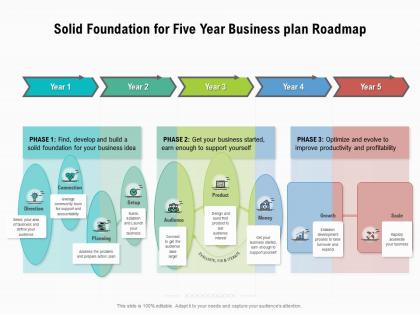
Visualize your work plan and communicate your ideas impactfully with our pre designed Solid Foundation For Five Year Business Plan Roadmap. Showcase the detailed overview of the project, the key deliverables, and the milestones to be achieved with the help of our fully customizable PowerPoint layout. You can easily emphasize on the project goals and discuss all the activities involved in an easy to comprehend manner by utilizing our professionally designed PPT theme. This roadmap PowerPoint layout is a perfect strategic planning tool that can help in keeping the project on track. With our attractive PowerPoint theme, you can articulate the workflow, track the work progress, and have a clear vision of the goal to be achieved. Download this versatile Solid Foundation For Five Year Business Plan Roadmap and save your hours of work.
People who downloaded this PowerPoint presentation also viewed the following :
Solid foundation for five year business plan roadmap with all 2 slides:
Use our Solid Foundation For Five Year Business Plan Roadmap to effectively help you save your valuable time. They are readymade to fit into any presentation structure.

FAQs for Solid foundation for five year
Key components of an effective business roadmap include strategic objectives, measurable milestones, resource allocation timelines, risk assessment frameworks, and performance metrics. These elements work together by aligning team priorities, streamlining decision-making processes, and enabling systematic progress tracking, with many organizations finding that comprehensive roadmaps deliver enhanced operational efficiency and sustainable competitive advantage.
A business roadmap facilitates strategic planning by providing visual clarity of objectives, timelines, resource requirements, and key milestones, while ensuring all stakeholders understand priorities and dependencies. Through structured frameworks, organizations streamline decision-making processes, enhance cross-departmental coordination, and maintain focus on strategic initiatives, with many companies finding that roadmaps significantly improve goal achievement rates and operational alignment.
Effective business roadmap visualization techniques include timeline charts, Gantt charts, swimlane diagrams, milestone maps, and strategic themed roadmaps with color coding. These approaches enhance stakeholder communication by presenting complex strategic initiatives through clear visual hierarchies, progress indicators, and dependency mapping, while many organizations find that interactive digital formats enable real-time updates and improved cross-functional alignment.
Determining timeframes and milestones involves analyzing market conditions, resource availability, competitive pressures, and strategic priorities to establish realistic yet ambitious targets. Through comprehensive assessment of team capabilities, budget constraints, and dependencies, organizations create phased approaches with quarterly reviews and measurable outcomes, ultimately delivering sustainable growth and competitive advantage.
Stakeholder input provides critical market insights, resource constraints, customer needs, and strategic priorities that shape realistic roadmap objectives and timelines. Through collaborative workshops and feedback sessions, organizations align diverse perspectives from sales, operations, finance, and customers, ultimately delivering roadmaps with broader buy-in and higher execution success rates.
Business roadmaps for startups emphasize agility, rapid pivoting, and minimal viable products, while established companies focus on stakeholder alignment, resource optimization, and strategic integration with existing systems. Startups benefit from shorter planning cycles and flexible milestones, whereas established organizations require comprehensive change management, regulatory considerations, and cross-departmental coordination, ultimately delivering scalable growth strategies tailored to organizational maturity.
Common pitfalls include setting unrealistic timelines, lacking stakeholder input, ignoring market changes, insufficient resource planning, and vague milestone definitions. These challenges can derail strategic initiatives by creating misaligned expectations, missed deadlines, and budget overruns, with many organizations finding that regular review cycles and cross-functional collaboration ultimately deliver more adaptable, achievable roadmaps.
Technology and software enhance business roadmap creation through collaborative planning platforms, real-time data integration, automated progress tracking, and visual mapping tools. These solutions streamline strategic alignment by enabling cross-functional teams to simultaneously update milestones, track KPIs, and adjust timelines, with many organizations finding that digital roadmapping reduces planning cycles while improving stakeholder visibility and accountability.
Key metrics include revenue growth, market share expansion, customer acquisition costs, operational efficiency ratios, and milestone completion rates. These indicators help organizations assess strategic progress by measuring financial performance, competitive positioning, and execution effectiveness, with many companies finding that balanced scorecards combining leading and lagging indicators deliver the most comprehensive roadmap evaluation insights.
Business roadmaps should be reviewed quarterly and updated as needed, with major revisions typically occurring annually or when significant market changes emerge. Many organizations find that regular quarterly assessments enable them to adapt to evolving priorities, market conditions, and strategic shifts, while maintaining long-term vision alignment and competitive responsiveness.
A business roadmap supports cross-departmental collaboration by establishing shared objectives, clarifying interdependencies between teams, aligning resource allocation timelines, and creating transparent communication channels across all functions. Through centralized strategic visibility, organizations streamline coordination between marketing, operations, finance, and development teams, while reducing silos and miscommunication, ultimately delivering faster project execution and enhanced organizational efficiency.
Ensuring roadmap flexibility requires regular market assessments, agile planning frameworks, stakeholder feedback loops, and built-in pivot points for strategic adjustments. Through quarterly reviews and scenario planning, organizations can adapt their roadmaps while maintaining core objectives, with many companies finding that flexible roadmaps enable faster responses to market shifts, ultimately delivering competitive advantage and sustained growth in increasingly dynamic business environments.
Strategic roadmaps focus on long-term vision, major goals, and high-level direction over 2-5 years, while tactical roadmaps detail specific actions, timelines, and resources for shorter-term execution. Strategic roadmaps guide organizations through market positioning and competitive advantage, whereas tactical roadmaps streamline day-to-day operations, project management, and resource allocation, ultimately delivering coordinated business outcomes.
Visual templates enhance business roadmap communication by providing structured frameworks, clear timelines, stakeholder alignment tools, and progress tracking mechanisms that transform complex strategic information into digestible formats. These templates enable organizations to present milestones, dependencies, and resource allocation more effectively, with many executives finding that visual roadmaps facilitate faster decision-making and stronger team buy-in across departments.
Successful business roadmaps include Tesla's electric vehicle ecosystem expansion, Amazon's cloud services evolution through AWS, Apple's integrated hardware-software strategy, Microsoft's cloud-first transformation, and Netflix's streaming platform pivot. These strategic roadmaps demonstrate how organizations achieve market leadership by aligning innovation with customer needs, ultimately delivering sustained competitive advantage and revenue growth across multiple sectors.
No Reviews