


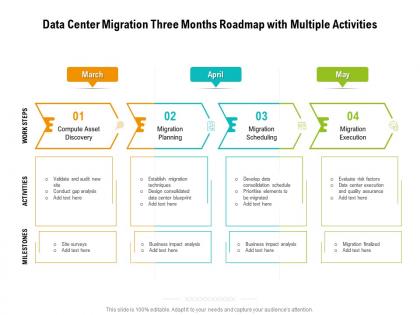
Data center migration three months roadmap with multiple activities




Try Before you Buy Download Free Sample Product
 Impress Your
 Audience
 100%
100% Editable
 Save Hours
 of Time


The success rate of business plans is hugely dependent on the plan of action, and this editable Data Center Migration Three Months Roadmap With Multiple Activities rightly serves the purpose. Encapsulate all the information related to the project in a well structured manner to obtain maximum efficiency by incorporating our stunning PowerPoint theme. State the critical deliverable, steps involved, time frame, workforce allocation, and lots more in an easy to understand manner by utilizing this pre designed roadmap PowerPoint layout. You can also prioritize your tasks and discuss the problem areas with your colleagues by incorporating this tailor made PPT layout. Empower your work plan by employing this professionally designed PPT theme. Entrepreneurs can download Data Center Migration Three Months Roadmap With Multiple Activities as a beneficial communication tool that facilitates in collaborating with different tasks and achieve targets.
People who downloaded this PowerPoint presentation also viewed the following :
Data center migration three months roadmap with multiple activities with all 2 slides:
Use our Data Center Migration Three Months Roadmap With Multiple Activities to effectively help you save your valuable time. They are readymade to fit into any presentation structure.

FAQs for Data center migration three months roadmap
Key factors include capacity assessment, application dependencies, security protocols, downtime minimization strategies, and regulatory compliance requirements. These considerations streamline migration by ensuring adequate infrastructure scaling, maintaining data integrity, and preserving operational continuity, with many organizations finding that comprehensive planning ultimately delivers reduced costs and enhanced performance capabilities.
Assessing migration readiness involves evaluating server capacity, network bandwidth, storage systems, application dependencies, and security configurations through comprehensive audits and performance monitoring. Organizations typically conduct infrastructure assessments, dependency mapping, and compatibility testing, with many finding that early identification of bottlenecks and legacy system constraints enables smoother transitions and reduces migration risks significantly.
Data integrity strategies include real-time data synchronization, comprehensive backup protocols, checksums validation, rollback mechanisms, and phased migration approaches. These methods enhance security by minimizing data loss risks, ensuring consistent database states, and enabling rapid recovery options, with many financial institutions and healthcare organizations finding that automated validation tools ultimately deliver seamless transitions while maintaining regulatory compliance.
Determining the right timing for data center migration involves evaluating current infrastructure capacity, budget cycles, business growth projections, and regulatory requirements. Organizations typically find optimal windows during low-traffic periods or fiscal year transitions, with many enterprises successfully aligning migrations with hardware refresh cycles, ultimately minimizing disruption while maximizing operational efficiency.
Cloud integration serves as the backbone of modern migration strategies, enabling hybrid deployments, seamless data transfers, automated scaling, and cost optimization throughout the transition process. Through strategic cloud partnerships, organizations streamline workload distribution, minimize downtime, and enhance operational flexibility, with many financial services and healthcare institutions finding that phased cloud integration delivers faster recovery times and significantly reduced infrastructure costs.
Data center migration tools include cloud migration platforms, virtualization technologies, network assessment software, data replication systems, and automated provisioning tools. These technologies streamline migration by minimizing downtime, ensuring data integrity, and automating complex processes, with many organizations finding that strategic combinations of these tools deliver faster transitions and reduced operational risks.
Effective stakeholder communication during data center migration requires establishing clear communication channels, regular progress updates, defined escalation procedures, and role-specific reporting frameworks. Through structured weekly briefings, real-time dashboards, and dedicated project portals, organizations streamline information flow across technical teams, business units, and executive leadership, while proactive risk communication and milestone celebrations maintain alignment and confidence throughout the transition process.
Data center migration risks include data loss, extended downtime, security vulnerabilities, application compatibility issues, and budget overruns. These challenges can be mitigated through comprehensive backup strategies, phased migration approaches, and rigorous testing protocols, with many organizations finding that detailed planning, stakeholder communication, and experienced migration teams ultimately deliver seamless transitions while minimizing operational disruption.
Benchmarking performance involves establishing baseline metrics for network latency, application response times, throughput capacity, system availability, and resource utilization before migration begins. Post-migration testing should measure these same parameters using identical workloads and conditions, with many organizations finding that comprehensive monitoring tools enable accurate comparisons, ultimately delivering validated performance improvements and identifying optimization opportunities.
IT teams should follow comprehensive planning, thorough data assessment, robust backup strategies, phased migration approaches, and rigorous testing protocols throughout the process. These practices enable organizations to minimize downtime, ensure data integrity, and reduce operational risks, with many financial institutions and healthcare providers finding that structured methodologies ultimately deliver seamless transitions and enhanced system performance.
Compliance regulations significantly shape data center migration planning by dictating data handling procedures, geographic restrictions, cross-border transfer requirements, and mandatory security protocols. Industries like healthcare, financial services, and government must navigate GDPR, HIPAA, and sector-specific mandates while ensuring continuous compliance throughout migration phases, ultimately requiring strategic timing and specialized expertise to avoid regulatory violations.
Disaster recovery steps include comprehensive data backups, redundant system configurations, failover testing protocols, recovery time objective definitions, and rollback procedures. These safeguards enable organizations to maintain business continuity during migration phases, with many financial institutions and healthcare providers finding that staged recovery testing significantly reduces downtime risks while ensuring seamless service restoration.
A phased migration approach benefits large organizations by minimizing operational disruption, reducing financial risk, and enabling continuous testing and optimization throughout the process. This strategic method allows enterprises to maintain critical services while gradually transitioning systems, with many financial institutions and healthcare organizations finding that phased approaches deliver smoother implementations, better resource allocation, and significantly lower downtime costs.
Data center migration financial implications include infrastructure costs, downtime expenses, staff training investments, licensing fees, and ongoing operational changes. These investments present both challenges and opportunities, with many organizations finding that strategic planning enables cost reduction through improved efficiency, streamlined operations, and enhanced scalability, ultimately delivering competitive advantage in an increasingly digital landscape.
Post-migration staff training involves comprehensive documentation, hands-on workshops, vendor-provided certifications, and phased knowledge transfer sessions. Organizations should implement mentorship programs pairing experienced technicians with newer staff, establish clear escalation procedures, and maintain detailed troubleshooting guides, with many data centers finding that ongoing training schedules significantly reduce operational errors and improve system efficiency.
-
Perfect template with attractive color combination.
-
Very unique, user-friendly presentation interface.
-
Excellent Designs.