

Decision point example




Try Before you Buy Download Free Sample Product
 Impress Your
 Audience
 100%
100% Editable
 Save Hours
 of Time


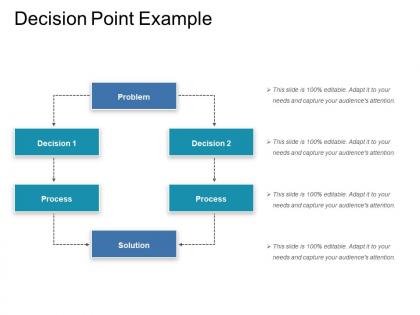
Decision Point Example PPT template- your go-to flow chart for explaining strategy. The decision flow chart included within this PowerPoint slide allows for multiple plans of action to be discussed simultaneously. You can easily describe your plan A as well as Plan B to your teammates and convince them of your decision. Elucidate the central issue at the top text box in this PPT layout. You can propose the changes in decision 1 and decision 2 sections and explain how each path leads to solving the problem in the next level. The final stage can be used to resolve the issue in this flowchart. This professionally-designed PPT theme is very versatile in its applications as you can use it on multiple fronts with minimal editing. All aspects of this aesthetically developed PowerPoint presentations focus on providing a clear-cut picture for problem-resolution. Earn the confidence of your clients with this troubleshooting flow diagram PPT slide. Your hard work will be ideally presented with our decision-point example PowerPoint template.
People who downloaded this PowerPoint presentation also viewed the following :
Decision point example with all 5 slides:
Bypass hazards with our Decision Point Example. You will find a better alternative.
FAQs for
So you'll want solid data first - garbage in, garbage out, right? Know your timeline and budget constraints upfront. Figure out who this actually impacts before diving in. Short-term wins can totally backfire later, so think ahead. Risk tolerance is huge too, especially if you're in some buttoned-up industry. Here's what I learned the hard way - talk to whoever's implementing this stuff. They'll catch problems you never saw coming from your fancy strategy meetings. One trick that actually works? List your key criteria before you even look at options. Keeps you from getting bulldozed by whoever talks the loudest.
Ugh, biases are the worst because they totally sabotage your leadership without you even realizing it. Like confirmation bias makes you cherry-pick info that backs up what you're already thinking. Then there's anchoring - you get weirdly attached to whatever data point hits you first. Overconfidence is probably the biggest trap though; makes you feel like some kind of genius when really you're missing huge gaps in your knowledge. Here's what actually works: surround yourself with people who aren't afraid to tell you you're wrong, and build some kind of process that forces you to hear different viewpoints before you pull the trigger on big decisions.
So basically, data analysis stops you from making decisions based on hunches and actually shows you what's going on. You know how we always think we know what customers want? Well, this lets you see the real patterns instead of just guessing. It cuts through all that bias we naturally have when making choices. Think of it like having x-ray vision for your business decisions - way better than a magic 8-ball, lol. My advice? Pick something you're trying to figure out this week and see what numbers you already have sitting around that might help. Start there.
Ugh, group dynamics mess with decisions so badly. There's groupthink where nobody wants to rock the boat, so terrible ideas sail right through. Or the opposite happens - people fight constantly and can't agree on anything. The loudest person always dominates while shy teammates (who probably have brilliant ideas) stay quiet. Social pressure's real too - I've definitely gone along with stuff I knew was wrong just to fit in. My advice? Actually push for different opinions. Make space for quiet voices. Oh, and don't let one person hijack every conversation - super annoying but happens all the time.
Honestly, drawing stuff out makes such a difference when you're stuck on big decisions. Your brain picks up on patterns way better when it's visual instead of just a mental list bouncing around your head. Even messy sketches help - I'm talking chicken scratch level, nothing Pinterest-worthy. Decision trees or basic pros/cons charts let you actually see the consequences mapped out. Plus it's way easier to explain your thinking to other people when you've got something to point at. Seriously, try sketching your next major choice instead of just overthinking it.
Honestly, a simple pros/cons list works way better than people think - just weight each thing by how much it actually matters to you. For bigger stuff, I like the 10-10-10 rule: how will you feel about this in 10 minutes vs 10 months vs 10 years? That one's saved me from some dumb impulse choices. You could also try a decision matrix where you score your options against what you care about most. The WRAP thing is solid too - widen options, reality-test your assumptions, get some distance, prepare to be wrong. Even just writing the problem down clearly helps tons. Pick whatever clicks and stick with it though.
Honestly, emotional intelligence is like having a superpower when everything's going crazy. You know that panicky feeling where your brain just shuts down? EI helps you catch yourself before that happens. I've found the trick is recognizing what you're actually feeling in the moment - like "okay, I'm freaking out, but what are the real facts here?" It's weird how much clearer things get when you separate your emotions from what's actually happening. Plus you get better at reading how stressed everyone else is too. The whole "take a deep breath and check in with yourself" thing actually works, but you've got to practice it when things aren't falling apart first.
Honestly, I think you need both but the order depends on what you're dealing with. Big decisions? Do your homework first - get the facts, make your lists, all that stuff. Then see how it sits with you. If something feels weird about the "right" answer, pay attention to that. But for everyday stuff, just go with your gut since it's basically your brain processing tons of past experience super fast. I used to be all about the spreadsheets and logic, but man, those decisions always seemed to miss the human stuff that actually mattered. Now I let the analysis inform my instincts, then trust that gut check.
Start with psychological safety - nobody's gonna speak up if they think they'll get demolished for it. Train people on cognitive biases too, confirmation bias is everywhere once you notice it. Mix up your meeting voices and actually reward the person who questions things, even if they're totally off base. Nothing kills innovation like everyone nodding at whoever talks loudest (ugh, we've all been there). Set clear decision frameworks so people know who decides what. Oh, and celebrate smart processes, not just lucky outcomes. That mindset shift alone changes everything.
Ugh, where do I even start? Most people get stuck overthinking the small stuff - like, you don't need three hours to pick a restaurant. Then there's confirmation bias where you only look for evidence that backs up what you already decided. Honestly, group decisions are the worst because everyone just nods along to keep peace. Also watch out for getting too hung up on whatever info you hear first. Set some basic criteria beforehand and give yourself actual deadlines. When you feel stuck, just ask yourself what you might be overlooking.
Okay so scenario planning is basically thinking through different "what if" situations ahead of time. You map out like 3-4 ways things could go - best case, worst case, couple realistic options in between. That way you're not totally caught off guard when stuff happens. Look for early warning signs that tell you which direction you're heading so you can adjust. I actually do this for most big decisions now and it really helps. Pick something you're dealing with right now and just sketch out three possible outcomes. Trust me, you'll feel way more ready for whatever comes next.
Ugh, hierarchy is such a pain for making quick decisions. Everything has to go up the chain for approval, then back down - meanwhile you're just sitting there waiting. By the time someone finally says yes, the moment's probably passed. And don't even get me started on how your idea gets twisted as it passes through different people... like that telephone game but with actual consequences. The trick is letting people make calls within their own area without needing permission for every little thing. You still need some oversight, obviously, but constant escalation kills momentum.
So AI basically flips everything - instead of going with your gut, you're working with actual data. Processing huge amounts of info happens in seconds now instead of taking forever. You'll catch patterns that would've been impossible to spot before, plus get predictions before you waste resources. It's crazy how much faster things move. But honestly? You still need to use your brain to figure out what the AI's telling you and whether it actually applies to your situation. Don't let it think for you completely - just use it to make better decisions.
First thing - figure out what success looks like before you even start. Then actually track it (I'm terrible at this part honestly). Compare your results to what you originally planned. Hit your timeline? Meet the budget? Get feedback from everyone who had to deal with your decision too. Numbers tell you one story, but people will tell you what really happened day-to-day. Write down what worked and what was a disaster. Set phone reminders for 30, 90, and 180 days out. Otherwise you'll totally forget to check back on how things turned out.
Honestly, just start asking yourself who gets hurt when you make big decisions - sounds obvious but most people skip this step completely. I'd make a quick mental checklist: what are the downsides here? Does this match what we actually stand for as a company? It feels like extra work at first, but trust me, it's way better than dealing with the fallout later. Once you get in the habit of running through these questions, it becomes automatic. You're not trying to be perfect, just more thoughtful about the ripple effects.
-
Top Quality presentations that are easily editable.
-
Professional and unique presentations.