


Decision support system analysis information gear framework




Try Before you Buy Download Free Sample Product
 Impress Your
 Audience
 100%
100% Editable
 Save Hours
 of Time


Our Decision Support System Analysis Information Gear Framework are topically designed to provide an attractive backdrop to any subject. Use them to look like a presentation pro.
People who downloaded this PowerPoint presentation also viewed the following :
Decision support system analysis information gear framework with all 9 slides:
Use our Decision Support System Analysis Information Gear Framework to effectively help you save your valuable time. They are readymade to fit into any presentation structure.


FAQs for Decision support system analysis
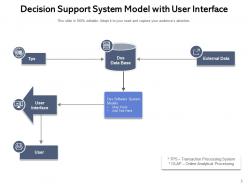
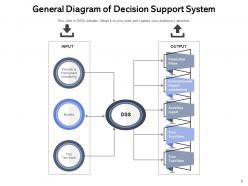
Key components of a Decision Support System include database management systems, model management systems, user interface systems, knowledge management systems, and communication networks. These integrated technologies streamline organizational decision-making by consolidating data sources, automating analytical processes, and delivering real-time insights, with many enterprises finding that strategic DSS implementation enhances operational efficiency and competitive responsiveness.
A DSS improves organizational decision-making by providing data analysis, predictive modeling, and scenario simulation capabilities that transform raw information into actionable insights. Through integrated dashboards and analytical tools, managers can evaluate multiple alternatives, assess potential risks, and optimize resource allocation more effectively, while reducing decision time and enhancing strategic outcomes across departments.
Decision Support Systems can integrate transactional databases, external market data, social media feeds, IoT sensors, and cloud-based analytics platforms. These diverse sources streamline decision-making by combining internal operational metrics with real-time external insights, enabling organizations in healthcare, finance, and retail to enhance forecasting accuracy and ultimately deliver faster, more informed strategic responses.
DSS differs from traditional management information systems through interactive analysis capabilities, what-if scenario modeling, semi-structured problem solving, and real-time decision support rather than just reporting. While conventional systems deliver historical data and standard reports, DSS enables dynamic exploration of alternatives, supports unstructured decisions, and provides analytical tools, ultimately delivering strategic flexibility and faster decision-making for complex business challenges.
Machine learning algorithms enhance Decision Support Systems by automating pattern recognition, improving predictive accuracy, and enabling real-time data analysis from multiple sources. These algorithms streamline decision-making processes through advanced analytics, personalized recommendations, and continuous learning capabilities, with many organizations finding that ML-powered systems deliver faster insights, reduce human error, and ultimately provide significant competitive advantages in complex business environments.
User interface design significantly impacts DSS effectiveness by determining accessibility, usability, and decision-maker adoption rates across organizations. Well-designed interfaces streamline data interpretation, minimize training requirements, and enhance real-time decision-making capabilities, with many financial institutions and healthcare systems finding that intuitive dashboards ultimately deliver faster analysis, reduced errors, and improved strategic outcomes.
DSS applications in healthcare include clinical decision support for diagnosis, treatment planning algorithms, patient risk stratification, medication management systems, and resource allocation optimization. Through predictive analytics and real-time data integration, hospitals streamline care pathways, reduce medical errors, and enhance treatment effectiveness, while enabling physicians to make faster, evidence-based decisions that ultimately improve patient safety and outcomes.
Successful financial Decision Support Systems include credit scoring platforms like FICO, algorithmic trading systems used by Goldman Sachs, fraud detection networks at Visa and Mastercard, and portfolio management tools at BlackRock. These systems streamline risk assessment, automate trading decisions, and enhance regulatory compliance, with many financial institutions finding that integrated DSS solutions deliver faster loan approvals and significantly improved customer experiences.
A DSS manages uncertainty and risk through scenario modeling, sensitivity analysis, Monte Carlo simulations, and probabilistic forecasting techniques. These systems enable organizations to evaluate multiple outcomes, quantify potential risks, and assess decision impacts across various conditions, with financial institutions and healthcare providers finding that structured risk assessment ultimately delivers more informed strategic choices and competitive advantage.
Decision Support System performance metrics include response time, data accuracy, user adoption rates, decision quality improvement, and system reliability scores. These metrics enable organizations to assess operational efficiency, measure cost reductions from faster decision-making, and evaluate user satisfaction across departments like finance, healthcare, and manufacturing, ultimately delivering enhanced strategic outcomes and competitive advantage.
Cloud computing enhances DSS accessibility through remote access capabilities, real-time data synchronization, multi-device compatibility, and reduced infrastructure requirements, while delivering scalability through elastic resource allocation and automated scaling features. These cloud-based solutions enable organizations to streamline decision-making processes across distributed teams, minimize operational costs, and adapt system capacity to fluctuating demands, ultimately delivering competitive advantage in increasingly dynamic business environments.
A Decision Support System facilitates strategic planning by analyzing complex data sets, modeling various scenarios, and providing predictive insights that guide long-term business decisions. Through advanced analytics and simulation capabilities, organizations can evaluate market opportunities, assess resource allocation strategies, and anticipate competitive responses, ultimately enabling data-driven strategic choices that enhance competitive positioning.
Best practices for implementing a DSS include thorough needs assessment, stakeholder engagement, data quality validation, phased rollout strategies, and comprehensive user training. These approaches streamline adoption by ensuring system alignment with organizational goals, minimizing resistance through early involvement, and delivering measurable improvements in decision speed and accuracy, with many organizations finding that gradual implementation ultimately enhances operational efficiency.
A DSS supports collaborative decision-making by providing shared access to real-time data, centralized analytical tools, and interactive dashboards that enable multiple stakeholders to contribute insights simultaneously. Through integrated communication features and scenario modeling capabilities, teams across departments can evaluate options together, compare different perspectives, and reach consensus more efficiently, ultimately accelerating strategic decisions while ensuring all relevant expertise is incorporated.
Ethical considerations include data privacy protection, algorithmic transparency, bias prevention, user consent protocols, and accountability frameworks. These safeguards enhance decision-making by ensuring fair outcomes, maintaining stakeholder trust, and enabling regulatory compliance, with many organizations finding that transparent, ethical DSS implementations ultimately deliver better stakeholder relationships and sustainable competitive advantage.
-
Much better than the original! Thanks for the quick turnaround.
-
Excellent Designs.
-
Great product with effective design. Helped a lot in our corporate presentations. Easy to edit and stunning visuals.
-
Designs have enough space to add content.