

Decoding Digital Reality Of Physical World With Megaverse AI CD V




Try Before you Buy Download Free Sample Product
 Impress Your
 Audience
 100%
100% Editable
 Save Hours
 of Time


Explore our expertly crafted Decoding digital reality of a physical world with Megaverse PowerPoint Presentation, which unveils the captivating realm of Augmented Reality AR, Cryptocurrency, Virtual Reality VR, Non-Fungible Tokens NFTs, Digital Land, Blockchain, and more. This Cryptocurrency PPT delves into the distinction between the Metaverse and the Internet Web 3.0, delves into the Metaverses architectural intricacies, and unveils the vital steps to enter this digital wonderland. Moreover, Non-Fungible Tokens NFTs presentations uncover many business prospects entwined with the Metaverses evolution, poised to revolutionize work, lifestyle, and entertainment dynamics. Lastly, our Virtual Reality segment transports you to a realm where the Metaverse shapes new landscapes for societal impact while we ponder its future implications. Download this customizable presentation today, and embark on a journey into the boundless frontiers of the Megaverse. Get access now.
People who downloaded this PowerPoint presentation also viewed the following :
Content of this Powerpoint Presentation
Slide 1: This slide introduces Decoding digital reality of physical world with Megaverse.
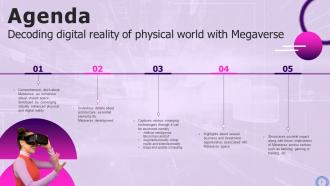
Slide 2: This is an Agenda slide. State your agendas here.
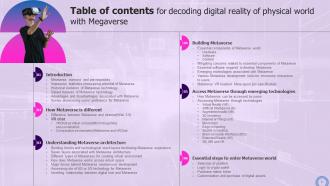
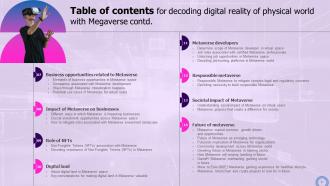
Slide 3: This slide shows Table of Content for the presentation.
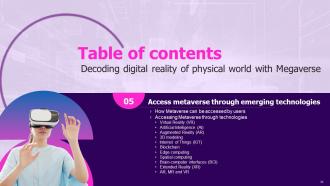
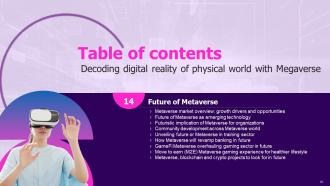
Slide 4: This slide also shows Table of Content for the presentation.
Slide 5: This slide shows title for topics that are to be covered next in the template.
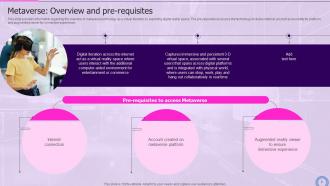
Slide 6: This slide provides information regarding the overview of metaverse technology.
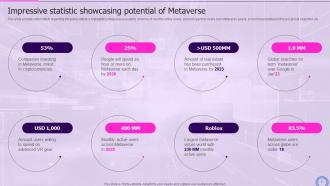
Slide 7: This slide displays information regarding intriguing statistics highlighting Metaverse popularity.
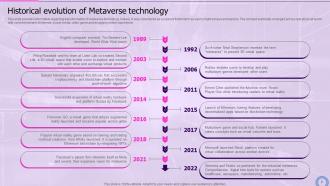
Slide 8: This slide presents information regarding transformation of metaverse technology.
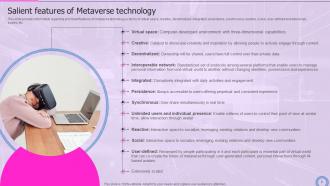
Slide 9: This slide provides information regarding prominent features of metaverse technology.
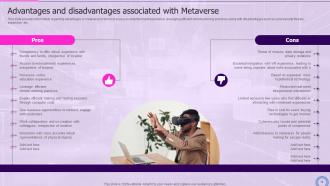
Slide 10: This slide displays information regarding advantages or metaverse.
Slide 11: This slide provides information regarding survey highlighting users’ preference for metaverse.
Slide 12: This slide shows title for topics that are to be covered next in the template.
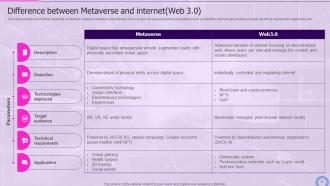
Slide 13: This slide provides information regarding comparison between metaverse and internet (Web 3.0) and are assessed on the parameters.
Slide 14: This slide presents information regarding VRChat as emerging virtual social platform used for gaming and socialization.
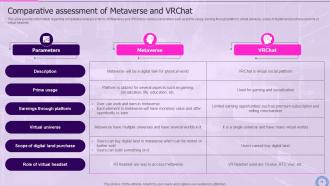
Slide 15: This slide provides information regarding comparative analysis in terms of Metaverse and VRChat on various parameters.
Slide 16: This slide shows title for topics that are to be covered next in the template.
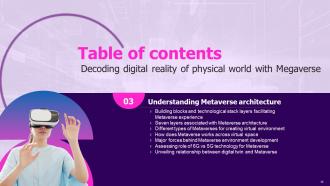
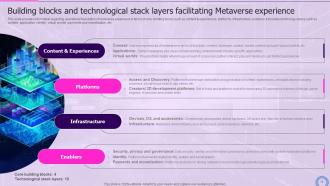
Slide 17: This slide displays information regarding operational foundation of metaverse experience in terms of core building blocks.
Slide 18: This slide provides information regarding the critical layers associated with metaverse architecture.
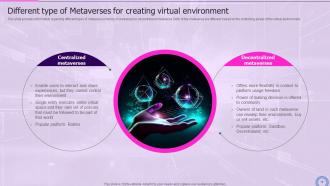
Slide 19: This slide presents information regarding different types of metaverse in terms of centralized or decentralized metaverse.
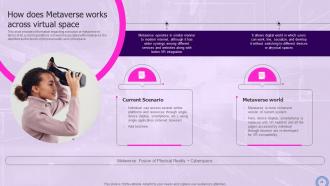
Slide 20: This slide displays information regarding execution of metaverse in terms of its current operations and world associated with metaverse.
Slide 21: This slide provides information regarding building forces associated with metaverse.
Slide 22: This slide presents information regarding assessment of 6G and 5G technology for metaverse.
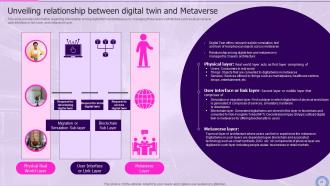
Slide 23: This slide displays information regarding interrelation among digital twin and Metaverse by managing three layers architecture.
Slide 24: This slide shows title for topics that are to be covered next in the template.
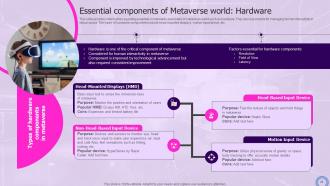
Slide 25: This slide provides information regarding essential components associated of metaverse world such as hardware.
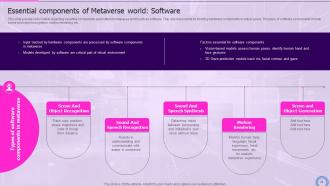
Slide 26: This slide displays information regarding essential components associated of metaverse world such as software.
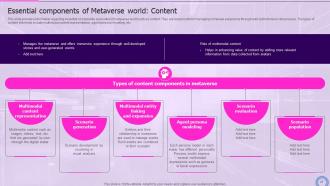
Slide 27: This slide provides information regarding essential components associated of metaverse world such as content.
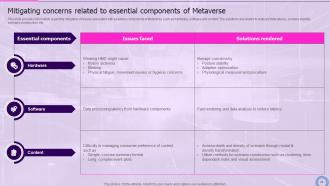
Slide 28: This slide presents information regarding mitigation of issues associated with essential components of Metaverse.
Slide 29: This slide provides information regarding crucial software required for developing metaverse.
Slide 30: This slide displays information regarding emerging technologies related to Metaverse.
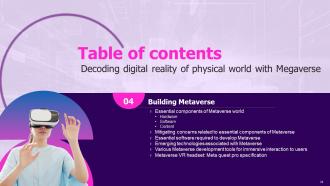
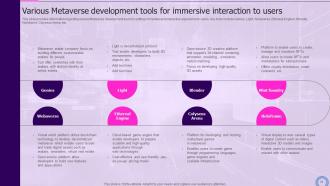
Slide 31: This slide provides information regarding several Metaverse development tools for setting immersive and interactive experience to users.
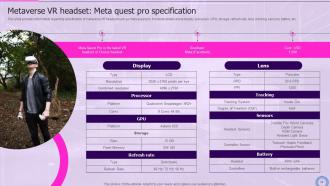
Slide 32: This slide displays information regarding specification of metaverse VR headset such as meta quest pro.
Slide 33: This slide shows title for topics that are to be covered next in the template.
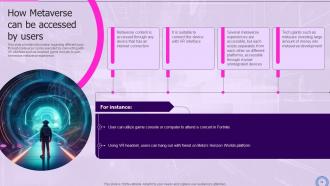
Slide 34: This slide provides information regarding different ways through metaverse can be executed by connecting with VR interface.
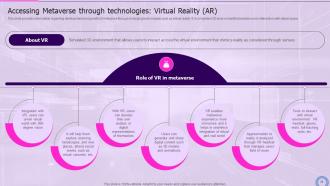
Slide 35: This slide displays information regarding development and growth of metaverse through emerging technologies such as virtual reality.
Slide 36: This slide provides information regarding development and growth of metaverse through emerging technologies such as artificial intelligence.
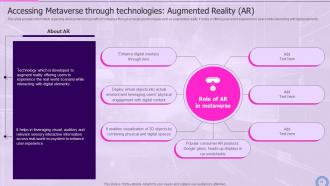
Slide 37: This slide presents information regarding development and growth of metaverse through emerging technologies such as augmented reality.
Slide 38: This slide displays information regarding development and growth of metaverse through emerging technologies such as 3D modeling.
Slide 39: This slide provides information regarding development and growth of metaverse through emerging technologies such as internet of things (IoT).
Slide 40: This slide displays information regarding development and growth of metaverse through emerging technologies such as blockchain.
Slide 41: This slide provides information regarding development and growth of metaverse through emerging technologies such as edge computing.
Slide 42: This slide displays information regarding development and growth of metaverse through emerging technologies such as spatial computing.
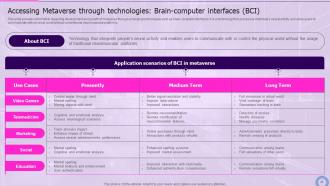
Slide 43: This slide provides information regarding development and growth of metaverse through emerging technologies such as brain-computer interfaces.
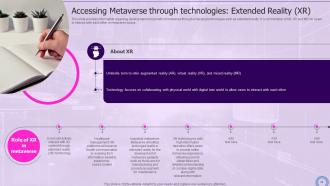
Slide 44: This slide provides information regarding development and growth of metaverse through emerging technologies such as extended reality.
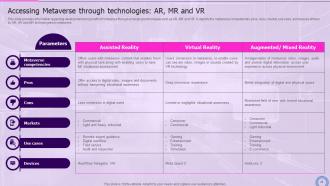
Slide 45: This slide displays information regarding development and growth of metaverse through emerging technologies such as AR, MR and VR.
Slide 46: This slide shows title for topics that are to be covered next in the template.
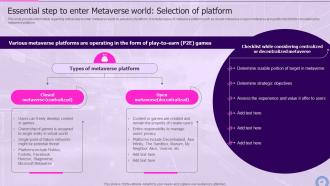
Slide 47: This slide provides information regarding critical step to enter metaverse world by selection of platform.
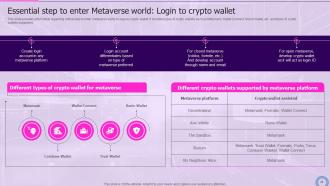
Slide 48: This slide presents information regarding critical step to enter metaverse world by login to crypto wallet.
Slide 49: This slide displays information regarding natural language processing techniques.
Slide 50: This slide also provides information regarding natural language processing techniques.
Slide 51: This slide shows title for topics that are to be covered next in the template.
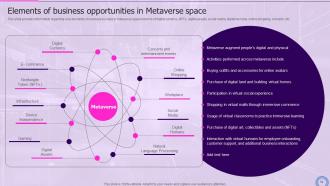
Slide 52: This slide provides information regarding core elements of business success in metaverse space.
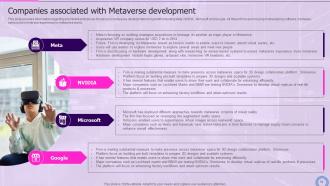
Slide 53: This slide presents information regarding prominent enterprises focusing on metaverse development and growth.
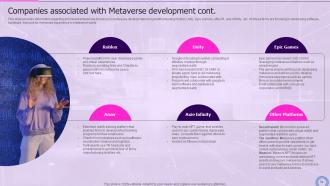
Slide 54: This slide also displays information regarding prominent enterprises focusing on metaverse development and growth.
Slide 55: This slide presents information regarding ways through which metaverse can be successfully monetized in terms of people generating profits.
Slide 56: This slide displays information regarding use cases of metaverse in different sectors.
Slide 57: This slide also provides information regarding use cases of metaverse in different sectors.
Slide 58: This slide shows title for topics that are to be covered next in the template.
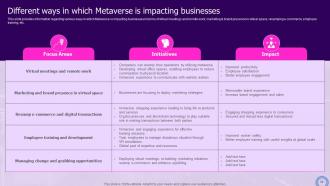
Slide 59: This slide provides information regarding various ways in which Metaverse is impacting businesses.
Slide 60: This slide displays information regarding various investment opportunities across Metaverse in terms of platforms.
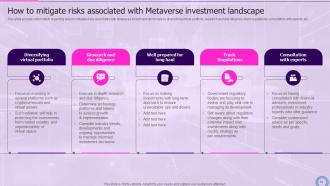
Slide 61: This slide provides information regarding ways to mitigate risks associated with Metaverse investment landscape.
Slide 62: This slide shows title for topics that are to be covered next in the template.
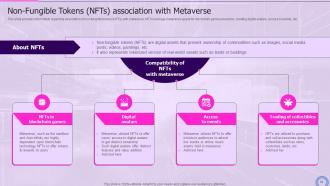
Slide 63: This slide provides information regarding association of non-fungible tokens (NFTs) with metaverse.
Slide 64: This slide also provides information regarding importance of non-fungible tokens (NFTs) in metaverse.
Slide 65: This slide also displays information regarding importance of non-fungible tokens (NFTs) in metaverse.
Slide 66: This slide shows title for topics that are to be covered next in the template.
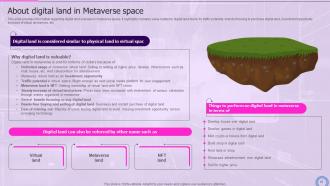
Slide 67: This slide provides information regarding digital land overview in metaverse space.
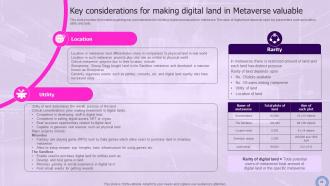
Slide 68: This slide presents information regarding key considerations for building digital land valuable in metaverse.
Slide 69: This slide shows title for topics that are to be covered next in the template.
Slide 70: This slide provides information regarding role of Metaverse developer in virtual space in building 3D assets.
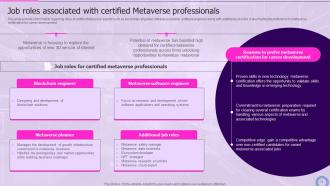
Slide 71: This slide displays information regarding roles of certified Metaverse experts.
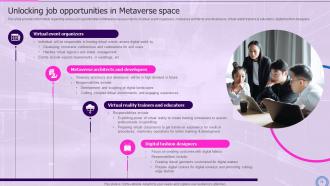
Slide 72: This slide provides information regarding various job opportunities in Metaverse space.
Slide 73: This slide displays information regarding various job-hunting platforms in Metaverse world.
Slide 74: This slide shows title for topics that are to be covered next in the template.
Slide 75: This slide provides information regarding role of metaverse in mitigating complex legal and regulatory issues.
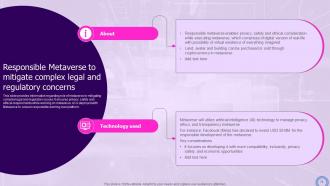
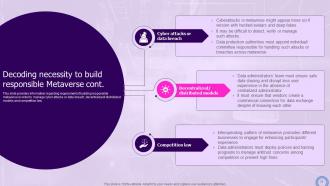
Slide 76: This slide displays information regarding requirement of building responsible metaverse in order to improve data protection.
Slide 77: This slide provides information regarding requirement of building responsible metaverse in order to manage cyber attacks.
Slide 78: This slide shows title for topics that are to be covered next in the template.
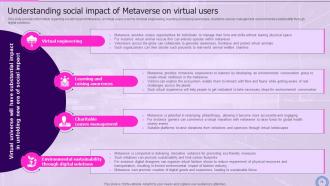
Slide 79: This slide displays information regarding social impact of Metaverse on virtual users.
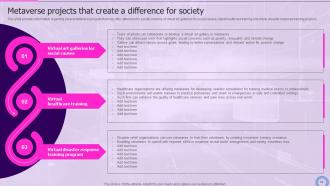
Slide 80: This slide provides information regarding several Metaverse projects that may offer difference for society.
Slide 81: This slide shows title for topics that are to be covered next in the template.
Slide 82: This slide presents information regarding metaverse market insights in terms of market size.
Slide 83: This slide displays information regarding future vision of Metaverse as emerging technology.
Slide 84: This slide provides information regarding inferences offered by metaverse in future to organizations.
Slide 85: This slide displays information regarding role of community build across Metaverse world.
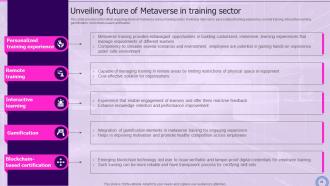
Slide 86: This slide provides information regarding future of metaverse across training sector.
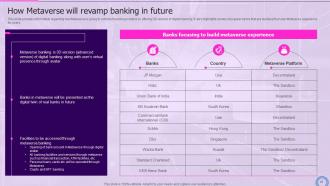
Slide 87: This slide displays information regarding how Metaverse is going to refurbish banking in future by offering 3D version of digital banking.
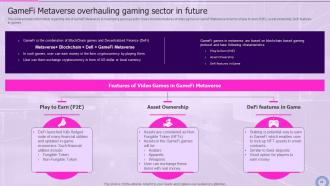
Slide 88: This slide provides information regarding role of GameFi Metaverse in revamping gaming sector.
Slide 89: This slide displays information regarding move to earn (M2E) Metaverse gaming experience for healthier lifestyle for users.
Slide 90: This slide provides information regarding metaverse based blockchain and crypto projects to emerge in future.
Slide 91: This slide shows all the icons included in the presentation.
Slide 92: This slide is titled as Additional Slides for moving forward.
Slide 93: This is About Us slide to show company specifications etc.
Slide 94: This is Our Goal slide. State your firm's goals here.
Slide 95: This slide shows SWOT analysis describing- Strength, Weakness, Opportunity, and Threat.
Slide 96: This is a Timeline slide. Show data related to time intervals here.
Slide 97: This slide provides 30 60 90 Days Plan with text boxes.
Slide 98: This slide shows Post It Notes for reminders and deadlines. Post your important notes here.
Slide 99: This slide presents Roadmap with additional textboxes.
Slide 100: This slide provides Clustered Column chart with two products comparison.
Slide 101: This is a Thank You slide with address, contact numbers and email address.
Decoding Digital Reality Of Physical World With Megaverse AI CD V with all 97 slides:
Use our Decoding Digital Reality Of Physical World With Megaverse AI CD V to effectively help you save your valuable time. They are readymade to fit into any presentation structure.

































FAQs for Decoding Digital Reality Of Physical World With Megaverse
So digital reality breaks down into a few key pieces. You've got your hardware - VR headsets, AR glasses, haptic stuff. Then there's the software that actually creates and manages those virtual spaces. The connectivity layer handles real-time interactions, which honestly can make or break everything if it's laggy. User interfaces are huge too - bad UI ruins even the coolest tech. Oh, and there's this whole data processing layer running behind the scenes doing tracking, rendering, physics simulations. It's pretty wild how much computation goes into making things feel natural. Get these basics down first, then you'll know what solutions actually work for what you need.
So AR just puts digital stuff over what you're already seeing in real life. Retail's probably the most obvious - you can try on clothes virtually or see if that couch actually fits your living room. Surgeons use it for planning operations, which is honestly pretty crazy when you think about it. Manufacturing workers get assembly instructions right in their vision, cuts down on mistakes. Education gets way cooler too - 3D models you can actually mess around with instead of boring textbook diagrams. It doesn't replace anything, just adds useful info on top. Maybe start with those silly AR filters to get the hang of it.
Honestly, VR is a game-changer for education. Your students can walk through the actual Colosseum instead of staring at textbook photos - which is pretty incredible when you think about it. Training gets way safer too since you can practice dangerous stuff like surgeries or emergency scenarios without anyone getting hurt. Visual learners especially love it, though I'd say start small first. Maybe try one VR module and see how people react? Oh, and the repetition factor is huge - students can mess up and try again without real consequences. Don't go crazy buying everything at once though.
So AI is basically what makes digital stuff feel real and respond to you naturally. Real-time rendering, NPCs that don't suck, content that adapts to how you actually behave - that's all AI doing the work behind the scenes. Your VR setup learns what you like and tweaks things automatically, which is pretty cool honestly. Performance optimization too, so you won't get those headache-inducing lag spikes. Oh and the personalization aspect is huge - way more important than people realize. If you're building something immersive, figure out where AI can make it smarter first, then worry about making it look good.
So instead of clicking around on a flat screen, you're basically moving stuff around in 3D space with your hands, voice, whatever. Way more immersive. The interface becomes part of where you are instead of just staring at a monitor - you can walk around data or grab virtual things. Honestly takes some getting used to but it's pretty cool once you do. Oh and eye tracking is becoming huge too. Think about how you'd naturally pick up or move real objects - that's basically your starting point for designing this stuff. Makes way more sense than traditional point-and-click when you think about it.
Honestly, the biggest problems are privacy invasion and how addictive this stuff gets. Companies are constantly harvesting your data while people lose touch with reality - it's wild. Plus there's this manipulation thing where they can literally mess with what you think is real vs. what's designed to influence you. Oh, and not everyone can access these technologies equally, so it widens the gap even more. You should probably check what platforms you're using daily and actually read their data policies. I bet you'd be shocked at what you've agreed to without realizing it.
Honestly, digital reality stuff is pretty cool for letting customers mess around with your products first. AR try-ons for clothes, VR house tours, 360 product spins - way better than static photos. People get emotionally invested when they can actually "experience" what you're selling instead of just guessing. Returns drop too since they know what they're getting. I'd probably start small though - maybe some basic AR filters or 3D views? You don't need to blow your whole budget right away. My cousin's furniture company started with just letting people virtually place couches in their living rooms and it worked surprisingly well.
Ugh yeah VR can mess with you if you overdo it. The eye strain is real - like staring at a screen way too close for hours. You'll probably get headaches too. Coming back to reality feels super trippy, your brain gets confused switching between worlds. Motion sickness hits some people hard, and you might feel off-balance afterward. Honestly the isolation thing bothers me most though - you're basically shutting out everyone around you. Just take breaks every 30-45 minutes or so. Don't become one of those people who disappears into VR for like 6 hours straight.
So digital twins are basically like having a virtual copy of your whole city - roads, buildings, water pipes, all that stuff. You can mess around with scenarios before doing anything in real life. Like "what if we shut down this highway?" Singapore's doing some cool experiments with crowd control and flooding. Honestly, it beats learning from expensive screwups. Traffic management might be a good starting point if you're thinking about this - way less overwhelming than trying to map everything at once. The whole point is breaking things digitally first so you don't break your budget later.
Dude, VR is seriously changing everything in gaming right now. You can literally step inside games and grab stuff with your hands - it's wild how responsive these environments are getting. AR is getting crazy sophisticated too (way beyond Pokemon Go). What blows my mind though is the social aspect - hanging out with friends in virtual spaces actually feels real now, even when they're on different continents. If you're thinking about game dev, honestly you should mess around with this tech ASAP. Flat-screen gaming isn't going anywhere but it's definitely not the only game in town anymore, you know?
Dude, start with data privacy and encryption - these apps are basically vacuum cleaners for personal info. Eye tracking, hand movements, how your room looks... it's honestly creepy how much they collect. You'll also want solid user authentication and secure APIs. Input validation is huge too since injection attacks are no joke. Oh, and don't overlook the physical stuff - people wearing headsets can't see what's happening around them, which creates weird new security issues. I'd probably start with threat modeling to figure out what you're actually dealing with first.
Look, you gotta build accessibility in from the start - can't just slap it on at the end. Think voice controls, eye tracking, gestures for people who can't use regular controllers. High contrast visuals are huge, plus audio descriptions for important stuff. Motion sickness is brutal for some folks, so definitely include comfort settings. Honestly, the testing part is where most people mess up - you need real users with different abilities giving feedback throughout development, not just once you're "done." Test early, test often. Also random tip: movement options are surprisingly important.
Honestly, AI and machine learning are total game-changers for VR/AR right now - everything feels way more responsive and actually tailored to you. 5G basically killed those motion sickness issues we used to get from lag, which is huge. The haptic stuff is getting insane too... you can literally feel textures and pushback in virtual spaces now. Brain-computer interfaces sound like sci-fi but they're actually happening (though still pretty early). What gets me excited is when companies start mixing all these techs together instead of just doing one thing really well.
Honestly, virtual interactions are way more intentional but you lose all the subtle stuff. No random coffee machine chats or picking up on someone's body language. Everything needs a deliberate click - joining voice, sending that message, starting a video call. It's kinda weird how it makes conversations more focused though? But you definitely miss those organic moments that just happen when you're actually around people. My advice - you gotta be way more proactive about reaching out since those casual "oh hey" encounters won't magically happen anymore.
It's pretty messy right now, honestly. The EU has their AI Act coming which hits some XR stuff, but over here it's all scattered - FTC's doing privacy, FDA handles medical VR devices. IEEE and those standards groups are working on specs but they're slow as hell compared to how fast everything's moving. I'd probably stay connected with industry groups if I were you. Oh and watch the privacy frameworks that are popping up - those'll probably dictate how you build this stuff down the line.
-
Easy to use and customize templates. Helped me give a last minute presentation.
-
Great designs, really helpful.