Design Of Experiments Process And Collection Of Quality Control Templates Ppt Mockup

Rating:
80%
Design Of Experiments Process And Collection Of Quality Control Templates Ppt Mockup
Slide 1 of 6
Favourites Favourites

Try Before you Buy Download Free Sample Product

Audience Impress Your
Audience
Editable 100%
Editable
Time Save Hours
of Time
The Biggest Sale is ending soon in
0
0
:
0
0
:
0
0
AI-Ready
Upload this template to AI and ask it to make any changes to content or color
100% editable Powerpoint Template for AI-assisted presentations. Finish your work in less time. ​
Works with
Microsoft PowerPoint
Microsoft 365
Claude for PowerPoint
ChatGPT
Google Slides
Microsoft Copilot
Rating:
80%
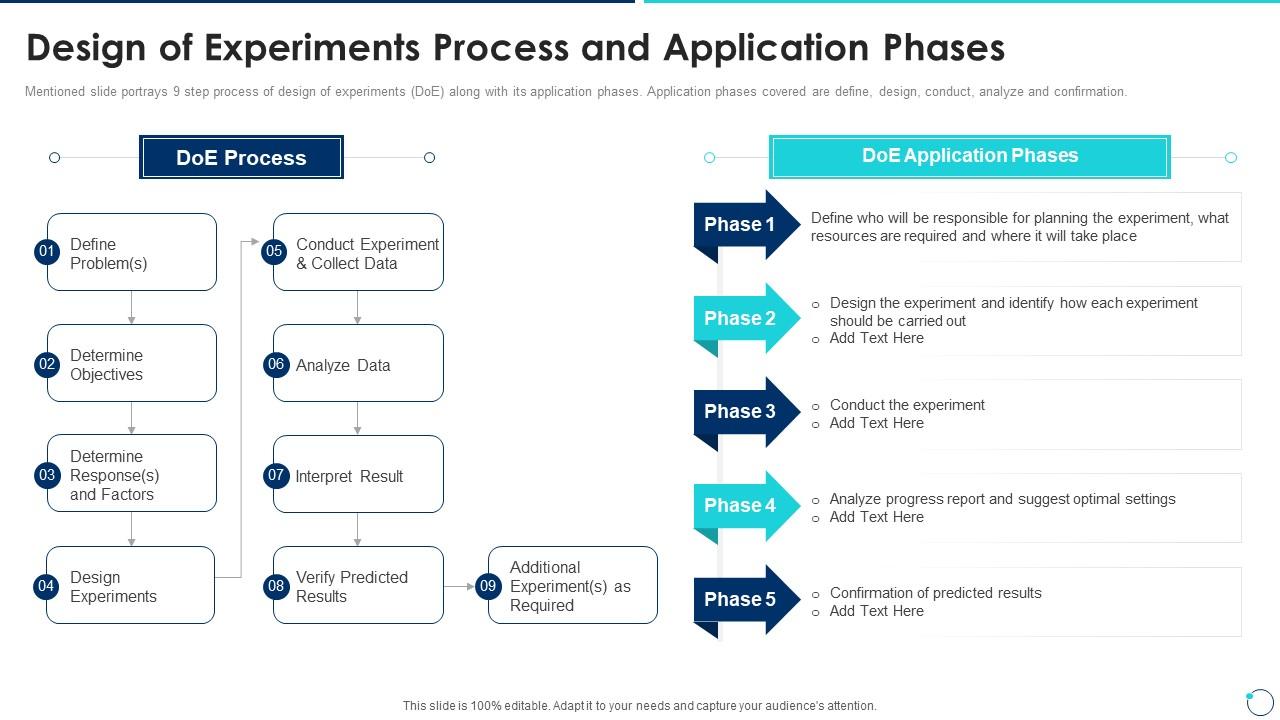
Mentioned slide portrays 9 step process of design of experiments DoE along with its application phases. Application phases covered are define, design, conduct, analyze and confirmation.Present the topic in a bit more detail with this Design Of Experiments Process And Collection Of Quality Control Templates Ppt Mockup Use it as a tool for discussion and navigation on Define Problem, Determine Objectives, Design Experiments This template is free to edit as deemed fit for your organization. Therefore download it now.

FAQs for Design Of Experiments Process And Collection Of Quality Control

Look, DOE is basically three things: control what you can, randomize what you can't, and always run multiple trials. Control means locking down variables that could mess with your results. Randomization is huge - run your experiments in random order because systematic errors are sneaky little bastards. Multiple trials matter because single tests will straight-up lie to you every time. My old professor used to say one trial is an anecdote, not data, and honestly? He was right. These three things will save you from most experimental disasters that burn through budgets. Way better than learning the hard way.

So basically DOE lets you test a bunch of process variables at the same time instead of doing it one by one forever. Way smarter than the usual trial-and-error mess everyone does. You can see how things like temperature and pressure actually interact with each other - which you'd totally miss otherwise. First step is figuring out your critical factors, then you design structured test conditions around those. Honestly, I'd start with a simple factorial design if you're new to this stuff. You'll probably be shocked how fast you find the sweet spot. Beats running hundreds of random experiments any day.

Look, randomization is huge because it lets you actually prove your intervention caused the results. You randomly assign people to groups, which controls for all the weird variables you didn't even know existed (there's always something). Selection bias gets eliminated too. Without randomizing, maybe your treatment group was just healthier from the start - who knows? Then you can't tell if your thing actually worked or if the groups were different all along. I know it feels like extra steps sometimes, but honestly your whole study's credibility rides on this. Just do the randomization.

Okay so you'll need four main things: effect size, statistical power (80-90% usually), significance level (0.05 is standard), and how much your data varies. Effect size is honestly a pain because you're guessing what'll happen. I'd use G*Power or those R/Python functions to do the actual math. Can't figure out effect size? Check similar studies or do a tiny pilot study first - saves you headaches later. Oh and definitely go a bit higher than you think you need. Trust me, underpowered studies are the worst when you can't tell if your results actually mean anything.

So factorial designs test every combo of your factors - fractional ones just pick a subset. Here's the thing: full factorial gets pricey super quick. Like, 5 factors with 2 levels each? That's 32 runs right there. Fractional cuts your runs in half (sometimes more) but you'll lose some of those higher-order interactions. I'd go fractional if you're just starting out or money's tight. Save full factorial for when you actually need all that interaction data - which honestly isn't always.

Use RSM when you're trying to optimize something and think there might be curved relationships or interactions between your variables. Works great for manufacturing stuff, chemical mixes, anywhere you're hunting for that sweet spot. Honestly, it's way better than basic linear models when things get complicated. Save it for later in your experiments though - like when you're already close to optimal and just need to fine-tune. I'd go with central composite or Box-Behnken designs to map everything out without running a million experiments. Perfect for when simple straight-line relationships aren't telling the whole story.

DOE lets you test multiple variables at once instead of that painfully slow one-at-a-time method. So you can optimize formulations way faster by testing drug concentration, excipients, pH, and temperature together in one go. Total game-changer for those insane FDA deadlines! Plus you'll catch interactions between variables that you'd completely miss otherwise. Honestly, the amount of info you get from fewer experiments is pretty mind-blowing. Start with screening designs to find your critical factors first. Then use response surface methodology to really dial in that optimal formulation.

Oh man, confounding variables will absolutely wreck your study if you're not careful. I've watched so many experiments fall apart because people missed some obvious lurking variable. Selection bias is another killer - don't let your own preferences sneak into how you pick participants or assign groups. Sample size though? That's where most people really mess up. Do a power analysis first! Figure out how many people you actually need before you start collecting data. There's nothing more frustrating than finishing your experiment and realizing you can't detect anything meaningful because your sample's too small.

Stick to whatever analysis plan you made before collecting data - saves you from p-hacking later. Check your assumptions first (normality, equal variances, all that fun stuff), then run the right tests for your design. ANOVA for factorial stuff, t-tests for basic comparisons. Here's the thing though - don't get obsessed with p-values. Effect sizes and confidence intervals actually tell you if your results matter in the real world. Make some plots that show what's going on. And honestly? The most important part is connecting everything back to your original question, not just what the numbers spit out.

Write down your hypothesis and plan before you even touch anything - trust me on this one. I messed up a whole experiment once because I forgot to note the room temperature (seems stupid but it mattered!). Document literally everything during the experiment. Environmental conditions, any weird stuff that happens, parameter changes. Keep your raw data totally separate from processed data. After you're done, write out exactly how you analyzed things so someone else could copy your work. Honestly, just start a lab notebook template now. You'll be so grateful later when you're not scrambling to remember what you did.

So basically, control groups are like your reality check - they show you what happens when you do nothing. You need them to figure out if your treatment actually works or if stuff would've changed anyway. It's kind of like A/B testing but for real experiments. Your control group should be identical to the treatment group except for whatever you're testing. Honestly, this is where tons of studies mess up - they either skip controls entirely or accidentally influence them. Just make sure both groups are experiencing the exact same conditions except for that one variable you're messing with.

So instead of testing one thing at a time like most people do, multivariate testing lets you look at multiple outcomes together - yield, quality, cost, whatever matters to your process. The cool part? You'll spot connections you'd never see otherwise. Maybe boosting one metric actually tanks another one behind the scenes. Plus you catch those weird interaction effects that only pop up when everything's working together. Honestly, it's way more realistic than pretending your process variables exist in isolation. I'd start with your 2-3 biggest concerns and design around those.

So first thing - people are way slower than you'd expect, and they get mentally fried pretty easily. Give them realistic time and don't overload their brains with complex tasks. Your participants will be all over the place skill-wise too, which honestly can mess with your data if you're not ready for it. Might need more people than you originally planned. Long experiments? People zone out hard. I learned that one the rough way lol. Definitely pilot test with like 3-4 people first - you'll catch weird issues that seemed totally obvious in hindsight. Trust me on this one.

So confounding variables are basically those sneaky factors that make it impossible to figure out if your treatment actually works or if something else is causing the effect. Like, you think your new study method helped your grades, but maybe you also started sleeping better that same week? Now you can't tell which one actually helped. It totally screws up cause-and-effect relationships and makes your whole experiment pretty much useless. The trick is catching these confounders early when you're planning everything out. You can deal with them through randomization or matching groups - honestly wish more people took this step seriously because it saves so much headache later.

So basically, simulation lets you test your DOE setup virtually before doing the real experiments - saves you money and time. Build a computational model of whatever you're studying, then run your experimental design through it to see what happens. Super helpful when the actual experiments cost a fortune or take forever. You can tweak factor levels, catch problems early, maybe even cut down on how many real tests you need. Though honestly, if your simulation model sucks, you're just getting pretty-looking nonsense back. Make sure it's validated first - that part's critical.

Ratings and Reviews

80% of 100
Review Form
Write a review
Most Relevant Reviews
  1. 80%

    by Noah Hernandez

    It saves your time and decrease your efforts in half.
  2. 80%

    by Donovan Cunningham

    Much better than the original! Thanks for the quick turnaround.

2 Item(s)

per page: