


Determine swot analysis for insurance business commercial insurance services business plan




Try Before you Buy Download Free Sample Product
 Impress Your
 Audience
 100%
100% Editable
 Save Hours
 of Time


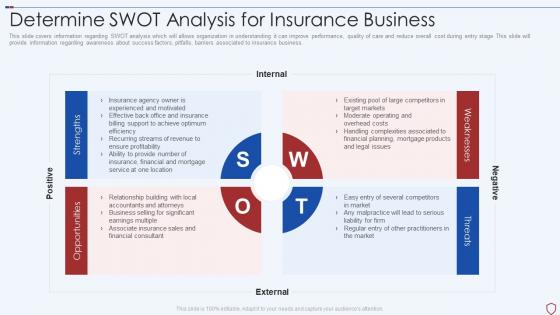
This slide covers information regarding SWOT analysis which will allows organization in understanding it can improve performance, quality of care and reduce overall cost during entry stage. This slide will provide information regarding awareness about success factors, pitfalls, barriers associated to insurance business.
People who downloaded this PowerPoint presentation also viewed the following :
Determine swot analysis for insurance business commercial insurance services business plan with all 6 slides:
Use our Determine SWOT Analysis For Insurance Business Commercial Insurance Services Business Plan to effectively help you save your valuable time. They are readymade to fit into any presentation structure.





FAQs for Determine swot analysis for insurance business commercial insurance
Honestly, insurance is in a pretty good spot right now. Market demand is crazy high - literally every business needs coverage. You can customize policies like mad, which clients love. Renewals keep that cash flow steady too, which is nice. Oh, and digital tools have made underwriting so much faster than the old days. Here's the thing though - all those regulations actually work in your favor since they keep random startups from barging in. I'd focus on the tech upgrades and building solid relationships. People still want that human touch when they're dealing with complex stuff, you know?
Dude, regulatory changes mess with your entire SWOT - not just one piece. They usually hit as threats first because costs go up and everything gets more complicated. But if you're fast? Sometimes you can flip them into opportunities, like offering new compliance stuff. Your biggest strengths might become useless if the rules totally change. I've seen whole industries get scrambled overnight because of new regulations. The smart move is making "we're good at adapting to regulatory BS" one of your key strengths instead of just crossing your fingers that nothing changes.
Ugh, where do I even start? Response times are painfully slow, and there's way too much red tape in claims. Customers get passed around between departments like hot potatoes. Most of these companies are stuck with ancient tech systems that make everything harder than it needs to be. Customer service reps can't actually fix anything either - they have zero authority, so every issue gets escalated. Oh, and they're still doing phone-only support when everyone expects apps and online portals. Honestly, they need to cut the approval BS and let their front-line people actually make decisions.
Honestly, tech can totally transform how you grow. Start with AI for faster underwriting - it's crazy how much quicker decisions get made. IoT sensors give you live data from clients, so you can do usage-based pricing instead of guessing. Everyone wants that Amazon experience now, so digital platforms are pretty much mandatory. Telematics works great for fleet stuff. Predictive analytics help with claims too. Oh, and chatbots handle the basic questions so your team doesn't go insane. Pick whatever process your clients bitch about most and digitize that first. You'll see results way faster than trying to overhaul everything at once.
Yeah, insurtech startups are definitely the biggest headache right now. Amazon, Google, Tesla - they're all sniffing around the insurance game with their fancy AI and data tools. Way faster underwriting, cheaper rates, customers actually like dealing with them. Wild concept, right? Big tech has deep pockets too, so they can afford to experiment. These guys are also going after all those weird niche markets that traditional insurers basically ignored. My advice? Double down on the complex commercial stuff where you actually need expertise - that's harder to automate. But you'll also need to upgrade your digital game or you'll get left behind.
Look, client feedback is your reality check - it shows what you're actually good at, not what you think you're good at. When clients keep praising how fast you process claims or how accurate your risk assessments are, boom - those are real strengths you can build on. But if they're constantly griping about slow response times? Yeah, that's not making your strengths list anytime soon. You've gotta look for patterns across all their feedback. Honestly, sometimes what clients notice most isn't even on your radar. Use their perspective to either back up or totally flip your assumptions, then double down on what's actually working.
Dude, reputation is EVERYTHING in commercial insurance. Like, businesses are literally trusting you with their entire operation if something goes wrong. Good rep means you can charge higher rates and keep clients longer - nobody wants to switch insurers, it's such a headache. Look at Chubb or AIG, they totally own the high-value market because everyone knows they'll actually pay out. For your SWOT thing, definitely play up any awards or client testimonials you've got. That stuff carries way more weight than people think, especially when you're competing against the big guys.
Look for gaps between what people actually need and what's out there right now. Cyber insurance is perfect example - didn't really exist 15 years ago, now it's massive because everything went digital. ESG stuff, climate risks, gig workers - all creating demand for new coverage types. Honestly, half the battle is just paying attention to emerging risks before they blow up and cause major losses. Your clients are probably already asking about risks they can't get decent coverage for. That's literally your roadmap for what to build next. Stay ahead of it instead of scrambling after the fact.
Yeah, economic downturns are brutal for commercial insurance. Businesses close or cut back, so your premium revenue takes a hit right away. Everyone starts shopping around for cheaper policies too - can't really blame them when money's tight. Claims spike from all the usual suspects: business interruption, employee lawsuits, companies going under. The investment side gets hammered when markets crash, which messes with your reserves. Honestly, client retention becomes everything during these times. You might want to think about flexible payment options - it's better than losing clients entirely, you know?
Oh man, operational inefficiency is brutal for commercial insurance. You're drowning in paperwork, risk assessments take forever, and underwriting moves at a snail's pace. Clients hate waiting weeks for quotes - honestly, who has time for that anymore? Claims drag on and on, which pisses everyone off. Your costs shoot up because everything takes more people and more time. Compliance gets messy too. My advice? Map out your current processes first. Sounds boring, I know, but you'll spot the worst bottlenecks pretty fast. That's where the easy fixes usually hide.
Look, tech partnerships are game-changers because they amplify what you're already good at. You'll get AI for risk assessment, automated underwriting, real-time policy apps - all that good stuff. The data analytics alone will help you spot trends and price better (seriously, the difference is night and day). Plus you can launch new products way faster without building everything yourself. Oh, and customer experience improves big time. My advice? Figure out which tech gaps are killing your best services right now, then find partners who actually know their stuff in those specific areas.
Consumer preferences totally flip your SWOT opportunities on their head. What seemed perfect last year? Probably dead now. Commercial insurance clients want digital experiences, usage-based pricing, ESG coverage - honestly, the speed is crazy. Your opportunities section needs to match this stuff: app-based claims, specialized cyber products for remote work, that kind of thing. I'd update your SWOT every quarter to spot these shifts early. Beat your competitors to the punch, you know? The companies that adapt fastest usually win in insurance.
Look, spreading out your commercial insurance lines is basically risk management 101. When one area tanks - and trust me, it will at some point - you've got other revenue keeping the lights on. Say property insurance gets hammered by new regulations or some startup undercuts everyone. No big deal if you're also writing cyber liability, workers' comp, D&O policies. Multiple streams mean you don't panic when one dries up. Honestly, the boring stuff like workers' comp can be your most reliable earner. Start by asking current clients what coverage they're missing - easiest sales you'll ever make.
Look at your customer retention rates first - that's where the real story is. Claims processing speed matters huge too, plus your loss ratios obviously. I'd grab some customer satisfaction scores and NPS data since those tell you what clients actually think. Quote-to-policy conversion rates are super telling for how smooth your process is. Oh and underwriting time - if that's dragging, people notice. Expense ratios can't be ignored either because profit keeps the lights on. Honestly, just compare all this stuff to industry benchmarks and you'll see the gaps pretty quick.
So globalization totally messes with your SWOT analysis - it's wild how different things look depending on your market. Developed countries? You're dealing with way more international competition, but you can also expand globally and tap into better tech. Emerging markets are the opposite though. Tons of opportunities in underserved areas, but good luck with sketchy regulations and crappy infrastructure. Here's what gets me: your local expertise might be gold at home, but means nothing against some massive global company with unlimited cash. You really can't use the same SWOT framework everywhere - each region needs its own breakdown.
-
Great quality product.
-
I discovered this website through a google search, the services matched my needs perfectly and the pricing was very reasonable. I was thrilled with the product and the customer service. I will definitely use their slides again for my presentations and recommend them to other colleagues.