Developing Unique Buyer Persona Developing Retail Merchandising Strategies Ppt Information

Rating:
90%
Developing Unique Buyer Persona Developing Retail Merchandising Strategies Ppt Information
Slide 1 of 6
Favourites Favourites

Try Before you Buy Download Free Sample Product

Audience Impress Your
Audience
Editable 100%
Editable
Time Save Hours
of Time
The Biggest Sale is ending soon in
0
0
:
0
0
:
0
0
Rating:
90%
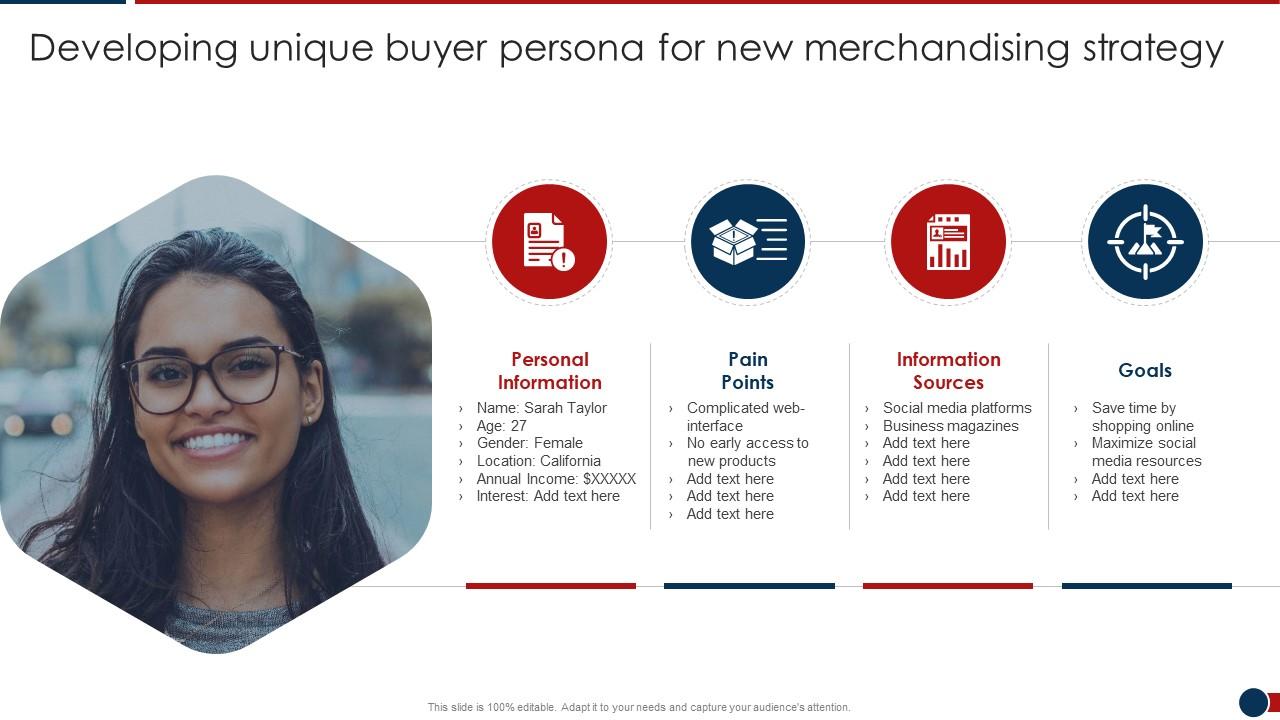
Introducing Developing Unique Buyer Persona Developing Retail Merchandising Strategies Ppt Information to increase your presentation threshold. Encompassed with four stages, this template is a great option to educate and entice your audience. Dispence information on Personal, Information, Information Sources, Goals, using this template. Grab it now to reap its full benefits.

People who downloaded this PowerPoint presentation also viewed the following :

FAQs for Developing Unique Buyer Persona Developing Retail Merchandising

Effective buyer personas include demographic details, behavioral patterns, pain points, goals and motivations, preferred communication channels, and decision-making processes. These comprehensive profiles enhance marketing strategies by enabling targeted messaging, personalized content creation, and strategic channel selection, with many organizations finding that detailed personas significantly improve conversion rates and customer engagement across sales and marketing initiatives.

Demographic data enhances buyer persona accuracy by providing quantifiable insights into age, income, location, education, and occupation patterns that directly influence purchasing behavior and preferences. These concrete data points enable businesses to segment audiences more precisely, tailor messaging effectively, and predict consumer needs across different markets, ultimately delivering more targeted campaigns and improved conversion rates.

Buyer personas influence marketing strategy by informing channel selection, content creation, messaging tone, product positioning, and campaign timing to align with specific audience preferences and behaviors. Through detailed demographic and psychographic insights, companies like retail brands and SaaS platforms streamline their marketing investments, enhance customer engagement rates, and ultimately deliver more personalized experiences that drive higher conversion rates.

Methods for gathering qualitative insights include in-depth customer interviews, focus groups, ethnographic research, social media listening, and customer journey mapping. These approaches enable businesses to uncover emotional drivers, pain points, and decision-making processes across various touchpoints, with many organizations finding that combining multiple methods delivers deeper understanding and more accurate personas for targeted marketing strategies.

Buyer personas should be updated every 6-12 months or following major market shifts, product launches, customer feedback trends, and significant business changes. Through regular surveys, sales team insights, and analytics reviews, organizations can identify evolving customer needs, preferences, and behaviors, ultimately maintaining accurate targeting and competitive messaging strategies.

Customer pain points serve as foundational elements in buyer persona development, revealing specific challenges, frustrations, obstacles, and unmet needs that drive purchasing decisions. These insights enable marketers to create targeted messaging, develop relevant solutions, and craft personalized experiences that directly address audience concerns, ultimately delivering higher conversion rates and stronger customer relationships across diverse market segments.

Businesses leverage buyer personas for content creation by developing targeted messaging, selecting relevant topics, choosing appropriate formats, optimizing distribution channels, and personalizing customer journeys. Through persona-driven content strategies, companies in sectors like retail and software create more engaging blog posts, social media campaigns, and email sequences, ultimately delivering higher conversion rates and stronger customer connections.

Common buyer persona mistakes include relying on assumptions rather than data, creating too many personas, focusing solely on demographics while ignoring motivations, and developing static personas without regular updates. These oversights lead to misaligned marketing strategies, with many organizations finding that successful persona development requires ongoing customer research, cross-departmental input, and regular validation to ensure messaging resonates effectively.

Social media analytics inform buyer persona development by revealing demographic patterns, engagement preferences, content consumption habits, and behavioral triggers across different platforms. Through analyzing metrics like audience insights, post interactions, and follower demographics, marketers can identify distinct customer segments, refine targeting strategies, and create more accurate personas, ultimately delivering personalized campaigns and enhanced customer experiences.

**INPUT**: What tools or software are best suited for creating and managing buyer personas? **OUTPUT**: Effective buyer persona tools include HubSpot's Make My Persona, Xtensio, Userforge, SEMrush Persona, and UXPressia, which streamline data collection, template creation, and collaborative development. These platforms enhance persona accuracy by integrating analytics data, survey insights, and team collaboration features, with many marketing teams finding that centralized persona management ultimately delivers more targeted campaigns and improved customer engagement across all touchpoints. **Word count: 60 words**

Buyer personas significantly influence lead generation by enabling targeted messaging, strategic channel selection, and personalized content creation that resonates with specific audience segments. Through persona-driven campaigns, businesses can optimize their marketing spend, improve conversion rates, and enhance lead quality across platforms like social media, email, and search, ultimately delivering higher ROI and more qualified prospects for sales teams.

Buyer personas can differ significantly across marketing channels, as audiences engage differently through email, social media, search, and content platforms, requiring channel-specific messaging approaches. These variations enable marketers to tailor content, tone, and timing strategically, with many organizations finding that customized persona applications across channels deliver enhanced engagement rates and improved conversion outcomes.

Buyer personas significantly enhance customer journey mapping by providing detailed demographic, behavioral, and motivational insights that inform each touchpoint and interaction. Through persona-driven mapping, businesses in retail, healthcare, and financial services can identify specific pain points, optimize engagement strategies, and deliver personalized experiences, ultimately improving conversion rates and customer satisfaction across all journey stages.

Small businesses can develop buyer personas cost-effectively through customer surveys, social media analytics, website data analysis, competitor research, and direct customer interviews. These budget-friendly approaches enable companies to gather valuable demographic and behavioral insights without expensive market research, with many small retailers and service providers finding that even basic persona development significantly improves their marketing targeting and customer acquisition rates.

Buyer persona validation techniques include customer interviews, survey data analysis, website analytics review, social media insights examination, and sales team feedback collection. These methods enable organizations to cross-reference assumptions with real customer behavior, purchasing patterns, and demographic data, with many companies finding that regular validation through multiple touchpoints ultimately delivers more targeted marketing campaigns and higher conversion rates.

Ratings and Reviews

90% of 100
Write a review
Most Relevant Reviews
  1. 80%

    by Williams Morales

    The designs are super attractive. Me and my team love using SlideTeam’s presentations.
  2. 100%

    by Edward Nunez

    I've been looking for a good template source for some time. I'm happy that I discovered SlideTeam. Excellent presentations must try!

2 Item(s)

per page: