


Download sales and distribution management ppt diagram




Try Before you Buy Download Free Sample Product
 Impress Your
 Audience
 100%
100% Editable
 Save Hours
 of Time


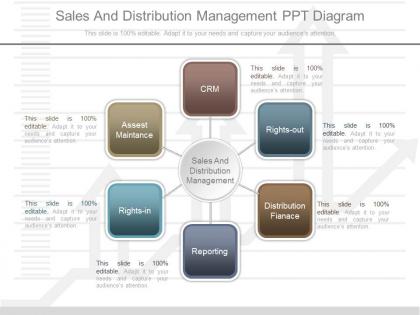
Learn about the various aspects of sales and distribution management, beginning with its introduction with the help of our download sales and distribution management PPT diagram. Talk about its various aspects like rights out, distribution finance, reporting, rights in, asset maintenance and CRM in detail. Let your people understand the significance of sales as a function. Make your sales team recognize the importance of the role played by them in generating revenues for the company. Also educate your audience with the intricate function of keeping track of the movement of goods from supplier to point of sale. The color coded aspects of sales and distribution management PowerPoint presentation can first be introduced as one liner in a holistic approach and thereby each of them can be detailed out in respective slides. You can make use of the given sales and distribution management PPT example to cover any topic related to evolution of sales concept, nature of selling, objectives of selling, integration of sales, distribution and marketing and environmental factors affecting sales and distribution management.Our Download Sales And Distribution Management Ppt Diagram are as good as they come. Like your thoughts they are second to none.
People who downloaded this PowerPoint presentation also viewed the following :
Download sales and distribution management ppt diagram with all 7 slides:
Create curiosity with our Download Sales And Distribution Management Ppt Diagram. They excel at generating a buzz.

FAQs for Download sales and distribution
Key components include market segmentation, channel selection, territory planning, performance metrics, and distributor relationship management. These strategic elements work together by aligning sales resources with market opportunities, optimizing channel partnerships, and establishing clear performance standards, with many organizations finding that this integrated approach delivers faster market penetration and sustainable revenue growth.
Technology enhances sales and distribution management through CRM systems, automated inventory tracking, predictive analytics, mobile sales platforms, and AI-powered demand forecasting. These solutions streamline operations by improving customer relationship tracking, optimizing supply chain visibility, and enabling real-time sales performance monitoring, ultimately delivering faster order processing, reduced operational costs, and enhanced customer experiences across retail, manufacturing, and distribution sectors.
Customer relationship management (CRM) centralizes customer data, tracks interactions, automates follow-ups, manages leads through sales funnels, and provides analytics for strategic decision-making. Through CRM systems, sales teams streamline prospecting, enhance customer service, and optimize distribution channels, while organizations achieve better customer retention, increased sales efficiency, and ultimately stronger revenue growth across multiple touchpoints.
Sales forecasting significantly impacts distribution planning by enabling accurate inventory allocation, optimizing warehouse capacity, and streamlining transportation routes based on anticipated demand patterns. Through predictive analytics, companies can strategically position products closer to expected high-demand regions, reduce stockouts while minimizing excess inventory, and coordinate supply chain resources more effectively, ultimately delivering faster customer fulfillment and improved operational efficiency.
Key sales performance metrics include revenue growth, conversion rates, customer acquisition cost, average deal size, sales cycle length, and customer lifetime value. These metrics enable organizations to identify bottlenecks, optimize resource allocation, and enhance forecasting accuracy, with many companies finding that tracking multiple metrics simultaneously delivers better strategic insights and competitive advantage.
Companies ensure effective communication between sales and distribution teams through integrated CRM systems, regular cross-functional meetings, shared performance dashboards, standardized reporting protocols, and collaborative planning sessions. These approaches streamline information flow by aligning inventory forecasts with sales projections, coordinating promotional activities, and establishing clear escalation procedures, ultimately delivering faster order fulfillment and enhanced customer satisfaction across distribution channels.
Managing a global sales and distribution network presents challenges including cultural differences, regulatory compliance variations, currency fluctuations, supply chain complexities, and coordination across time zones. These obstacles require strategic adaptation by standardizing processes while allowing local flexibility, implementing robust communication systems, and leveraging technology platforms, with many multinational organizations finding that centralized oversight combined with regional autonomy ultimately delivers operational efficiency and market responsiveness.
Businesses leverage data analytics to improve sales distribution by analyzing customer behavior patterns, optimizing territory assignments, predicting demand fluctuations, and identifying high-performing channels. Through advanced analytics platforms, organizations streamline inventory allocation, enhance route planning, and personalize customer targeting strategies, with many retail and manufacturing companies finding that data-driven distribution delivers faster fulfillment and increased market penetration.
Pricing strategy significantly impacts sales and distribution by influencing customer demand, channel partner margins, competitive positioning, and market penetration rates. Strategic pricing enables businesses to optimize revenue streams, attract target segments, and incentivize distribution partners, with many retail and manufacturing companies finding that dynamic pricing models enhance sales velocity while maintaining profitability across multiple channels.
Companies optimize inventory management through demand forecasting, automated reordering systems, real-time tracking technologies, supplier relationship management, and strategic safety stock positioning. These approaches streamline operations by reducing stockouts, minimizing carrying costs, and improving order fulfillment speed, with many retailers and manufacturers finding that optimized inventory ultimately enhances customer satisfaction while delivering significant competitive advantage.
Best practices for training sales and distribution personnel include comprehensive product knowledge development, customer relationship management techniques, territory optimization strategies, digital sales tools proficiency, and performance measurement systems. These training approaches enhance revenue generation by improving customer interactions, streamlining distribution processes, and accelerating deal closure rates, with many organizations finding that well-trained teams deliver significantly higher sales performance and market penetration.
Channel partners can be effectively managed through clear communication, structured training programs, performance metrics, incentive alignment, and regular relationship reviews. These management approaches streamline collaboration by establishing mutual expectations, providing ongoing support, and ensuring consistent brand representation, with many organizations finding that strategic partner enablement ultimately delivers expanded market reach and enhanced customer experiences.
Sales and distribution management risks include supply chain disruptions, inventory mismanagement, channel conflicts, demand forecasting errors, and relationship breakdowns with key partners. These challenges can be mitigated through diversified supplier networks, real-time inventory tracking systems, and clear channel partner agreements, with many organizations finding that proactive communication and data-driven forecasting ultimately deliver enhanced operational resilience and competitive advantage.
Sales promotions influence distribution channels by incentivizing retailers to stock more products, securing better shelf placement, and encouraging distributors to prioritize specific brands over competitors. These promotional strategies streamline channel relationships through volume discounts, cooperative advertising, and exclusive deals, with many retail partners finding that strategic promotions ultimately enhance inventory turnover and deliver stronger profit margins.
Current trends shaping sales and distribution management include AI-powered analytics, omnichannel integration, predictive forecasting, customer data platforms, and automated workflow systems. These technologies streamline operations by enhancing demand planning, personalizing customer experiences, and optimizing inventory allocation, with many organizations finding that strategic adoption ultimately delivers faster response times, reduced costs, and significant competitive advantage.
-
Colors used are bright and distinctive.
-
Great quality slides in rapid time.