


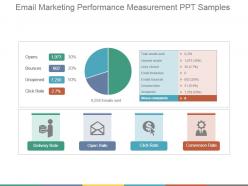
Email marketing performance measurement ppt samples





Try Before you Buy Download Free Sample Product
 Impress Your
 Audience
 100%
100% Editable
 Save Hours
 of Time


Our Email Marketing Performance Measurement Ppt Samples ensure glances. Eyes will be completely fixed on you.
People who downloaded this PowerPoint presentation also viewed the following :
Email marketing performance measurement ppt samples with all 5 slides:
Identify influences that induced errors with our Email Marketing Performance Measurement Ppt Samples. Highlight emotional judgements.
FAQs for Email marketing performance
Key metrics for evaluating email marketing effectiveness include open rates, click-through rates, conversion rates, bounce rates, and unsubscribe rates. These metrics work together to reveal campaign performance, with many organizations finding that tracking delivery rates, list growth, and revenue per email provides comprehensive insights into subscriber engagement, content relevance, and ultimately delivers measurable ROI across marketing initiatives.
A/B testing improves email marketing performance by systematically comparing subject lines, content formats, send times, and call-to-action placements across split audience segments. Through controlled testing of variables like personalization levels and visual designs, marketers can optimize open rates, click-through rates, and conversion metrics, with many organizations finding that data-driven refinements deliver significantly higher engagement and revenue outcomes.
Open rate serves as a foundational engagement metric that measures initial audience interest and subject line effectiveness, though it presents both visibility opportunities and measurement limitations in today's privacy-focused landscape. While open rates help marketers gauge campaign reach and optimize send times, successful email strategies increasingly combine this metric with click-through rates, conversions, and revenue attribution to deliver comprehensive performance insights.
Click-through rates can be analyzed by examining segment performance, timing patterns, content relevance, and device preferences to understand audience behavior. Banks and retail companies increasingly track CTR alongside conversion rates and customer journey metrics, finding that targeted campaigns with personalized content deliver significantly higher engagement, ultimately enabling more strategic email marketing decisions and improved customer experiences.
Best practices for segmenting email lists include demographic segmentation, behavioral tracking, purchase history analysis, engagement level classification, and geographic targeting. These approaches enhance performance by delivering personalized content, improving open rates, and reducing unsubscribe rates, with many retailers and service providers finding that targeted segments generate significantly higher conversion rates and customer lifetime value.
Conversion rates can be measured by tracking specific actions like purchases, sign-ups, or downloads directly attributable to email campaigns, calculating the percentage of recipients who complete desired actions. Through advanced analytics platforms, businesses monitor click-to-conversion ratios, revenue per email, and customer lifetime value, with many retail and e-commerce companies finding that segmented campaigns deliver significantly higher ROI and measurable business growth.
Comprehensive email marketing analytics are delivered by platforms like Mailchimp, HubSpot, Campaign Monitor, Constant Contact, and SendinBlue, which track open rates, click-through rates, conversion metrics, and subscriber engagement patterns. These tools streamline performance measurement by providing real-time dashboards, A/B testing capabilities, and automated reporting features, with many organizations finding that integrated analytics ultimately enhance campaign optimization and drive measurable ROI improvements.
Subscriber retention significantly enhances email marketing performance by maintaining audience size, reducing acquisition costs, and building deeper customer relationships over time. Long-term subscribers typically demonstrate higher engagement rates, increased purchase frequency, and greater lifetime value, with many businesses finding that retained subscribers generate 3-5 times more revenue than newly acquired ones, ultimately delivering sustained growth and improved ROI.
Factors that can skew email marketing metrics include deliverability issues, spam filtering, list hygiene problems, tracking pixel blocking, mobile rendering inconsistencies, and timezone variations across recipients. These challenges create measurement gaps that can misrepresent campaign effectiveness, with many marketing teams finding that cross-platform analytics and segmented testing deliver more accurate performance insights, ultimately enabling better strategic decisions and improved ROI.
Email deliverability issues significantly skew performance measurement by creating artificial drops in open rates, click-through rates, and conversion metrics when emails reach spam folders or bounce entirely. These technical problems mask true campaign effectiveness, making successful content appear unsuccessful, with many marketers finding that addressing deliverability first provides more accurate performance data and better strategic insights.
Customer feedback post-email campaign can be collected through surveys, reply tracking, social media monitoring, website analytics, and direct customer service interactions. These methods enable businesses to analyze sentiment patterns, identify content preferences, and measure engagement quality across different customer segments, ultimately delivering enhanced targeting strategies and improved campaign ROI for future initiatives.
Strategies to reduce unsubscribe rates include segmenting audiences based on preferences, personalizing content through behavioral data, optimizing send frequency, implementing preference centers, and A/B testing subject lines and content formats. These approaches enhance subscriber engagement by delivering relevant messaging, reducing email fatigue, and respecting user preferences, ultimately improving open rates, click-through rates, and long-term customer retention across campaigns.
Performance metrics should be reported through visual dashboards displaying key KPIs like open rates, click-through rates, conversion rates, and ROI alongside comparative data and trend analysis. These reports enhance stakeholder understanding by presenting actionable insights, segmented performance data, and strategic recommendations, with many organizations finding that regular, contextualized reporting ultimately delivers better decision-making and improved campaign optimization.
GDPR and other privacy regulations significantly impact email performance measurement by restricting data collection, requiring explicit consent for tracking, and limiting cross-platform attribution capabilities. These compliance requirements often reduce detailed analytics availability, while pushing organizations toward privacy-first measurement approaches like server-side tracking and consent-based segmentation, ultimately delivering more transparent customer relationships and sustainable long-term engagement strategies.
Subject lines significantly influence open rates by determining first impressions, conveying value propositions, creating urgency, and establishing sender credibility. Strategic subject line optimization can increase open rates by 15-25%, with personalized and action-oriented lines performing exceptionally well across retail, financial services, and B2B sectors, ultimately driving higher engagement, click-through rates, and conversion outcomes for comprehensive campaign success.
-
Thanks for all your great templates they have saved me lots of time and accelerate my presentations. Great product, keep them up!
-
Use of icon with content is very relateable, informative and appealing.