


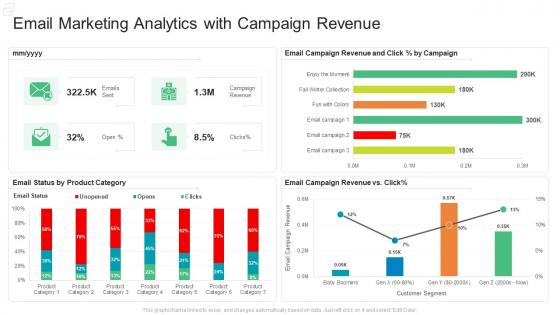
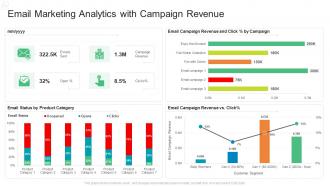
Email marketing analytics with campaign revenue




Try Before you Buy Download Free Sample Product
 Impress Your
 Audience
 100%
100% Editable
 Save Hours
 of Time


Our Email Marketing Analytics With Campaign Revenue are topically designed to provide an attractive backdrop to any subject. Use them to look like a presentation pro.
People who downloaded this PowerPoint presentation also viewed the following :
Email marketing analytics with campaign revenue with all 2 slides:
Use our Email Marketing Analytics With Campaign Revenue to effectively help you save your valuable time. They are readymade to fit into any presentation structure.
FAQs for Email marketing analytics
Key email marketing metrics include open rates, click-through rates, conversion rates, bounce rates, and unsubscribe rates, along with revenue per email and list growth metrics. These analytics enable marketers to optimize subject lines, content effectiveness, and audience segmentation, with many organizations finding that tracking these comprehensive metrics ultimately delivers higher engagement and measurable ROI improvements.
Subject line optimization significantly influences open rates by incorporating personalization, urgency indicators, clear value propositions, optimal length, and A/B testing methodologies. Through strategic subject line crafting, retailers, financial services, and healthcare organizations enhance open rates by 15-25%, reduce unsubscribe rates, and improve customer engagement, ultimately delivering higher conversion rates and stronger ROI across campaigns.
Segmentation enables more precise email marketing analytics by dividing audiences based on demographics, behavior, purchase history, and engagement patterns, allowing marketers to track performance metrics for specific customer groups. This targeted approach delivers deeper insights into campaign effectiveness, higher conversion rates, and improved ROI, with many businesses finding that segmented campaigns generate significantly better results than broad, untargeted messaging.
A/B testing enhances email marketing performance by comparing different subject lines, content formats, send times, and call-to-action placements to identify what resonates with audiences. Through systematic testing of these variables, marketers can optimize open rates, click-through rates, and conversion metrics, with many organizations finding that data-driven refinements ultimately deliver significantly improved campaign ROI and customer engagement.
Popular email marketing analytics tools include Mailchimp, Constant Contact, HubSpot, Klaviyo, and Campaign Monitor, each offering comprehensive tracking capabilities. These platforms streamline data analysis by providing real-time metrics, automated reporting, and segmentation insights, with many organizations finding that integrated analytics ultimately enhance campaign performance and deliver measurable ROI improvements.
Email delivery timing significantly impacts response rates by aligning with recipient behavior patterns, time zones, and industry-specific schedules. Financial services and retail companies increasingly find that Tuesday through Thursday mid-morning deliveries generate higher engagement, while B2B campaigns perform better during business hours, ultimately delivering improved open rates and conversion metrics that enhance overall campaign ROI.
Best practices for monitoring bounce rates include segmenting bounces by type, tracking trends over time, setting automated alerts for unusual spikes, regularly cleaning email lists, and analyzing bounce patterns by campaign demographics. These monitoring approaches streamline list management by identifying deliverability issues early, maintaining sender reputation, and optimizing targeting strategies, with many organizations finding that consistent bounce rate analysis ultimately delivers higher engagement rates and improved campaign ROI.
Click-through rates reveal which content types, subject lines, call-to-action placements, and messaging approaches resonate most effectively with your audience segments. By analyzing CTR patterns across different campaigns, marketers can identify high-performing content themes, optimal email structures, and audience preferences, ultimately enabling more targeted content creation and strategic segmentation for enhanced engagement.
Analyzing unsubscribe rates reveals content relevance issues, frequency preferences, audience segmentation effectiveness, and campaign timing problems. These insights enable marketers to optimize send frequency, refine targeting strategies, and improve content quality, with many organizations finding that addressing high unsubscribe triggers enhances overall engagement rates and delivers stronger customer retention.
Engagement metrics like open rates, click-through rates, time spent reading, and conversion patterns reveal which content resonates with specific audience segments, enabling marketers to refine targeting parameters and personalization strategies. By analyzing these behavioral indicators, companies can segment audiences more precisely, deliver more relevant messaging, and ultimately improve campaign performance while reducing marketing costs and enhancing customer experiences.
Common pitfalls include focusing solely on open rates while ignoring click-through rates, attributing all conversions to email without considering multi-channel journeys, and making decisions based on insufficient data samples. These mistakes lead organizations to misallocate resources, optimize for vanity metrics rather than revenue impact, and miss crucial insights about subscriber behavior, ultimately undermining campaign effectiveness and strategic growth opportunities.
Conversion tracking can be implemented through UTM parameters in email links, pixel tracking on landing pages, integration with analytics platforms like Google Analytics, and CRM system synchronization to monitor customer journeys. These methods enable marketers to measure click-through rates, purchase completions, and revenue attribution, with many retail and e-commerce businesses finding that comprehensive tracking delivers measurable ROI improvements and strategic campaign optimization insights.
GDPR and privacy laws significantly impact email marketing analytics by requiring explicit consent for data collection, limiting tracking capabilities, and mandating data portability rights. These regulations present both challenges and opportunities, with many organizations finding that enhanced transparency and consent-driven strategies ultimately deliver stronger customer relationships and more engaged subscriber bases.
Customer feedback from email surveys can be analyzed through sentiment analysis, response categorization, trend identification, and performance correlation with engagement metrics. This strategic combination enables businesses to enhance product offerings, refine messaging strategies, and personalize customer experiences, with many organizations finding that systematic feedback analysis drives higher retention rates and competitive advantage.
Effective email marketing visualizations include line charts for tracking open rates over time, bar charts for comparing campaign performance, heat maps for engagement patterns, funnel charts for conversion tracking, and dashboard summaries for key metrics. These visual tools enhance decision-making by highlighting trends, identifying top-performing content segments, and streamlining performance analysis, ultimately enabling marketers to optimize campaigns and deliver improved ROI across their email strategies.
-
Innovative and Colorful designs.