

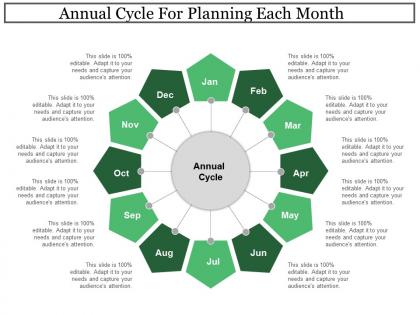
Annual cycle for planning each month




Try Before you Buy Download Free Sample Product
 Impress Your
 Audience
 100%
100% Editable
 Save Hours
 of Time


Eliminate factors causing inefficiency with our Annual Cycle For Planning Each Month. Create the environment for better functioning.
People who downloaded this PowerPoint presentation also viewed the following :
Annual cycle for planning each month with all 5 slides:
Apply a dash of jam with our Annual Cycle For Planning Each Month. Add to your basic bread and butter.

FAQs for Annual cycle for
Most companies start with a strategic review - basically looking at how last year went and what's happening in the market. Then you set goals and priorities for the new year. Budget allocation comes next, which is honestly where things get political if resources are tight. After that, you create implementation plans with deadlines and assign owners. The whole thing usually starts in Q3 or Q4. One thing I've learned - build in quarterly check-ins or you'll drift off course. Every company does this process a bit differently though, so don't expect a cookie-cutter approach.
Here's what I'd do - take those big 3-5 year goals and work backwards. Your annual stuff should directly feed into at least one of them, otherwise you're wasting time honestly. I like to think of it as building a bridge, one piece at a time. Break everything down into chunks you can actually measure each year. Oh, and definitely check in quarterly because things change fast. Every major project needs to push you closer to that bigger picture - no exceptions. One thing that really helped me was getting the leadership team together for a strategy session. Sounds boring but it actually works.
Look, data analysis is basically your roadmap for everything. Pull your metrics from the last 12-18 months first - performance stuff, budget numbers, customer patterns. You'll probably be shocked at how wrong your gut instincts were (I know I always am). Hunt for trends and gaps before you even touch next year's goals. This is honestly where most teams have their "oh shit" moment and realize what they thought worked... didn't. Use all that info to set goals that aren't totally insane and actually allocate your resources right.
Start collecting feedback way before planning season - like 2-3 months early. Anonymous surveys are your friend here since people will actually be honest about what's broken. We tried "planning cafes" at my last job where people could just drop by and chat - honestly worked better than formal meetings. Ask specific stuff like "what should we ditch/add/keep doing" instead of vague questions that get you nowhere. Oh, and this is huge - you have to circle back and show how their input actually changed things. Otherwise people feel ignored and won't bother next time.
Oh man, don't dive into tiny details right away - you'll spend forever on stuff that changes anyway. Get your team involved or you'll end up with some fantasy plan nobody can actually execute. I used to just copy-paste last year's stuff which was... not great lol. Focus on maybe 3-5 big things instead of cramming everything in there. Nobody follows a plan that's trying to do 47 different things at once. Start broad, ask people what they think early on, and expect it to shift because it definitely will. Trust me on this one.
Honestly, the right tech tools are game-changers for annual planning. No more chasing down random spreadsheets from accounting or whoever. Planning platforms like Monday.com or Asana let everyone update their stuff at the same time, and you get real-time updates without drowning in emails. They automatically pull data too, which is clutch. You can spot problems early and actually see what's happening instead of guessing. Excel works if you're not ready for something fancy - just use good templates. Pick something that plays nice with whatever systems you already have. Get your main team using it first, then expand from there.
Honestly, getting different departments to actually plan together is a game-changer. Sales talks to marketing, ops chimes in with what's realistic - suddenly you're not caught off guard when someone promises deliverables that can't happen. Everyone sees the bigger picture instead of just their slice. Resource conflicts? You'll spot them before they bite you. Revenue targets actually make sense. The buy-in is so much better too since people helped create the plan rather than having it dumped on them. I'd start with joint sessions where each team shares their priorities upfront. Way less drama later, trust me.
Focus on three main areas: financial stuff (revenue vs targets, profit margins), how efficiently you're operating (project completion rates, resource usage), and strategic wins (market share, customer satisfaction). The financial metrics are no-brainers. Leading indicators though? They're honestly way better predictors than most people realize. Pick whatever KPIs connect to your company's big priorities this year. Here's the thing - stick to 5-7 metrics that actually influence decisions, not just pretty dashboard numbers. Monthly check-ins are clutch so you can pivot early instead of scrambling at year-end.
Honestly, just build it into your quarterly reviews and annual planning - way easier than making it a separate thing. Pick 3-4 big uncertainties that could mess with your business this year. Then create different scenarios around those. I get it, you're already drowning in budget stuff, but this actually saves time later. Run your plans through these scenarios to see what breaks. Gets you thinking about backup options before you're stuck. Oh, and definitely bounce these scenarios off other teams - they'll catch stuff you totally missed. The trick is making it routine, not some random exercise you do once and forget about.
Honestly, just use last year's numbers as your starting point - way better than guessing. Get each department to build their piece first, then add it all up. Your department heads actually know what they need (shocking, I know), so loop them in early. Oh, and definitely build in some buffer for inflation plus random stuff that'll pop up. There's always something. Create a few different scenarios too - like if things go great, if they suck, and what'll probably actually happen. You'll thank yourself later when your first guess inevitably gets blown up.
Honestly, market research is like your GPS for annual planning. It shows you what customers actually want and where the market's going. Plus you can see how you compare to competitors - which is always fun, right? Use all that data to set revenue targets that aren't completely unrealistic. Figure out which products deserve your attention and where to spend your budget. Don't plan blind basically. Research helps you catch opportunities and avoid throwing money at dying trends. Oh, and start collecting this stuff 2-3 months early so you're not scrambling later.
Look, you gotta check in on your annual plan regularly or you'll end up chasing stuff that made sense in January but is totally irrelevant by summer. I've watched teams burn through entire quarters on goals that were already dead in the water. Markets change, new opportunities show up out of nowhere – happens all the time. Set up quarterly reviews to see what's actually working and what needs to shift. It's like adjusting your route when traffic hits, not scrapping the whole trip. Put those review dates in your calendar right now though, because you know you'll forget otherwise.
Honestly, just be super open about everything from the start. Tell everyone your timeline, how you're making decisions, what criteria you're using - the whole deal. Write down why you picked certain options because trust me, people will forget and ask again in a few months. Regular check-ins help too so folks can actually give input instead of complaining later. Oh, and definitely publish the final plan with clear owners and deadlines. Otherwise you'll get that annoying "I thought Sarah was handling this" situation when nothing gets done.
You need KPIs as your guiding light when planning out the year - they show you what realistic targets look like and whether you're actually on track. Build your strategies and budget around hitting those specific numbers. Without them, you're basically just guessing (learned that the hard way). Quarterly check-ins become super straightforward when you've got concrete metrics to review. Oh, and don't go overboard - pick maybe 3-5 KPIs that actually matter to your business goals. Tracking everything just creates noise.
So here's what actually works - plan for three scenarios: best case, worst case, and realistic. COVID taught me that rigid plans are basically useless when life hits you sideways! Set up quarterly check-ins to pivot when needed. Track stuff that predicts the future, not just what already happened. I always keep like 10-15% of budget flexible for random opportunities or fires you need to put out. Oh, and treat your plan more like a Google doc than stone tablets - you're gonna change it constantly anyway.
-
Great product with highly impressive and engaging designs.
-
Designs have enough space to add content.