


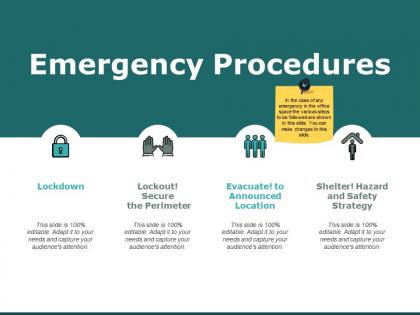
Emergency procedures location ppt powerpoint presentation file vector




Try Before you Buy Download Free Sample Product
 Impress Your
 Audience
 100%
100% Editable
 Save Hours
 of Time


Elaborate on exceptional acts of bravery with our Emergency Procedures Location Ppt Powerpoint Presentation File Vector. Highlight displays of indomitable courage.
People who downloaded this PowerPoint presentation also viewed the following :
Emergency procedures location ppt powerpoint presentation file vector with all 5 slides:
Applaud acts of exceptional bravery with our Emergency Procedures Location Ppt Powerpoint Presentation File Vector. Encourage folks to exhibit indomitable courage.




FAQs for Emergency procedures location ppt powerpoint
Key elements include clear evacuation routes, emergency contact information, step-by-step response protocols, assembly point locations, and communication procedures. These components streamline crisis management by ensuring consistent messaging, reducing response times, and enhancing coordination across departments, with many organizations finding that well-structured templates significantly improve emergency preparedness and employee safety outcomes.
Visuals enhance emergency procedure understanding by simplifying complex instructions, creating memorable visual cues, illustrating proper evacuation routes, and demonstrating equipment usage through clear diagrams and infographics. These visual elements streamline comprehension during high-stress situations, with many organizations finding that employees retain critical safety information more effectively through visual presentations, ultimately delivering faster response times and improved workplace safety outcomes.
**INPUT**: What specific formatting styles are most effective for highlighting critical emergency information? **OUTPUT**: Effective formatting for critical emergency information includes bold headings, high-contrast color schemes, large readable fonts, numbered step sequences, and prominent visual icons. These design elements streamline comprehension by minimizing reading time, enhancing visibility under stress, and ensuring consistent information hierarchy, with many organizations finding that strategic formatting ultimately delivers faster emergency response and improved safety outcomes.
Different industries can customize emergency procedure templates by adapting protocols to their unique hazards, regulatory requirements, facility layouts, and operational workflows. Manufacturing facilities focus on equipment shutdowns and chemical spills, while healthcare organizations prioritize patient evacuation and medical continuity, and financial institutions emphasize data protection and business continuity, ultimately delivering sector-specific safety frameworks that enhance response effectiveness.
Employee training plays a crucial role in emergency procedures effectiveness by ensuring comprehension, building muscle memory through practice drills, and creating confident response teams. Well-trained employees can execute evacuation plans seamlessly, operate safety equipment correctly, and guide others during crisis situations, ultimately minimizing panic and reducing response times when emergencies occur.
Emergency procedures can be made accessible by implementing multiple communication formats, including visual alarms, tactile signage, clear audio announcements, accessible evacuation routes, and assistive technology integration. Organizations enhance accessibility through braille instructions, large-print materials, and designated assistance protocols, with many facilities finding that these comprehensive approaches streamline evacuations while ensuring inclusive safety compliance and reducing liability risks.
**INPUT**: What strategies can be used to keep emergency procedures engaging and memorable for the audience? **OUTPUT**: Effective strategies include interactive simulations, visual storytelling, gamification elements, regular scenario-based drills, and multi-sensory learning approaches. These methods enhance retention by combining hands-on practice with engaging content delivery, while organizations across healthcare, manufacturing, and corporate sectors find that incorporating real-world case studies and role-playing exercises significantly improves employee preparedness and response effectiveness. [Word count: 58 words]
Emergency procedures presentations should be updated annually at minimum, with immediate revisions following regulatory changes, facility modifications, or incident analyses. Many organizations in healthcare, manufacturing, and education find that quarterly reviews ensure procedures reflect current protocols, staff changes, and evolving safety standards, ultimately delivering enhanced preparedness and regulatory compliance.
Cultural diversity significantly impacts emergency procedure communication through varying language preferences, communication styles, risk perception differences, and information processing approaches. Organizations increasingly find that tailored multilingual materials, culturally sensitive visual aids, and diverse communication channels enhance comprehension across teams, ultimately delivering safer workplaces and more effective emergency responses in global business environments.
Interactive elements like quizzes, scenario-based decision trees, clickable evacuation maps, role-playing simulations, and real-time polling can be seamlessly integrated into emergency procedure presentations. These engagement tools enhance knowledge retention by allowing participants to practice responses, test their understanding of protocols, and navigate virtual emergency situations, ultimately delivering more effective training outcomes and better preparedness across organizations.
Best practices for distributing emergency procedure presentations to remote workforces include cloud-based platforms, mobile-accessible formats, multi-channel communication, regular update notifications, and interactive acknowledgment systems. These approaches streamline emergency preparedness by ensuring instant access, maintaining version control, and enabling real-time tracking, with many organizations finding that automated distribution and mandatory completion tracking ultimately deliver better compliance and faster emergency response across distributed teams.
Employee feedback can be incorporated through surveys, focus groups, drill debriefings, and regular safety meetings to identify template gaps and improvement opportunities. Many organizations find that frontline workers, especially in manufacturing and healthcare sectors, provide invaluable insights about clarity, accessibility, and real-world application challenges, ultimately delivering more effective emergency responses and enhanced workplace safety.
PowerPoint, Canva, Prezi, Google Slides, and specialized safety software like iAuditor are recommended for creating effective emergency procedure presentations. These platforms enable clear visual communication through infographics, interactive elements, and multimedia content, with many organizations finding that professional templates and consistent formatting significantly enhance comprehension and retention during critical safety training sessions.
Case studies of past emergencies provide critical insights into procedural gaps, communication failures, and response effectiveness, enabling organizations to identify weaknesses and strengthen protocols. Through analyzing real incidents from healthcare facilities, manufacturing plants, and corporate offices, companies can enhance training materials, streamline evacuation routes, and improve emergency presentations, ultimately delivering faster response times and better crisis management outcomes.
Collaboration between departments ensures comprehensive emergency procedures by integrating diverse expertise, identifying cross-functional dependencies, establishing clear communication protocols, and creating unified response strategies. This collaborative approach enables organizations to develop more robust emergency frameworks that address various scenarios simultaneously, with many institutions finding that interdepartmental coordination significantly reduces response times and enhances overall organizational resilience during critical situations.
No Reviews