


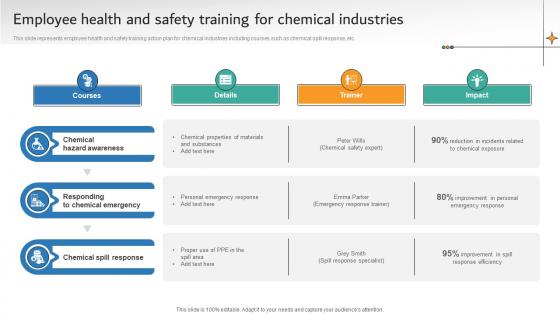
Employee Health And Safety Training For Chemical Industries




Try Before you Buy Download Free Sample Product
 Impress Your
 Audience
 100%
100% Editable
 Save Hours
 of Time


This slide represents employee health and safety training action plan for chemical industries including courses such as chemical spill response, etc.
People who downloaded this PowerPoint presentation also viewed the following :
Employee Health And Safety Training For Chemical Industries with all 9 slides:
Use our Employee Health And Safety Training For Chemical Industries to effectively help you save your valuable time. They are readymade to fit into any presentation structure.








FAQs for Employee Health And Safety Training
Key components include hazard identification and risk assessment, comprehensive safety training, emergency response procedures, incident reporting systems, and regular safety audits. These elements work together by creating proactive prevention measures, ensuring regulatory compliance, and fostering a safety-first culture, with many organizations finding that systematic implementation reduces workplace injuries while enhancing employee productivity and retention.
Organizations measure health and safety effectiveness through incident rates, injury frequency statistics, compliance audit scores, employee satisfaction surveys, and safety training completion metrics. These measurements enable companies to track progress across manufacturing, healthcare, and construction sectors, while identifying areas for improvement, ultimately reducing operational costs and enhancing workplace culture through data-driven safety strategies.
Employee training plays a crucial role in workplace safety by educating workers on hazard identification, proper equipment usage, emergency procedures, and regulatory compliance requirements. Through comprehensive safety programs, organizations significantly reduce workplace accidents, minimize liability risks, and enhance operational efficiency, with many companies finding that well-trained employees become safety advocates who proactively identify and address potential hazards.
Mental health integration involves embedding psychological wellbeing assessments, stress management protocols, mental health first aid training, and employee assistance programs into existing safety frameworks. Organizations across healthcare, manufacturing, and financial services are finding that combining mental health screenings with physical safety audits, implementing peer support networks alongside hazard reporting systems, and training managers in psychological safety protocols ultimately reduces absenteeism while enhancing overall workplace resilience.
Workplace hazards significantly reduce employee productivity through increased absenteeism, slower work pace, and higher error rates, while simultaneously damaging morale by creating stress, anxiety, and job dissatisfaction. Organizations with poor safety records experience decreased engagement, higher turnover, and reduced collaboration, with many finding that addressing hazards proactively delivers improved performance and competitive advantage.
Companies should address ergonomic issues through workplace assessments, adjustable equipment installation, employee training programs, and regular monitoring protocols. These comprehensive approaches streamline injury prevention by identifying risk factors, enhancing workspace design, and promoting proper techniques, with many organizations finding that proactive ergonomic investments ultimately deliver reduced workers' compensation costs and improved productivity.
Legal requirements for health and safety compliance include OSHA standards, industry-specific regulations, worker training mandates, hazard communication protocols, and incident reporting procedures. These requirements vary significantly across sectors, with manufacturing facing stricter chemical exposure limits, healthcare requiring infection control measures, and construction emphasizing fall protection, ultimately ensuring worker protection while minimizing organizational liability and operational disruptions.
Organizations foster safety culture through leadership commitment, comprehensive training programs, open communication channels, employee involvement in safety decisions, and consistent policy enforcement. By implementing regular safety meetings, recognizing safe behaviors, encouraging incident reporting without blame, and providing necessary protective equipment, companies create environments where safety becomes ingrained in daily operations, ultimately reducing workplace accidents and enhancing employee well-being across all organizational levels.
Workplace safety technologies include IoT sensors, wearable devices, AI-powered video analytics, environmental monitoring systems, and mobile safety applications. These solutions enhance safety by detecting hazardous conditions, tracking employee movements, and providing real-time alerts, with manufacturing plants and construction sites finding that automated monitoring delivers faster emergency response and significantly reduced workplace incidents.
Workers can be encouraged to report safety concerns through anonymous reporting systems, clear non-retaliation policies, regular safety training, and leadership commitment to open communication. Organizations like manufacturing plants and healthcare facilities find that establishing safety committees, offering multiple reporting channels, and recognizing proactive safety behavior ultimately creates a culture where employees feel secure raising concerns, leading to fewer incidents and improved workplace safety.
Strategies include gradual work reintroduction, modified duties based on medical limitations, ergonomic workplace adjustments, comprehensive rehabilitation support, and regular health monitoring. These approaches streamline recovery by reducing re-injury risks, maintaining productivity, and demonstrating organizational commitment, with many companies finding that proactive return-to-work programs ultimately enhance employee loyalty while minimizing long-term disability costs.
Different demographics significantly influence workplace health and safety through varying physical capabilities, health conditions, cultural backgrounds, and risk tolerances. Younger workers may require enhanced safety training for inexperience, while older employees need ergonomic accommodations, and diverse cultural groups benefit from multilingual safety communications, ultimately enabling organizations to create more inclusive, effective safety programs that reduce incidents across all employee populations.
Leadership and management establish health and safety culture through policy development, resource allocation, training programs, compliance oversight, and consistent communication of safety priorities. These leaders drive organizational change by modeling safe behaviors, implementing comprehensive safety management systems, and creating accountability structures, with many companies finding that visible leadership commitment significantly reduces workplace incidents while enhancing employee engagement and operational efficiency.
Businesses can effectively communicate health and safety policies through regular training sessions, visual reminders like posters and digital displays, accessible employee handbooks, and interactive workshops that encourage questions and feedback. Companies across manufacturing, healthcare, and retail find that combining multiple communication channels, including team meetings and digital platforms, enhances policy understanding and compliance, ultimately reducing workplace incidents.
Best practices for creating a health and safety committee include establishing clear roles and responsibilities, ensuring diverse representation from all departments and levels, providing comprehensive training on safety regulations and hazard identification, and implementing regular meeting schedules with documented action plans. These committees enhance workplace safety by fostering employee engagement, streamlining incident reporting, and maintaining regulatory compliance, with many organizations finding that structured committees significantly reduce workplace accidents while improving overall safety culture and operational efficiency.
-
Wow, never been this impressed with any online service provider. Really appreciate the customer support all along from the navigation to purchasing the right products.
-
Out of the box and creative design.