


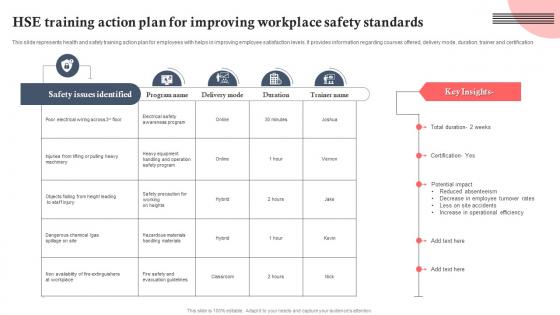
HSE Training Action Plan For Improving Workplace Safety Standards




Try Before you Buy Download Free Sample Product
 Impress Your
 Audience
 100%
100% Editable
 Save Hours
 of Time


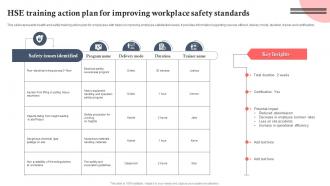
This slide represents health and safety training action plan for employees with helps in improving employee satisfaction levels. It provides information regarding courses offered, delivery mode, duration, trainer and certification.
People who downloaded this PowerPoint presentation also viewed the following :
HSE Training Action Plan For Improving Workplace Safety Standards with all 6 slides:
Use our HSE Training Action Plan For Improving Workplace Safety Standards to effectively help you save your valuable time. They are readymade to fit into any presentation structure.





FAQs for HSE Training Action Plan For Improving
You'll want to focus on four key things: hazard identification training so people can actually spot problems early, solid procedures for equipment and emergencies, hands-on practice (because just reading about it doesn't stick), and regular refreshers to keep it all current. Honestly, most companies totally bomb on the practical side. People forget so fast without actually doing the work. Track completion rates and document everything - it saves your butt later. Oh, and definitely audit what you have now first. Figure out where the biggest knowledge gaps are before you build anything new.
Track both leading and lagging indicators - stuff like incident rates, near-miss reports, and safety audit scores before/after training. Quiz people weeks later, not right when they finish (memory's still fresh then). Behavioral observations work great too. Honestly, safety culture surveys tell you way more than most people think. Set your baseline measurements first, then check quarterly for real improvement trends. Oh, and don't forget employee engagement in safety programs - that's huge for seeing if training actually stuck.
Oh man, employee pushback is the worst part - everyone thinks it's just box-checking instead of actually keeping them safe. Scheduling around shifts is a total headache too. Generic training materials are useless, honestly. People zone out immediately. Language barriers make everything harder, especially if you've got a mixed crew. My advice? Start with small groups and get your managers to actually show up and participate. Makes a huge difference when leadership isn't just paying lip service to it. Focus on the real hazards people deal with every day, not some corporate template nonsense.
So here's the thing - good HSE training gets your whole crew thinking the same way about safety. People stop treating it like paperwork and actually make it part of what they do every day. You'll notice they start catching problems and actually saying something about it, which is honestly half the battle. Plus when someone sees unsafe stuff happening, they won't feel weird about calling it out. The key is making your training sessions interactive and tied to real situations they deal with. Otherwise people just zone out. Regular training builds this shared mindset where everyone feels responsible for keeping each other safe.
Dude, tech is totally changing HSE training for the better. VR lets you practice dangerous stuff without actually getting hurt, which is pretty genius if you ask me. Mobile apps work great for quick learning sessions when people are swamped. AR gives workers real-time help right on the job. The analytics from learning management systems show exactly where your team's struggling most - that data's honestly incredible. My advice? Don't go crazy trying to digitize everything at once. Pick one solution that fixes your biggest headache first, then build from there. Way better than those boring PowerPoint marathons everyone used to sit through.
Just figure out what hazards your people actually deal with first. Construction crews need the heavy-duty stuff - fall protection, machinery safety, all that. Healthcare workers? Infection control is huge, plus chemical handling. Office folks mostly need ergonomics training and basic emergency stuff (honestly way less exciting but whatever). Do a real risk assessment for each job before you build anything. Different industries have totally different legal requirements too - that part's annoying but you can't skip it. I'd start by listing your worst-case scenarios and work backwards from there. Way easier than trying to cover everything at once.
Honestly, the biggest thing is mixing it up so people don't fall asleep during another boring slideshow. Get them doing hands-on stuff - equipment demos, role-playing scenarios, group discussions about problems they actually deal with. Videos and quizzes help too. I'd start each session asking what safety issues they're seeing right now, then focus on that instead of generic examples. Case studies work great if they're based on real workplace situations. Oh, and get people moving around - sitting there for hours kills engagement. Short activities beat long lectures every time.
Honestly? Once a year minimum, but that's barely cutting it these days. I'd check your stuff every 6 months - regulations change constantly and you don't want to get caught off guard. Do a complete overhaul annually though. Oh, and if there's ever a major incident at your workplace or new safety rules drop, update everything right away. Don't wait around. Industries move fast now and what worked last year might not fly today. Set those calendar reminders or you'll totally forget!
Honestly, it's a total mess because every country does their own thing. OSHA handles it in the US, UK has their HSE rules, and don't even get me started on how the EU makes each member state follow their directives. Most places want basic safety training for everyone though. Then you've got role-specific stuff on top of that, plus refresher courses every so often. Construction and chemical work? Yeah, they pile on extra requirements. Your best bet is hitting up your local labor authority's website - they're usually pretty good about listing what you actually need for your industry. Way easier than trying to guess.
VR's actually perfect for this stuff - you can throw trainees into confined spaces, chemical spills, equipment breakdowns, all without anyone getting hurt. The headsets don't suck anymore either, which is nice. They get real practice making tough calls instead of just sitting through another boring safety video. Plus you can see exactly where they mess up and make them run it again until they get it right. My buddy's company started with their scariest scenarios first and built from there. The whole "learning by doing" thing really sticks better than traditional training methods.
Honestly, mix it up - don't just do one thing. Written tests are obvious for checking if people actually remember the safety rules. But the real gold is having them physically demonstrate stuff, like properly putting on PPE or doing lockout procedures. That shows they actually get it, not just memorized answers. Role-playing works great too for emergency scenarios. Group discussions can be surprisingly useful since people reveal what they understand when talking to each other. I learned this the hard way at my last job - we only did written tests and people still made basic mistakes on site. You want multiple ways to check if training actually stuck.
Make safety training part of regular life, not some annual box-checking thing. Monthly safety chats work great. So do peer sharing sessions where people actually talk about real stuff they've seen. Those boring click-through trainings? Total waste - I've sat through way too many. Instead, give people quick phone modules they can actually use. Teams should suggest their own training topics based on what's happening day-to-day. Encourage near-miss stories without making people feel like they'll get in trouble. Recognition goes a long way too. The whole point is making it feel like you're growing, not getting punished for something.
Make your HSE stuff actually relate to what your people do every day - real equipment, actual scenarios they'll face. Nobody's gonna remember a boring hour-long presentation anyway, so break it into chunks and make it interactive. Always explain the why behind safety rules, not just the what. Pictures and diagrams help tons. Honestly, I'd test everything with a few people first to see what's confusing. Oh, and this is huge - keep updating your materials when things change. There's nothing worse than training people on outdated procedures. You'll just create more problems.
Dude, language barriers totally mess up safety training. Workers miss crucial info when they can't understand what's being said. Then there's the cultural stuff - some people won't speak up about dangers because of how they were raised around authority figures. I've watched this blow up on sites with mixed crews, honestly it's frustrating to see. Get materials translated, bring in interpreters for the heavy stuff. Your training needs to work with different communication styles too. Oh, and make sure everyone feels okay asking questions - that part's huge.
VR/AR stuff is everywhere now - lets people practice dangerous scenarios safely. Microlearning's big too, like 5-10 minute chunks instead of those awful hour-long sessions. Your team's probably on phones half the day anyway, so mobile delivery just makes sense. Gamification honestly feels cheesy but the engagement numbers don't lie. Oh, and analytics are getting crazy good at pinpointing exactly where people zone out. I'd test some short mobile modules first. See how they compare to whatever you're doing now - might surprise you.
-
Illustrative design with editable content. Exceptional value for money. Highly pleased with the product.
-
Unique design & color.