


HSE Employee Training Matrix With Job Title




Try Before you Buy Download Free Sample Product
 Impress Your
 Audience
 100%
100% Editable
 Save Hours
 of Time


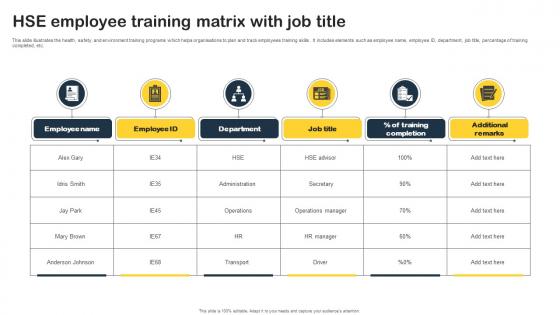
This slide illustrates the health, safety, and environment training programs which helps organisations to plan and track employees training skills. It includes elements such as employee name, employee ID, department, job title, percentage of training completed, etc.
People who downloaded this PowerPoint presentation also viewed the following :
HSE Employee Training Matrix With Job Title with all 6 slides:
Use our HSE Employee Training Matrix With Job Title to effectively help you save your valuable time. They are readymade to fit into any presentation structure.





FAQs for HSE Employee Training Matrix
So start with your job roles and what specific dangers each one faces. Map out the training they need and when it's due. I'd track competency levels too - basic stuff versus advanced certs, you know? Most places overcomplicate this from day one, which is a mistake. Begin simple, then layer on more later. Your matrix needs to show training status, renewal dates, and who delivers what. Create clear paths from basic induction up to specialized skills. Honestly, I'd just pick your 5 riskiest positions first and build backwards from there. Way easier than trying to do everything at once.
Start by doing a real job hazard analysis for each role - not those cookie-cutter templates everyone uses. Walk around, talk to your people, check incident reports. Your workers know the training gaps better than anyone, so survey them first. Look at injury data and near-miss reports too. Most companies skip this part and wonder why their training sucks. Map what skills people actually need against what they have now. Industry regs matter obviously, but focus on stuff that'll genuinely keep people safe instead of just ticking boxes. That's honestly where you'll see the biggest difference.
So the HSE training matrix is basically your roadmap for who needs what safety training. Maps out all the mandatory certs, refresher courses, role-specific stuff - you know, everything auditors will hunt for. Don't wing it like we did at my old place (disaster). Track expiration dates religiously or you'll get burned during inspections. Keep it updated and use it for training reports. Honestly, some of this regulatory stuff feels like overkill but when inspectors show up, you'll be glad you have everything documented properly. It's your lifeline when they start asking questions.
Dude, ditch those Excel spreadsheets from hell and get some proper training software. You'll set up automated alerts so people actually know when their certs are about to expire - no more "oh shit" moments when you realize everyone's confined space training lapsed weeks ago. Mobile apps are clutch because workers can knock out training modules from anywhere. Real-time dashboards show you exactly who needs what and when. Plus everything syncs with your HR system automatically, which honestly saves so much headache. Start looking at training management platforms that play nice with whatever systems you're already running.
Honestly, the best way is mixing a few different approaches. Do before/after assessments to see if people actually learned anything. Watch incident rates - that's where you'll see if training stuck or not. Get feedback from participants too, though sometimes they just say what they think you want to hear. I'd also observe how people actually behave at work afterward since that matters more than test scores. Track completion rates obviously. The key is reviewing all this stuff together maybe quarterly? That way you're not just looking at one metric and thinking you know the whole story.
Officially you're supposed to do it annually, but honestly every 6 months is way better if you can manage it. Really depends on your industry though - if regulations change a lot or you're bringing in new equipment, you'll need more frequent updates. New hires always mess up the matrix too, which is annoying but inevitable. High-risk industries definitely need more reviews. Oh and incidents obviously trigger updates when they show training gaps. Set a phone reminder right now or you'll totally forget about it until something bad happens.
Honestly, the worst part is just getting everyone on board - each department thinks they're too unique for your categories. Mapping every role to competencies at the start? Takes forever. Plus tracking who's actually finished their training across different systems is a nightmare. People love to drag their feet on this stuff. Refresh schedules are another pain because what works for sales definitely doesn't work for IT. My advice? Pick one department, get it right there first, then roll it out. Way less headache than trying to boil the ocean from day one.
So basically, an HSE training matrix shows what training each person needs vs what they've actually done. Think of it like a spreadsheet that doesn't suck - you can instantly see who's missing certs or whose stuff has expired. Super handy for avoiding compliance headaches. Start by listing all the mandatory requirements for each job, then go through your current records. The gaps will jump out at you pretty fast. Honestly saves so much time when you're trying to figure out training budgets and who needs what first.
So looking at that matrix, you want interactive stuff instead of boring lectures. Real scenarios work way better - like actual situations they'd face on the job. Hands-on practice is huge. Gamification is surprisingly effective too (who knew people would get competitive about safety quizzes lol). Personalize it for different experience levels and let veteran workers share their war stories - that peer learning hits different. The key thing though? Show them how it actually protects them and their teammates personally. I'd start by checking what you're doing now and pick one interactive element to test first.
So you gotta map this new stuff to your job roles first - figure out who actually needs it and whether it's required or just nice-to-have. Then update your competency matrix and build the training modules. Fair warning though, this part's pretty boring but you can't skip it. Set up some way to track completion too, because people will definitely "forget" otherwise. Honestly the biggest mistake I see is companies just tacking this on randomly instead of treating it like any other safety requirement. Assign it properly, track it, refresh it when needed. Oh and don't let anyone tell you it can wait - get ahead of it now.
Mix it up - online modules work fine for basic compliance stuff, but save classroom time for the complex topics where people actually need to discuss things. Honestly, hands-on training is where it gets real though. Nobody's learning proper PPE fitting from a screen, and don't even get me started on trying to teach fire extinguisher use virtually. Map each topic to whatever format actually makes sense for how they'll use it later. Confined space entry? That's gotta be hands-on. Risk assessments? Perfect for group discussion. The boring hazard ID theory stuff can totally be online modules.
Build a central framework first - map out your core HSE competencies and figure out what's absolutely non-negotiable versus what sites can tweak locally. Don't get stuck trying to make everything identical (learned that one the hard way). Set up standard job categories, then give managers templates they can actually customize for their specific regulations and hazards. Honestly, the tracking system matters more than perfect documentation. You need consistent audits too, otherwise sites will just do whatever's easiest. Focus on safety fundamentals that can't be compromised, but let them adapt the rest.
Track completion rates and test scores first - that's your quick wins data. Then watch incident rates and near-miss reports in areas where you've done the training. Behavioral observations are honestly where the magic happens though - are people actually doing what you taught them? I'd also survey folks after 30-60 days about their confidence levels. Oh, and don't go crazy trying to measure everything. Pick maybe 3-4 solid metrics to start. Time-to-competency is another good one if you're tracking skills development. Safety audit scores will show longer-term impact too.
Yeah, cultural stuff can totally mess up your HSE matrix if you're not careful. What kills it in Germany might bomb completely in Brazil or Thailand - people have wildly different attitudes about hierarchy and risk. Some cultures want you to just tell them what to do, others need the whole group discussion thing. Honestly, safety concepts you think are no-brainers sometimes just don't translate at all. Build flexibility right into your matrix from the start. Keep your core standards but let regions customize how they actually deliver the training and what examples they use. Way less headaches that way.
So basically an HSE training matrix shows you exactly who needs what training and when. You can map it against your actual workplace hazards to find the gaps - that's where I'd start. When incidents happen, you'll see if they connect to missing skills, then adjust your training plan. It becomes this living document that changes with your risks, which honestly makes way more sense than static training schedules. Plus you can track if the training's actually working over time. Way better than just ticking boxes and hoping people get safer.
-
Every time I ask for something out-of-the-box from them and they never fail in delivering that. No words for their excellence!
-
Loved the collection. Editing the presentation was seamless with their templates.