


Best Practices For HSE Management System




Try Before you Buy Download Free Sample Product
 Impress Your
 Audience
 100%
100% Editable
 Save Hours
 of Time


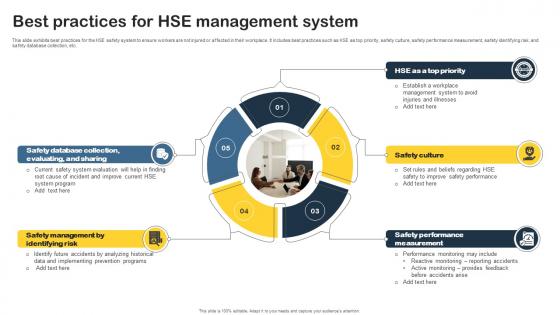
This slide exhibits best practices for the HSE safety system to ensure workers are not injured or affected in their workplace. It includes best practices such as HSE as top priority, safety culture, safety performance measurement, safety identifying risk, and safety database collection, etc.
People who downloaded this PowerPoint presentation also viewed the following :
Best Practices For HSE Management System with all 6 slides:
Use our Best Practices For HSE Management System to effectively help you save your valuable time. They are readymade to fit into any presentation structure.





FAQs for Best Practices For
You need leadership buy-in first - seriously, nothing works without that. Then build out your policies, risk assessments, and training programs. Don't forget incident reporting and regular audits to keep things honest. Communication channels are huge too, both up and down the chain. Here's the thing though - they all have to work together, not just exist as separate boxes you check. I'd honestly start by looking at what you already have in place and figuring out where the gaps are. Performance metrics help you see if it's actually working or just looks good on paper. Think of it more like a web than building blocks, if that makes sense.
Honestly, the trick is getting everyone to own it instead of just having safety officers bark orders. Get your team involved in writing the actual procedures - they're out there doing it every day, so they know what's really dangerous. Training's fine, but what really works is when bosses actually show up and praise people for good safety habits rather than just yelling about screw-ups. Oh, and create ways for people to report close calls without getting in trouble. Share those wins with other teams too. Make it feel collaborative instead of like you're being policed all the time. That's when people actually care versus just going through the motions.
Look, your leaders basically make or break the whole thing. If they're not walking the walk, everyone else will just phone it in - I've seen it happen so many times. Get them doing safety walks and actually showing up to HSE meetings. That visibility is huge. They need to model the right behaviors and actually put money behind safety initiatives, not just talk about it. When your leadership treats HSE like it matters instead of just another box to check, that attitude spreads fast. It's honestly the difference between a real safety culture and just having some policies on paper.
Stop treating risk assessment like a box-ticking exercise you do once and forget about. Build it into everything - project planning, daily ops, incident reviews, the works. Here's what kills me: companies let each department use different risk matrices and wonder why nothing makes sense. Pick one methodology and stick with it across the board. Your frontline workers are gold for spotting risks, so actually train them to report stuff. Keep updating your risk register when new hazards pop up or conditions change. Oh, and near-misses count too - don't ignore those. Start by figuring out where your current process is broken.
Make reporting super easy or people just won't do it. Multiple ways to report - online, phone, apps, whatever works. Anonymous options are huge. Build a no-blame culture so folks actually speak up about near-misses (this part's honestly the hardest). When stuff happens, use proper methods like root cause analysis instead of just writing down what went wrong. Speed matters - investigate within 24-48 hours while everyone remembers clearly. Don't forget to share what you learned with the whole team afterward. Otherwise you'll just see the same incidents over and over.
Dude, technology is a game-changer for HSE stuff. Mobile apps let people report hazards instantly instead of waiting around. IoT sensors do the monitoring 24/7 so you don't have to babysit everything. Those dashboard analytics are honestly pretty sweet - they catch problems before things go sideways. Digital audits mean no more drowning in paperwork (seriously, who has time for that?). Cloud platforms make training way easier across different locations. My advice? Pick whatever's causing you the biggest headache right now and digitize that first. You can always add more tools later once you see how much time it saves.
Hands-on stuff works way better than boring PowerPoint slides, trust me. Get people doing actual exercises - like spotting hazards or practicing incident responses. Short toolbox talks are gold since they focus on real situations your crew deals with every day. Make it specific to what they actually do, not generic safety BS. Monthly safety moments keep it fresh, or you could rotate topics. Oh, and peer-to-peer sharing is huge - people listen more when it's coming from coworkers. One training session and you're done? Nah, that never sticks.
Honestly, you've got to bake this stuff into your regular HSE routine instead of scrambling after something goes wrong. Monthly reviews work great - dig into your incident data and near-miss reports to catch patterns early. Your frontline workers are gold mines for this btw, they spot issues management totally misses during daily ops. Safety committees and suggestion boxes actually help if people use them. Post-incident reviews are obvious but still crucial. Oh, and compare yourself to industry benchmarks so you know where you're falling behind. The trick is actually following through on what you discover during these reviews.
Honestly, most places just stare at injury rates after people already got hurt - that's backwards. You want both sides: the stuff that predicts problems (training completion, hazard reports, near-misses) and the actual incidents that happened. Leading indicators are way more useful since they show if your prevention work is actually doing anything. Track incident rates and workers' comp too, but don't make that your whole world. The real trick is watching trends over months, not freaking out over one bad week. Start small though - maybe 3 solid metrics you can actually control.
So regulations are basically your starting point - the bare minimum you can't ignore. First thing is mapping out what actually applies to you (OSHA, EPA, whatever local stuff). Honestly, this part can be a total headache because some regs overlap in weird ways. But here's the thing - don't just stop there. Use compliance as your foundation, then add your own best practices on top. I'd start with a full regulatory review for your specific industry and location. That gives you the non-negotiables, then you can build out from there with company-specific controls.
Honestly, it starts with leadership - they've gotta show safety matters more than hitting deadlines. Talk about it daily, not just when something goes wrong. The places I've worked where safety was just lip service? Total disaster waiting to happen. Let people report near-misses without getting in trouble, celebrate the wins publicly, and give everyone permission to halt work if things feel sketchy. Your team needs to know that raising safety concerns gets them praise, not a target on their back. Oh, and involve everyone in the discussions - can't be some top-down management thing.
Honestly, the biggest thing is making sure your safety talks aren't just one-way lectures. Get your frontline people talking back - toolbox talks, regular briefings where they can actually call out hazards without getting in trouble. Digital dashboards are nice I guess, but nothing beats just having real conversations about the serious stuff. Your executives and supervisors need to be on the same page too, otherwise workers get mixed messages. Create that environment where people aren't scared to report close calls. I'd start by asking your team directly - where do they think communication is breaking down right now?
Honestly, the worst part is getting people to actually care about HSE instead of seeing it as annoying paperwork. Leadership buy-in is crucial - if your bosses aren't visibly supporting it, you're screwed. Different departments will implement things their own way, which creates chaos. The upfront costs for training and setup aren't cheap either. Oh, and communication between management and workers on the floor? That's always a mess. Start small with some easy wins first - builds momentum. Then make sure leadership is obviously backing the whole thing from the start.
Set up different ways for people to give feedback - surveys, safety committees, contractor meetings, community sessions if needed. Actually listen though, don't just pretend to care (those dusty suggestion boxes are the worst). Frontline workers catch stuff management totally misses. External people will call out environmental issues you're blind to. Always circle back and tell people what you changed based on their input - that's huge for trust. Do quarterly reviews to spot patterns and turn feedback into real improvements. It's honestly one of the most effective things you can do.
Look, audits are basically your wake-up call for figuring out if your HSE system actually works or if it's just paperwork nobody looks at. They show you where theory meets reality - and trust me, there's usually a gap. The smart move is catching issues before they blow up into real incidents. Don't let your team think auditors are there to bust them though. Frame it as "hey, let's find what we can fix" instead of playing gotcha. Internal audits work way better than waiting for outsiders to point out your mess. I learned that one the hard way at my last job.
-
Keep doing the good work guys. Surpass the needs and expectations always!!
-
“Superb. What a great finding. Thankful for SlideTeam. We were paying people to make slides which went all in vain. We are so happy to have found you.”