

Corporate HSE Management System Documentation Hierarchy




Try Before you Buy Download Free Sample Product
 Impress Your
 Audience
 100%
100% Editable
 Save Hours
 of Time


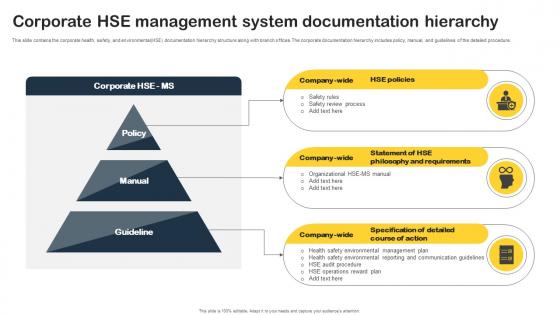
This slide contains the corporate health, safety, and environmental HSE documentation hierarchy structure along with branch offices. The corporate documentation hierarchy includes policy, manual, and guidelines of the detailed procedure.
People who downloaded this PowerPoint presentation also viewed the following :
Corporate HSE Management System Documentation Hierarchy with all 6 slides:
Use our Corporate HSE Management System Documentation Hierarchy to effectively help you save your valuable time. They are readymade to fit into any presentation structure.





FAQs for Corporate HSE Management
So basically there are four levels to HSE docs. Your policy sits at the top - that's all the big picture commitment stuff. Procedures come next, which are your "here's how to do this safely" step-by-step guides. Work instructions get way more specific about individual tasks. Records and forms are at the bottom. It's like a pyramid that gets more detailed as you work down. Oh, and make sure nothing contradicts between levels - I've seen that mess up companies before. The whole thing falls apart if your policy says one thing but procedures say something else.
So your safety policy is basically the boss of all your other HSE docs. Everything flows down from there - procedures, work instructions, all of it. Like if your policy says "zero harm," then your procedures better actually show how you're gonna make that happen with real controls. The whole thing works when there's a clear line from your big-picture policy down to the nitty-gritty stuff. Auditors love this because they can trace everything back up the chain without finding weird gaps. Makes sense once you see how it all connects - though honestly, some companies still mess this up pretty badly.
So HSE procedures are basically your big-picture "what needs to happen" docs - they cover the overall process and compliance stuff. Work instructions are way more detailed though. They're the actual step-by-step guides your workers follow on the floor. I always think of procedures like a roadmap, while work instructions are more like those annoying GPS directions that tell you exactly when to turn (but actually useful for safety). Usually one procedure will reference several work instructions underneath it. Oh, and when you're writing this stuff - start with the procedure first to get your framework down, then drill into the specific work instructions for each task.
Look, good HSE docs are basically your safety net with regulators - they can see you're actually walking the walk, not just talking. I'd start by figuring out which regs hit your operations first (sounds boring but trust me on this). Then build your documentation to match those requirements directly. Honestly, once you get organized it makes everything smoother. You'll have standard processes that cut down on mistakes, solid proof of training and risk assessments, plus you can grab whatever paperwork auditors want in like two seconds. Makes inspections way less stressful too.
Risk assessments are basically the middle layer of your HSE docs - they connect your big picture policies to the actual day-to-day work instructions. You can think of them as translating "we care about safety" into "here's exactly how we'll handle this specific risk." Honestly, they get referenced more than almost any other document because they feed directly into procedures, training, and emergency plans. Oh, and when you're setting up your hierarchy, make sure there's a clear line from policies down through risk assessments to procedures. That connection is what actually makes everything work together instead of just sitting there looking official.
Look, you've gotta build this into people's actual jobs or it won't happen. Quarterly reviews for the risky stuff, yearly for everything else. Give your frontline workers an easy way to report when something's wrong - they catch these issues way before management does. Someone needs to own each document, period. Version control is non-negotiable so you can see what changed. Oh, and watch for regulatory updates that might force immediate changes. Create a basic checklist covering accuracy and compliance. Honestly, incident reports are goldmines for spotting what needs fixing. Don't make this a "spare time" project - it'll just sit there gathering dust.
Ugh, version control is honestly the worst part - everyone's working off different docs and nobody knows what's current. Different teams read the same requirements and somehow come up with totally opposite interpretations. Then regulations change and suddenly half your procedures are outdated. People update stuff without going through proper reviews, which makes the whole hierarchy a mess. Oh, and trying to keep everything consistent across multiple sites? Good luck with that. You really need someone owning each document level and a solid review schedule. Regular audits will save you from compliance headaches later.
Honestly, go digital with your HSE docs - it'll save you so much time. Cloud platforms mean no more version confusion, and you can set up automated reminders so reviews don't get forgotten. Digital approval chains actually move fast, unlike those paper forms that vanish into thin air (seriously, where do they go?). Document management systems make searching a breeze too. I'd start with whatever procedures you update most - maybe your incident reports? You'll notice the difference right away, then just expand from there. Plus everything's trackable so you know who looked at what.
Honestly, mix it up - that's what works best. Start with hands-on workshops where people actually work through real documents instead of just sitting through boring presentations. Digital modules are solid for the basics, and your team can always go back to them later. Pair newbies with someone who really knows their stuff as a mentor. Oh, and don't forget regular refresher sessions, especially after you update procedures (which seems to happen constantly, right?). Test them with practical exercises, not those ridiculous multiple-choice quizzes. Everyone learns differently, so throwing different methods at them usually does the trick.
You definitely need to get stakeholders involved from day one - it totally changes what you prioritize and how you write policies. Workers, management, regulators, even community groups sometimes. I can't tell you how many gorgeous policy documents I've seen that just collect dust because nobody asked what actually happens in practice. Real talk: your hierarchy should bubble up from what frontline people are dealing with daily. Map out who you need early on (this part's honestly kind of tedious but worth it). Otherwise you'll end up with documentation that looks great but doesn't work for anyone who actually has to use it.
Track document access rates and completion percentages for required reading - that's your starting point. But honestly, the stuff that really matters comes later. Watch your incident rates, audit results, and compliance scores. Those tell you if people are actually applying what they read or just clicking through. Also measure how fast employees find info and whether you're getting fewer repetitive questions (that one's huge). I'd pick maybe 3-4 metrics that connect directly to your safety goals. Review monthly so you catch issues early.
Honestly, HSE docs are super helpful for incident investigations - they give you clear step-by-step procedures and templates so you're not flying blind. Your reports actually feed back into the system too, which is pretty cool. Like if you find gaps in training or procedures, that gets flagged for updates. The hierarchy thing means you know exactly how detailed to get depending on the incident type. Short stuff gets basic treatment, bigger incidents get the full treatment. Oh and definitely read through your site's specific reporting procedures before something actually happens - way easier than scrambling to figure it out in the moment.
Dude, records are basically your safety insurance policy. You can't prove jack without them when auditors show up. Document everything - training sessions, inspections, incidents. Otherwise your fancy procedures are just expensive paper. I learned this the hard way at my last job when we couldn't find training records during an audit. Total nightmare. Records help you spot patterns in incidents too, which is actually pretty useful for preventing future problems. Just stay consistent with it. Trust me, you'll be so glad you did when compliance time rolls around.
Good documentation basically gives everyone the same rulebook so nobody's guessing what to do. I've seen too many places where people just make stuff up as they go - not great for safety. When you write things down properly, it shows leadership actually cares instead of just talking about it. The hierarchy thing matters too because your critical policies need more attention than your everyday procedures. Honestly, I'd start by checking what you have on paper versus what's actually happening. That gap is usually pretty eye-opening.
Honestly, skip the corporate jargon completely - when people's safety is at stake, plain English wins every time. Get your subject matter experts involved early, but don't forget the folks actually using these docs daily. Their input is gold. Set up annual reviews (or after any incidents obviously). Version control will save your sanity later - trust me on this one. Template structure helps keep everything consistent with your risk tolerance. Oh, and definitely test run your documentation with real users first. They'll spot gaps you'd never think of. Short version: clear, tested, and regularly updated beats fancy every time.
-
A library of engaging, customizable and content-ready templates.
-
“I really like the convenient operation and professionalism I saw on the SlideTeam website. I want to express my regards and appreciation to the team.”