

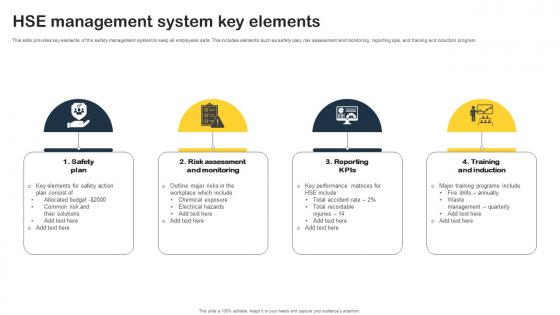
HSE Management System Key Elements




Try Before you Buy Download Free Sample Product
 Impress Your
 Audience
 100%
100% Editable
 Save Hours
 of Time


This slide provides key elements of the safety management system to keep all employees safe. This includes elements such as safety plan, risk assessment and monitoring, reporting kpis, and training and induction program.
People who downloaded this PowerPoint presentation also viewed the following :
HSE Management System Key Elements with all 6 slides:
Use our HSE Management System Key Elements to effectively help you save your valuable time. They are readymade to fit into any presentation structure.





FAQs for HSE Management
You'll need policy and leadership buy-in first - that's non-negotiable. Risk assessment and hazard ID come next, plus tracking legal compliance (ugh, the paperwork). Set clear objectives, put operational controls in place, and build a solid incident management system. Training is honestly where most places screw up though. People skip the competency development part and wonder why nothing works. Regular monitoring and audits keep things from falling apart, and management reviews tie it all together. The trick? Don't let these components work in silos - they need to actually connect. Map what you've got now, then fill the gaps.
Honestly, you've got to get your workers involved first - they actually know what's dangerous out there. Do proper risk assessments for everything: spot the hazards, figure out who gets hurt and how, then use whatever risk matrix your company has (usually just likelihood vs how bad it could be). Document it all because auditors are obsessed with paperwork. For communicating, mix it up - toolbox talks, safety meetings, put up visual stuff around the site. Training sessions work too, but keep everything simple and relevant to what each crew actually does. Otherwise people just tune out.
Oh man, training is huge for safety stuff. Your incident rates will drop like crazy when people actually know what they're doing and can spot problems early. I've seen too many companies just go through the motions though - total waste of time and money. You want training that connects to their real job, not some generic slideshow they'll forget in a week. Test them afterwards too. Keep everything current. Honestly, employees who understand the actual risks they face? They'll catch hazards before things go sideways, which beats dealing with accidents any day.
Honestly, digital tools are a game-changer for HSE stuff. Mobile apps let your field guys report incidents right away instead of waiting till they're back at their desk. IoT sensors track environmental data automatically - no more manual readings that everyone forgets about. I've worked with companies that literally cut their compliance workload in half using automated dashboards. Digital audit platforms make inspections way smoother too. The trick is finding systems that actually integrate well together. Nobody wants to bounce between five different apps all day. Pick one solid solution for your biggest headaches first, then build from there.
Look, when you bake HSE into your actual business strategy, it stops being this annoying checkbox thing. Your risk management gets way better. Compliance becomes automatic instead of this scramble every time regulators show up. Customers and investors eat that stuff up too - everyone's obsessed with "responsible business" now. The real game-changer though? When your team sees you treating safety metrics like you do revenue numbers, they actually start caring instead of just pretending to. Oh, and definitely add HSE stuff to your regular business reviews - makes a huge difference.
Track both leading and lagging indicators - incident rates, near-miss reports, audit scores, training completion. Leading indicators give you early warnings (safety observations, hazard reports). Lagging ones show what already went wrong. Most companies get obsessed with the lagging stuff when honestly, leading indicators are way better for actually preventing problems. Look at trends over months, not just snapshots. Don't skip the softer metrics either - employee feedback and culture surveys tell you tons. My old manager used to say "data without action is just expensive decoration," which is pretty accurate. Set up maybe 5-7 key metrics on a dashboard you'll actually check regularly.
Honestly, the pushback is real - people see HSE as just another stack of forms to fill out. Leadership has to actually show they care, not just send emails about it. Money and staffing are always tight too, which makes everything harder. Communication gets messy fast, especially when departments don't talk to each other. Here's what worked for me though - find your biggest complainers first and get them involved in planning. Sounds backwards, but once they feel heard, they'll often flip and become your best supporters. Start there before rolling anything out.
Safety has to feel personal, you know? Leadership can't just email about metrics - they need to actually show up. Get people on safety committees and reward them when they speak up about problems or near-misses. Don't make it scary to report stuff. Honestly, the psychology matters way more than formal training sessions. Celebrate the person who points out a hazard instead of making them feel like a snitch. Bring it up in regular meetings, not just after something goes wrong. People will care about safety when they see you actually care about their input.
Dude, this stuff gets overwhelming fast. OSHA's your starting point if you're in the US, plus whatever your state throws at you. EPA regulations are honestly where I've seen companies get burned the most - all those permits and reporting deadlines add up quick. Then you've got industry-specific stuff like DOT or FDA depending what you do. Going international? ISO 45001 and 14001 are solid frameworks to build from. My buddy at work swears by creating this big matrix that maps every regulation to what you actually do. Sounds nerdy but it works - nothing gets missed that way. Trust me, playing catch-up on compliance later is way worse than doing the homework upfront.
Honestly, get a good checklist going and stick to your schedule - that's half the battle right there. Talk to the actual workers, not just their bosses. They're the ones who know where stuff gets sketchy. I've watched so many audits completely whiff on obvious problems because they only chatted with supervisors. Take photos of everything and track both your compliance stuff plus any warning signs. Oh, and book your next round of inspections as soon as you finish this one - otherwise you'll forget and lose momentum. Make it feel like teamwork instead of gotcha moments. Workers shut down fast if they think you're hunting for problems to blame them for.
Look, incident reporting is basically your treasure trove for catching patterns before they bite you. Every near-miss and injury you document builds this database that shows trends you'd totally miss otherwise. Could be the same machine breaking down constantly, or maybe accidents always happen during shift changes - honestly, you never know what'll pop up. The real magic happens when you dig into that data to find root causes. Then you can actually fix your procedures or retrain people. It's this whole feedback thing that makes your safety program way smarter. Don't just treat reports like boring paperwork - each one's a lesson waiting to happen.
Honestly, you've got to make HSE feel like it matters to everyone personally, not just some corporate checkbox. Figure out what each group actually wants - workers need safety that doesn't kill their productivity, managers want easy compliance, execs want fewer lawsuits basically. Two-way communication is everything here. Set up safety committees, feedback sessions, and actually listen (wild concept, right?). Celebrate people publicly when they contribute to improvements - recognition works like crazy. But here's the key: let stakeholders help create the procedures they'll follow. When people have input, they'll buy in. Way better than just dropping rules on them.
Start by walking through your workplace and spotting hazards - then figure out how likely they are to cause harm and how bad it'd be. Get the actual workers involved because they know way more about real risks than management does. Document it all in whatever template your company uses (trust me, it'll save your butt during audits). Rate everything with your risk matrix, write down how you'll control each hazard, and make someone responsible for it. Keep the paperwork simple but complete. Oh, and actually review the thing regularly - most people just file it away and forget about it, which defeats the whole point.
Leadership makes or breaks everything honestly. If your managers aren't walking around, actually asking questions, and showing they care more about safety than hitting numbers, you're screwed. I've watched places where bosses just talk a big game but don't back it up with real money or decisions. Good leaders do site walks, listen when people bring up problems, and prove safety matters through their actions. Oh and they don't throw safety out the window when deadlines get tight. Watch how your current leaders actually act around safety stuff - that'll show you what kind of culture you're really dealing with.
Build your HSE system like building blocks - start small with the basics like incident reports and risk assessments. Those work whether you've got 10 people or 1000. Pick cloud-based tools that let you add users as you grow (way easier than switching platforms later). Documentation templates are clutch - make them once, use them everywhere. I'd honestly focus on automating the boring stuff first so you're not drowning in paperwork when the team doubles. Don't overthink the fancy features at the beginning. Simple role definitions that you can copy across departments will save you headaches down the road. Oh, and avoid anything that screams "enterprise solution" if you're still figuring things out.
-
You know what? I'm so glad I opted for this PPT design. It has been a total game-changer for me and my presentations. Thank you!
-
I joined SlideTeam last month and there’s no doubt that I tend to find our bond only strengthening over time. Best place to find world-class themes, templates, and icons.