


HSE Action Plan For Developing Safety Procedures





Try Before you Buy Download Free Sample Product
 Impress Your
 Audience
 100%
100% Editable
 Save Hours
 of Time


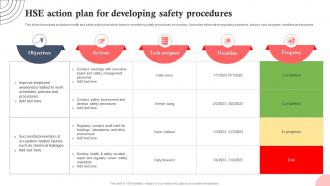
This slide showcases workplace health and safety action plan which helps in monitoring safety procedures at company. It provides information regarding objectives, actions, task assignee, deadline and progress.
People who downloaded this PowerPoint presentation also viewed the following :
HSE Action Plan For Developing Safety Procedures with all 6 slides:
Use our HSE Action Plan For Developing Safety Procedures to effectively help you save your valuable time. They are readymade to fit into any presentation structure.





FAQs for HSE Action Plan For
So you need hazard identification and risk assessment first - that's your foundation. Then build in solid control measures plus regular monitoring to catch stuff early. Training protocols are huge, and don't skip incident reporting or emergency response plans. Honestly, the communication piece is where most places screw up because people can't easily flag problems. Your procedures better be readable too, not some massive document that sits on a shelf collecting dust. At the end of the day, if your team can't quickly grab what they need when they're actually out there dealing with something, you've failed.
First thing - figure out what regs actually hit your business. Local stuff plus international standards like ISO 45001. Create a matrix tracking requirements vs what you're doing now. Internal audits are your friend, and get outside experts to review everything yearly. Don't treat this like a one-and-done thing though - compliance is ongoing work that'll bite you if you slack off. I'd do quarterly team reviews to spot problems early. The whole regulatory maze is honestly such a pain, but better to stay ahead of it than deal with violations later.
Look, risk assessment has to come first - it's what everything else builds on. You can't write decent safety procedures without knowing what hazards you're actually dealing with and which ones are most likely to bite you. I learned this the hard way at my last job when we skipped ahead and ended up with procedures that totally missed some obvious risks. The assessment helps you figure out where to focus your energy instead of just throwing generic rules at everything. Trust me, doing it upfront saves you from having to go back and fix stuff later when something goes wrong.
Training makes a huge difference because it turns boring rules into stuff people actually remember to do. Honestly, just handing someone a manual is pretty useless. When your team understands why safety protocols exist and sees what happens when things go wrong, they'll follow them way more consistently. I've watched compliance rates shoot up 40-60% after hands-on workshops. Make it interactive and relevant to what they actually do day-to-day. Short refreshers every few months help too - people forget. The whole point is showing them these aren't just company rules, they're what keeps everyone safe.
So I'd start with safety audits and incident tracking - that's your bread and butter right there. Near-miss reports are gold though, way better than waiting for actual injuries to tell you something's wrong. Monthly dashboards help you spot trends before they bite you. Employee surveys matter too since they'll tell you stuff the data won't catch. Safety walks are honestly underrated - just walking around and actually looking at things catches so much. Oh, and don't forget training completion rates as an early warning system. Mix the hard numbers with what your people are actually saying on the floor.
Look, incident reporting is basically your feedback loop for stopping accidents before they happen. Report everything - even close calls. That's where you get real data on what's actually breaking down out there. Then comes the good part: digging into why stuff went wrong instead of just pointing fingers at whoever was unlucky enough to be there. You start seeing patterns emerge, like how people always slip in that one spot when it's wet, or certain machines acting up during night shifts. Honestly though, none of this matters if you don't actually fix what you find.
Honestly, the worst part is dealing with people who are like "we've always done it this way" - good luck changing their minds. Your training budget will probably suck too. Management loves talking about safety until it conflicts with hitting deadlines, then suddenly production wins every time. Oh, and don't get me started on procedures written in corporate jargon that nobody actually reads. You really need your frontline supervisors bought in first though. Skip that step and you're basically just creating expensive paperwork that sits in a binder somewhere. Work from the bottom up instead of trying to force change from the top.
Honestly, tech can be a game-changer for HSE stuff. Mobile apps let people report incidents instantly instead of filling out paperwork later (when they've already forgotten half the details). IoT sensors track air quality and equipment issues 24/7, which is pretty wild. Predictive analytics help you catch hazard patterns before someone gets hurt. VR training simulations work way better than boring PowerPoints too. Digital dashboards give managers real-time safety data across all sites. My advice? Start with just one mobile reporting app. See if your team actually uses it, then expand from there. Don't try to implement everything at once or you'll overwhelm everyone.
Honestly, start with getting your managers on board - if they don't care, nobody else will. Get everyone thinking safety is their job, not just the safety guy's problem. Those regular safety meetings help, but the real game changer is making sure people can speak up without getting fired or written up. Give them different ways to report stuff - anonymous boxes, apps, whatever works. And here's the thing most places mess up: actually do something visible when they report hazards. Celebrate safety wins like you would hitting sales targets. Oh, and just ask your crew what's bugging them safety-wise right now.
At minimum once a year, but that's cutting it pretty close honestly. Most places I know do it every 6-12 months depending on how risky their operations are. After any incidents or near-misses? Definitely update immediately. Same goes for regulation changes - and man, those seem to pop up constantly now. New equipment or processes are also triggers for review. Oh, and if you're expanding into different areas or hiring for new roles. Set up calendar reminders though, because someone needs to actually own this or it'll just slip through the cracks every time.
Dude, you really don't want to mess around with HSE stuff. Fines can be brutal, and if someone gets seriously injured you're looking at potential criminal charges. Insurance costs will go through the roof too. The worst part? Good employees will avoid you like the plague once word spreads about sketchy safety practices. Work stoppages happen. Clients these days actually check safety records before signing contracts - learned that the hard way at my last company. One major incident can cost more than years of doing things right from the start. Get an audit done ASAP to see where you stand.
Honestly, you can't just throw a manual at people and expect them to remember safety stuff. Mix it up - put visual reminders around the workplace, do hands-on training sessions, and send quick safety tips through email or whatever app you use. Interactive talks work way better than boring lectures, especially when you tailor them to what each department actually deals with. Focus on your riskiest areas first since that's where you'll get the biggest impact. Repetition is everything though - people need to see the same info in different ways before it actually clicks. Short bursts beat information overload every time.
Honestly, start with the big three - fall protection, hazard communication, and scaffolding. Those rack up the most OSHA violations by far. Get your crew trained on PPE, lockout/tagout stuff, and excavation protocols too. Oh, and heavy machinery - that one's obvious but you'd be surprised how often it gets half-assed. I mean, these areas cover most of the nasty accidents you'll deal with. Walk through your sites and see which ones are the messiest right now. That's literally your to-do list. Might feel overwhelming but honestly once you tackle these, you're in way better shape.
Honestly, environmental stuff is just part of HSE now - you can't really split them up anymore. Risk assessments include both worker safety AND environmental impacts, like if a chemical spill hits your crew and the local water supply. Most places run integrated EHS systems where environmental compliance matters just as much as hard hats. Makes everything way more complicated but also more thorough, I guess. Your incident reports, training, audits - they all need environmental checkpoints built in. My old supervisor was obsessed with this integration thing. Basically treat environmental protection like any other safety rule you'd follow daily.
Dude, you gotta get stakeholders involved from day one when writing HSE protocols. Frontline workers know where the actual dangers are - not just what management thinks they are. Supervisors and contractors have war stories about what's failed before. Even clients sometimes spot stuff you'd miss. The thing is, people actually follow rules they helped create, which honestly makes your job way easier. I've watched so many safety programs crash and burn because some expert wrote them alone in an office. Get their feedback early and often. Trust me, it's worth the extra meetings upfront.
-
I had them make a presentation for an office retirement party. They were very helpful in understanding what we wanted and delivered the perfect presentation. Highly recommended!
-
Great designs, really helpful.