

HSE Report Action Plan To Promote Safety Culture




Try Before you Buy Download Free Sample Product
 Impress Your
 Audience
 100%
100% Editable
 Save Hours
 of Time


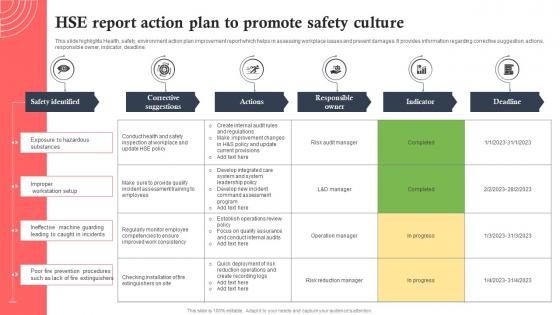
This slide highlights Health, safety, environment action plan improvement report which helps in assessing workplace issues and prevent damages. It provides information regarding corrective suggestion, actions, responsible owner, indicator, deadline.
People who downloaded this PowerPoint presentation also viewed the following :
HSE Report Action Plan To Promote Safety Culture with all 6 slides:
Use our HSE Report Action Plan To Promote Safety Culture to effectively help you save your valuable time. They are readymade to fit into any presentation structure.





FAQs for HSE Report Action Plan To
Your leaders have to actually walk the walk - choosing safety over hitting numbers when it really counts. Everyone needs to feel safe reporting close calls without getting blamed for it. Honestly, the blame game kills safety culture faster than anything. Keep learning from mistakes through regular training and incident reviews. Accountability matters, but make it about everyone watching each other's backs instead of pointing fingers. Short sentences work. The goal is making safety feel natural, like it's just part of how your team operates rather than some checkbox exercise.
Look, your team can totally tell when you actually care about safety versus just talking about it. Walk around and ask real questions - don't just hide in your office. Share those close-call stories without throwing anyone under the bus. People need to see you mess up sometimes too, honestly. Put actual money behind safety stuff, not just lip service. The biggest thing? Ask them what's making their jobs unsafe day-to-day. They'll tell you if they trust you won't retaliate. It's wild how much changes when people know they can speak up without getting screwed over.
Dude, engaged employees are literally your best safety asset. They'll actually follow protocols instead of just checking boxes. Disengaged workers? They ignore rules because they don't give a damn about the outcome - I've watched it happen so many times. But when people feel invested, they become safety champions who speak up about hazards and watch each other's backs. Honestly, the difference is night and day. Start simple: ask your team what safety stuff bugs them daily and actually listen. Those conversations will tell you everything you need to know.
Most companies track a bunch of different stuff to measure safety culture. Near-miss reports and training completion rates are good early warning signs. Injury rates and workers' comp claims tell you what already went wrong - kinda reactive if you ask me. But honestly? The best metric is anonymous employee surveys asking how comfortable people feel reporting safety issues. That's where you get the real dirt on whether leadership actually cares or just talks a good game. Oh, and track how many people speak up about hazards - silence is never a good sign in safety.
Honestly, it usually comes down to a few things. Management says they care about safety but doesn't actually follow through - classic case of do as I say, not as I do. People are scared to report problems because they think they'll get thrown under the bus. Production deadlines always seem to win over safety concerns too, which drives me crazy. Oh, and that whole "this is how we've always done it" attitude? Super common. Poor communication between departments makes everything worse. If your safety training is just mindless PowerPoint slides, people check out completely. Start with getting leadership actually committed and make sure your team feels safe speaking up without getting burned for it.
Honestly, tech can be a game-changer for safety culture if you pick the right stuff. Mobile apps let people report incidents right when they happen - way better than those paper forms that disappear into the void. Digital dashboards are clutch for showing everyone the safety numbers in real time. VR training sounds fancy but it's actually perfect for dangerous scenarios where you can't practice the real thing. Oh, and those wearable sensors? They'll catch environmental hazards people totally miss. Just make sure whatever you choose actually fits how your team works. Nobody's gonna use clunky systems consistently.
Yeah, so compliance can actually backfire on you if you're not careful. People get obsessed with checking boxes and stop thinking about real risks. Like, they'll do the bare minimum just to pass an audit instead of actually caring about safety - which is pretty backwards when you think about it. I always tell people to treat regulations as your starting point, not your finish line. Build on top of what's required based on what's actually dangerous in your workplace. And definitely push your team to report close calls and pitch ideas even when you're technically meeting all the rules. That's where the real improvements happen.
Honestly, don't treat safety like some separate thing you check off. Make it part of how you get stuff done faster. Your team will actually catch problems early when they feel safe speaking up - saves you from expensive disasters later. I've watched too many companies completely blow this by ignoring frontline workers who know where the real slowdowns happen. Ask your people straight up: "What makes your job both slow AND sketchy?" Those answers are gold. Track near-misses along with your usual numbers. Trust me, involving workers in designing better processes beats corporate safety theater every time.
Honestly, make it routine instead of waiting for something bad to happen. Daily huddles work great - just quick safety check-ins where people can ask anything without getting side-eyed. I've worked places where safety meetings were total BS theater, and nobody actually listened. Don't do that. Visual stuff helps too - dashboards or simple charts so people aren't drowning in data. When someone spots a hazard before it becomes a problem? Celebrate that win. The whole thing falls apart if people don't feel safe speaking up. Maybe start with a quick "safety moment" at your next few meetings and see how it goes.
Yeah, so aviation's all about those checklists and no-blame reporting systems. Healthcare focuses more on team communication - which honestly makes sense given how many people are involved in patient care. Construction? They're big on visible leadership and peer pressure, like the whole hard hat culture thing. Nuclear goes nuts with documentation and backup systems for everything. What's interesting is how much cross-pollination happens. Healthcare actually stole crew resource management from pilots, and lean manufacturing safety stuff works pretty much everywhere. I'd look at whatever high-reliability industries are similar to yours and just steal their best ideas.
Training makes a huge difference - like, it's what actually gets people following safety rules instead of just nodding at meetings. When you do regular hands-on stuff, your team sees you're serious about it. People get comfortable calling out problems too, which is honestly half the battle. The trick is keeping it real - ask what hazards they deal with most and build from there. Skip the boring generic modules. Make it about their actual job. That's where you'll see results, not from some cookie-cutter compliance thing everyone zones out during.
Honestly, you've gotta bake feedback into everything from the start. Anonymous reporting is clutch - people won't speak up otherwise. Do regular safety huddles too. But here's the thing that really matters: actually DO something when someone raises an issue. I can't tell you how many companies just let feedback die in suggestion boxes. Total trust killer. Even if you can't fix their exact problem, tell them what you're doing about it. Oh, and short huddles work better than long ones - people zone out. Bottom line: show that speaking up creates real change, not just more meetings.
You definitely need both types of metrics - leading and lagging. For leading stuff, track safety observations, near-miss reports, training participation, and those employee surveys about psychological safety (honestly the survey data ends up being way more predictive than people think). Lagging indicators are your usual suspects: incident rates, severity scores, workers' comp claims. Monthly or quarterly tracking works best. Look for patterns instead of getting worked up over random spikes. A basic dashboard helps you catch engagement drops early - way easier than fixing things after they've gone sideways.
Look, the trick is switching from "who messed up?" to "what can we learn here?" People need to know they won't get thrown under the bus for speaking up - honestly, I'd even reward transparency. Too many places I've worked, everyone just hides problems because they're terrified of getting canned. That makes everything so much worse. Run blameless post-mortems instead. Dig into the actual system failures and process gaps, not individual mistakes. You're trying to prevent the next incident, not punish the last one. Start simple - just publicly thank whoever brings up the next safety issue.
Remote work makes safety culture tricky as hell. You can't just swing by someone's desk to see if they're drowning in work or stress. People get weird when working from home too - they'll skip lunch, work until midnight, or develop back problems from their terrible dining room chair setup. I swear some people think ergonomics don't matter at home. You've got to be really deliberate about checking in. Schedule one-on-ones that actually dig into how people are doing, not just project status. Make talking about workload and mental health totally normal conversation.
-
Love the template collection they have! I have prepared for my meetings much faster without worrying about designing a whole presentation from scratch.
-
Templates are beautiful and easy to use. An amateur can also create a presentation using these slides. It is amazing.