

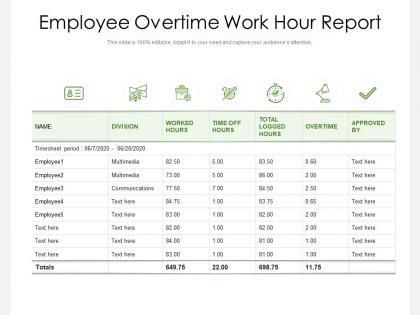
Employee overtime work hour report




Try Before you Buy Download Free Sample Product
 Impress Your
 Audience
 100%
100% Editable
 Save Hours
 of Time


Our Employee Overtime Work Hour Report are topically designed to provide an attractive backdrop to any subject. Use them to look like a presentation pro.
People who downloaded this PowerPoint presentation also viewed the following :
Employee overtime work hour report with all 2 slides:
Use our Employee Overtime Work Hour Report to effectively help you save your valuable time. They are readymade to fit into any presentation structure.

FAQs for Employee overtime
Honestly, overtime rules are all over the place depending where you are. In the US, non-exempt workers get time-and-a-half after 40 hours thanks to federal law. EU caps things at 48 hours weekly but each country handles overtime pay differently. Australia does 1.5x after 38 hours. Japan's been trying to fix their crazy work culture lately - about time! Canada changes by province, which is annoying. Your best bet? Look up the actual labor laws wherever your people work. Don't just wing it or you'll regret it later.
Track your time as you go instead of trying to remember later - trust me on this one. I use an app on my phone since I'm terrible at remembering to write stuff down, but a notebook or spreadsheet works too. Just log your actual start/end times and breaks. Memory is unreliable when it comes to reconstructing your week. Oh, and definitely snap pics of your timesheets before turning them in. Had a coworker get screwed over once because of a dispute about hours worked. Super annoying situation that could've been avoided.
Okay so the biggest thing people get wrong? Thinking ALL salaried workers can't get overtime. But if you make under $35,568 or don't actually manage people, you still qualify. Also, your boss can't just give you comp time instead of paying overtime - private companies have to pay cash. Period. And having "manager" in your job title means basically nothing if you're not doing real management work. Oh, and you can't sign away your overtime rights even if you wanted to (which honestly, why would you?). Just look at what you actually DO all day, not whatever fancy title they gave you.
Dude, constant overtime is such a morale killer. Your team gets burned out and starts hating their job when personal time vanishes. Here's the weird part - productivity actually tanks because exhausted people make more mistakes and work slower, even with extra hours. It's like that saying about working harder vs smarter, I guess? Short OT bursts for big deadlines? Totally fine. But when it becomes the standard, you get this awful cycle where tired workers need even MORE time to finish stuff. Watch your team's energy levels. If overtime turns into the daily routine, maybe it's time to redistribute work or bring in more people.
Dude, start by looking at your overtime patterns from last quarter - that'll show you where you're hemorrhaging cash. Cross-training is huge because then you're not screwed when people call out. Get some decent time-tracking software to watch hours closely. Honestly? Most overtime happens because of crappy planning (been guilty of this myself). Hire temp workers or part-timers during your crazy busy seasons. Also, spread workloads around better and make people get approval before working extra hours. Smart scheduling fixes like 80% of these problems.
So basically, if you're hourly you'll get time-and-a-half for anything over 40 hours a week. Salaried people usually don't get overtime at all though - kind of sucks but that's the deal with having steady pay. There's actually this weird exception where if you're salaried but make under $35,568 a year, you still get overtime under federal law. Pretty random threshold if you ask me. Check your contract to see which bucket you're in, because honestly it's not always obvious from the job title alone.
Overtime's pretty much your go-to when work suddenly explodes and you need bodies fast. Like, retail and manufacturing use it tons because demand goes crazy - think Black Friday madness or when everyone's shipping holiday packages. You don't want to hire 50 people just for December, then fire them in January (that's just messy). The big win? You can scale up quick to hit deadlines without permanently expanding your team. Honestly, it's way smarter than scrambling to find new hires. Just watch those costs though - overtime pay adds up stupidly fast if you're not paying attention.
First thing - nail down exactly when overtime starts and what people get paid. No wiggle room there or you'll have drama later. Get your team involved when you're writing this stuff up because nobody likes policies forced on them. Mix it up with comp time options, not just extra cash. Rotate who gets the overtime fairly - I've seen too many places where the same people always get screwed over. Test run it for a couple months, then tweak whatever isn't working. Oh, and definitely cap it somehow or people will burn out fast.
Ugh, yeah excessive overtime is brutal on your body. Heart disease and diabetes risks go way up when you're pulling 50+ hour weeks consistently. Sleep gets wrecked, your immune system tanks, and depression becomes a real issue. Plus relationships take a hit - which honestly just creates more stress on top of everything else. Your brain basically stops functioning at peak level too, so the work quality suffers anyway. I've seen teams where people start calling out sick constantly once the overtime becomes the norm. Worth flagging before everyone burns out completely.
Workflow software is a total game-changer for this stuff. Map out your current approval process first, then find tools like BambooHR or Slack workflows that match it. Employees can submit requests instantly, managers get phone notifications they can actually act on. The auto-documentation alone is worth it - no more awkward "wait, did I say yes to that?" conversations. Set up some smart rules too. Like auto-approving anything under 2 hours for certain people. Honestly cuts processing time by 80% once you get it dialed in. Route everything based on your org chart and budget limits, and you're golden.
Honestly, overtime can backfire on you big time if you're not careful. People burn out super quick when they're constantly working extra hours, and then they just bail for somewhere else. Nobody wants to feel like their personal life doesn't exist, you know? Now occasional overtime during crunch periods? That's totally different - most people get it if you're upfront about why it's happening and pay them fairly. But here's the thing: if your team is always working overtime, you've got bigger problems. You either need more people or your processes are trash. Don't just keep asking everyone to work harder.
Look, you gotta plan ahead and actually talk to your team about this stuff. Give people a heads up when busy seasons are coming - surprise overtime is the worst. Cross-train everyone so you're not burning out the same people over and over. Here's the thing though - some folks genuinely want those extra hours for the money, so just ask who's down for it. Maybe offer comp time instead of always paying out. Just don't let anyone work insane hours every single week, that's how you lose good people. Rotate it around and check how everyone's doing.
Dude, overtime violations will absolutely wreck your finances. The Department of Labor doesn't mess around - they'll make you pay back every cent of missed overtime PLUS the same amount again in damages. So $10K becomes $20K real quick. Employees can sue for attorney fees too, which honestly feels like adding insult to injury. I've seen small businesses get blindsided by this stuff because they thought their payroll was fine. Just double-check your hour tracking system now before it becomes a nightmare later.
Yeah, overtime totally leads to burnout - you're constantly drained and never get time to actually live your life. Like, when do you hang out with friends or even just watch Netflix without feeling guilty? Set some real boundaries about when overtime is truly needed vs just become the default expectation. Rotate who stays late so it's not always the same people getting screwed. Give comp time after crazy weeks. Honestly? Half the time companies just need more staff but they'd rather burn people out than hire. Short bursts of overtime happen, but if it's every week something's broken in how they're managing workload.
Honestly, having a clear OT policy makes your team communicate way better. People can't just randomly stay late anymore - they actually have to plan ahead and explain why they need extra hours. The approval process gets everyone talking about workload and deadlines before things get crazy. It's pretty transparent too, so you won't have that weird tension when someone's always working late and nobody knows why. Managers start discussing priorities with the team more, which is huge for collaboration. I'd set up something simple for requests - you'll be surprised how much more they coordinate once there's a system in place.
No Reviews