


Employee reward and recognition program plan




Try Before you Buy Download Free Sample Product
 Impress Your
 Audience
 100%
100% Editable
 Save Hours
 of Time


Our Employee Reward And Recognition Program Plan are topically designed to provide an attractive backdrop to any subject. Use them to look like a presentation pro.
People who downloaded this PowerPoint presentation also viewed the following :
Content of this Powerpoint Presentation
In the words of Doug Conant, "To win in the marketplace you must first win in the workplace." To win in the workplace, it is essential to appreciate employees' work, a practice that will encourage them to work better and efficiently. Employees' appreciation and productivity are, after all, two sides of the same coin, and without each of them, an organization cannot thrive. From business ideas to operations to sales to accounting, you need employees at every stage for the functioning of business, which makes it essential for you to value them. With the employee reward and recognition program plan, you recognize, celebrate, and elevate employee successes among coworkers and peers with different incentives and rewards.
However, deciding on rewards and recognition per employee and estimating annual expenditure can be tedious, as it involves maintaining spreadsheets and gaining approvals from a hierarchy of authorities. This is where our employee reward and recognition program plan template comes to the rescue.
Any wise manager will choose the ease of assorting and recording approvals on a single PPT template. With this presentation template in particular, you can easily plan and jot down the employee appreciation process and rate their achievements per the defined standards. Not only will this save you time, you'll be able to keep all the managers on the same page. As the presentation design is 100% editable and fully customizable, you only need to replace the content with your rules and standards.
This expert-prepared PPT design also explains to your seniors how rewards and recognition boost productivity and increase engagement and retention and how you could plan to reward and recognize employees by different means. Let's explore the design facets of this PPT Layout.
Template 1: Employee Reward And Recognition Program Plan
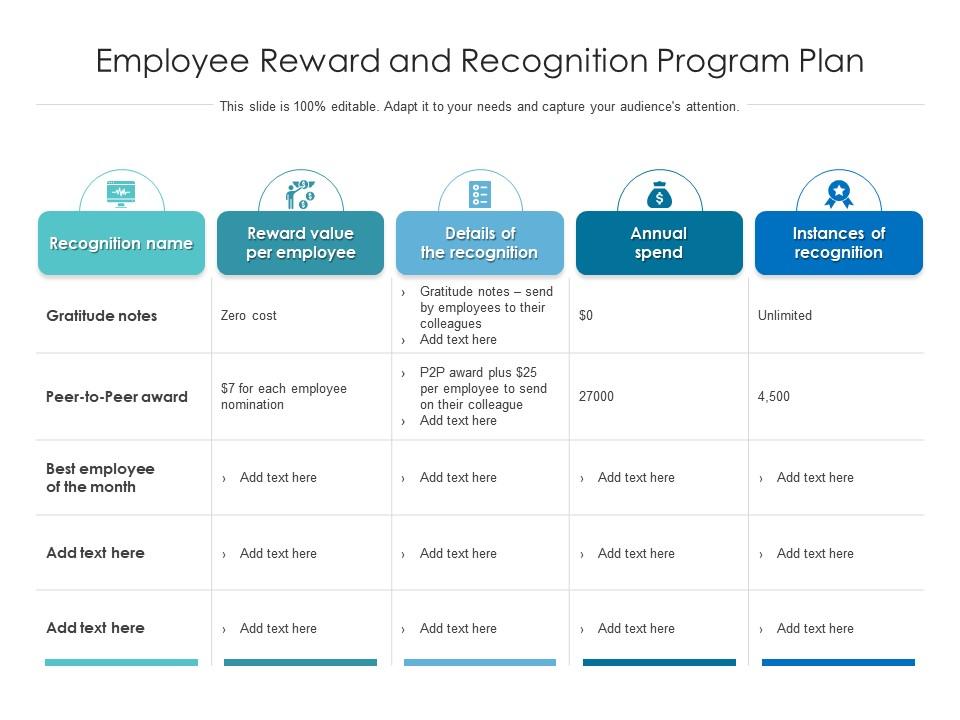
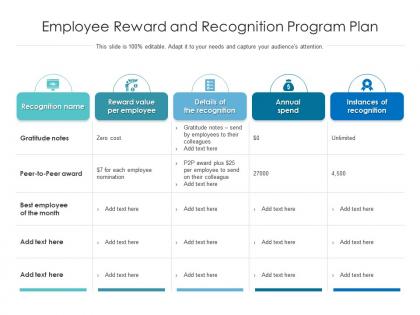
With the professionally curated rewards and recognition PPT Template, you can plan out the program for employee assessment with attention to detail. You can cover all sorts of recognitions, reward value per employee, details, and instances of recognition of annual spending on a single document. This PowerPoint Layout will assist the team leaders and managers in not only keeping a check on the expenditure involved but also helping them pre-plan everything in advance.
The Bottom Line
We hope we were able to convey the significance of rewards and recognition in enhancing the efficiency and retention of employees in your organization. So what are you waiting for? Get this well-designed presentation design and plan your company's future and the employees in advance. This pre-planning allows you to express appreciation and acknowledgment without setting a committee.
PS. Download our visually appealing, professionally curated, and content-ready Reward And Recognition Program Templates to rank and reward employees fairly.
Employee reward and recognition program plan with all 2 slides:
Use our Employee Reward And Recognition Program Plan to effectively help you save your valuable time. They are readymade to fit into any presentation structure.
FAQs for Employee reward and
Catch people doing good stuff and tell them immediately - be specific about what they nailed. Public shoutouts work great (team meetings, Slack), but don't skip the private thank-yous either. Honestly, I was skeptical about the public praise thing at first, but people eat it up. Get your team recognizing each other too, not just you doing all the praising. Small rewards help - gift cards, extra PTO for the big wins. The trick is staying consistent with it. Don't be like me and forget for three months then try to catch up. Pick one approach and actually start this week.
Honestly, tech makes recognition so much easier now. Real-time kudos through stuff like Bonusly or 15Five means everyone sees the praise instantly - no more quarterly review nonsense. Those custom digital badges are actually pretty cool, and some platforms trigger automatic rewards which is neat. Analytics show you recognition patterns too, so you'll catch anyone getting overlooked. My team started with just a Slack shout-out channel (super basic but it worked). The tracking happens automatically which saves tons of time. Start simple though - even basic tools beat doing nothing at all.
Honestly, public recognition is usually your best bet - it shows everyone what you value while giving that person a nice social boost. But some people absolutely hate being put in the spotlight, so private works better for them. I'd say use public for stuff others can learn from, and save private for more personal growth talks or awkward situations. The trick is actually knowing your team well enough to guess what they'd prefer. Oh, and definitely mix it up - doing the same thing every time gets stale. Ask people directly when you can swing it.
Honestly, just ask them straight up how they like being recognized! Found this out the embarrassing way when I publicly praised someone and they wanted to disappear under the table. Some people are all about the team meeting shoutouts, others would rather get a quick private message or handwritten note. Your introverts usually prefer the written stuff or one-on-one chats. Extroverts? They'll eat up the team celebrations. Makes sense when you think about it. I'd throw this question into your regular check-ins - what actually feels good to them recognition-wise?
Dude, timing is everything with recognition. You nail it when someone does great work, and they'll actually feel valued - not like you just remembered weeks later. I've seen managers wait forever to say anything, and honestly? It just feels fake at that point. Hit them within a day or two if you can. Even something quick like "killed it on that presentation" works wonders. People need that little dopamine boost right when they earn it. Shows you're actually watching their work too, which builds way more trust than some formal review months down the road.
Honestly, start with the basics - retention rates and engagement scores before you roll anything out. Then compare after a few months. Pulse surveys work great too, just ask people straight up if they feel recognized at work. Most people don't sugarcoat that stuff. Participation rates tell you a lot - if nobody's using your recognition program, it's probably boring or confusing. Oh, and pick like one or two things you can actually keep track of consistently. I've seen companies try to measure everything and end up measuring nothing useful.
Oh man, there's actually a bunch of stuff that works well! Slack channels dedicated to wins are honestly my favorite - keeps everyone hyped. Virtual high-fives during calls hit different too. You could set up peer nomination systems, do coffee chats with leadership, or even mail gift cards to people's houses (which feels weirdly personal in a good way). Personalized thank-you videos work great. The main thing? Don't be random about it. Public recognition is where it's at because when people see their teammates getting props, it motivates everyone else too.
Honestly, peer recognition is kind of magic - people start hyping each other up and suddenly the whole vibe shifts. Your coworkers calling out your wins hits different than when it's just your boss, you know? Way more genuine since they're actually in the trenches with you. It builds real trust between teammates too. People start hunting for good stuff instead of only seeing what's broken (which is pretty refreshing). You should totally try a weekly shoutout thing where everyone can highlight what their colleagues crushed that week. Creates this awesome cycle where everyone's looking out for each other.
Ugh, those generic "employee of the month" things are the worst - they feel so fake and box-checky. Biggest issues I see: recognition happens way too rarely, it's super vague, and only managers do it. You'll want peer-to-peer stuff too, not just top-down. Timing matters - don't wait months to acknowledge something cool someone did. Oh, and here's something people miss: not everyone wants to be called out publicly. Some folks would rather get a private thank you. Honestly? Just ask your team what actually means something to them before you build anything.
Dude, this stuff actually works - companies with good recognition programs have 31% less turnover. Makes total sense when you think about it. People just want to feel like their work matters, you know? The cool thing is you don't need budget for this. Quick "thanks" in meetings or even a text acknowledging someone's win goes surprisingly far. I'd say consistency beats grand gestures every time. Just be specific about what they did well instead of generic praise. Honestly, most managers are terrible at this, so you'll stand out immediately if you're decent at it.
Oh, you should totally try those virtual coffee chats where everyone celebrates wins together! Physical care packages are amazing too - people go crazy for them because they actually miss having something real to touch, you know? Digital "walls of fame" work great in Slack. Flexible PTO as rewards is genius. Surprise Uber Eats during meetings always gets people excited. The whole point is making remote people feel as important as the office crowd (which honestly shouldn't be that hard but here we are). Pick whatever fits your budget first, then just build on it.
Honestly, you don't need to spend much on employee recognition - the simple stuff often hits harder anyway. Try peer-to-peer shout-outs during meetings or handwritten thank-you notes. Give your top performer the best parking spot for a month. Flexible hours or an extra PTO day? Costs you almost nothing but employees love it. The trick is being consistent and knowing what actually matters to each person. Some people want public praise, others prefer quiet acknowledgment. Start with one thing that feels natural for your team, then add more as you figure out what works. I'd probably begin with the meeting shout-outs since those are totally free.
Honestly, you'll want to track both the soft stuff and the hard numbers. Engagement scores and retention rates are your best bet - plus see how many people actually use your recognition platform. Performance metrics matter too since people who feel valued usually stick around longer and move up internally. The hard part? Proving recognition directly caused those results. I'd throw in some quarterly pulse surveys asking people how often they get recognized and if it actually means anything to them. Short surveys work better - nobody wants to fill out something massive. Track how people feel about being valued at work too.
Yeah, it's crazy how much culture affects what makes people feel appreciated at work. Some folks love the big public praise - like getting called out in meetings or team celebrations. Others? They'd literally hide under their desk if you did that to them. They want the quiet "hey, nice job on that project" conversation instead. I've noticed some people care way more about getting props from their teammates than from the boss too. And don't even get me started on individual vs. team recognition - totally depends on their background. Honestly just ask them straight up how they prefer to be recognized. Way easier than guessing wrong.
Your managers probably suck at recognition - most do without proper training. They need to learn timing and being specific instead of just saying "nice work" and moving on. Teach them different styles too: some people want public shoutouts, others prefer growth opportunities or even just a handwritten note. The tricky part? Figuring out what actually motivates each person on their team. I'd honestly start small - have them practice giving one piece of specific, immediate feedback this week. Oh, and skip the generic praise. It's basically useless and everyone knows it.
-
Great designs, Easily Editable.
-
Awesome presentation, really professional and easy to edit.
-
Out of the box and creative design.
-
Enough space for editing and adding your own content.
-
Good research work and creative work done on every template.
-
Use of icon with content is very relateable, informative and appealing.
-
Very well designed and informative templates.