


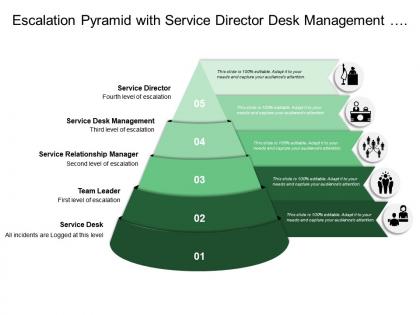
Escalation pyramid with service director desk management




Try Before you Buy Download Free Sample Product
 Impress Your
 Audience
 100%
100% Editable
 Save Hours
 of Time


Extract a good bargain with our Escalation Pyramid With Service Director Desk Management. Finalize the deal in your favour.
People who downloaded this PowerPoint presentation also viewed the following :
Escalation pyramid with service director desk management with all 5 slides:
Wow the world with our Escalation Pyramid With Service Director Desk Management. They will hold your thoughts in awe.




FAQs for Escalation pyramid with service
First thing - nail down your trigger criteria so people aren't guessing when to escalate. Map out who handles what level and set actual timeframes for each step. Nothing's worse than issues sitting there because nobody knows what's next, honestly. Documentation and communication protocols keep everyone updated. Each tier needs real authority to make decisions and fix problems - otherwise you're just passing the buck. Oh, and review your escalation data regularly to catch patterns. You'll spot bottlenecks and can tweak the process as you go.
Set up your criteria first - impact, urgency, who has authority to decide what. Multiple customers affected? Legal stuff? Goes over someone's pay grade? Escalate it. I always use dollar thresholds too, like anything over $X automatically goes up. The real problem is people who escalate everything because they're terrified of screwing up. That's where training helps. Give them decision trees or simple checklists they can actually use when they're panicking. Daily operational stuff should stay with your front-line people, but reputation risks or anything needing specialized knowledge? Get it upstairs fast.
Honestly, communication fixes like 90% of escalation problems. Keep everyone updated - what's going on, timeline, why you made certain calls. I've watched perfectly manageable situations blow up just because key people were left out of the loop (super frustrating to witness). Set up regular check-ins from day one and actually stick to them, even when you don't have much to report. People stay way more chill when they trust you're being straight with them. Being proactive about updates beats scrambling to do damage control later - trust me on this one.
Look, escalation management is basically your safety net when projects start going off the rails. Your team needs to know exactly who to ping when they hit a wall - saves everyone from wasting time being stuck. Trust me, there's nothing worse than watching people spin their wheels because they don't know where to go for help. It keeps the big bosses in the loop without burying them in every tiny issue too. Just map out your escalation levels early and make sure the triggers are crystal clear. Honestly beats scrambling later when everything's on fire.
So many good options for this! ServiceNow and Jira Service Management are the heavy hitters - they'll handle complex routing rules and SLA tracking. PagerDuty literally saved my life during those brutal on-call weeks, it's amazing for incident stuff. Zendesk or Freshservice work great if you don't need all the bells and whistles. Microsoft Power Automate is decent too. Here's what I'd do though - map out your current escalation process first, then find tools that actually fit how you work. Don't force your team to adapt to some clunky system just because it's popular. Integration with your existing setup matters way more than fancy features.
Honestly, role-playing is your best bet here. Have your team practice mock angry customer calls - fair warning though, it's exhausting for whoever's playing the difficult customer. Focus on active listening and empathy stuff, plus when they should escalate vs. handle it themselves. Everyone needs to know your escalation process inside and out. The repetition thing is huge because when people get flustered, they fall back on what they've practiced a million times. I'd also have newer folks shadow your best people during rough calls. Keep doing refresher training too - this isn't one-and-done stuff.
Honestly, start simple with just escalation volume and resolution times - those tell you the most. Customer satisfaction scores are obvious but super valuable. The game-changer though? Track WHY things get escalated in the first place. You'll spot patterns that show where your process is broken. First-call resolution rates matter too, plus whether escalated stuff actually gets fixed at the next level or just ping-pongs around forever (so annoying when that happens). Don't ignore your team's response times and confidence levels either - when agents are stressed, everything escalates more. Pick like 3-4 metrics max to start. Going overboard just creates noise.
Yeah, culture plays a huge role in escalations. Some people are super direct - they'll tell you straight up "this is broken." Others hint around problems instead of saying it outright, which honestly can be frustrating when you need clarity. Team members from more hierarchical backgrounds often won't escalate to leadership even when they should. Meanwhile, others skip right past you to the boss. Time expectations are all over the place too - some cultures move fast, others take forever to respond. My advice? Figure out each person's communication style early so you can adjust how you handle escalations with them.
Honestly, most people either wait way too long to speak up or they just dump problems on their boss without any background info. Super annoying for everyone involved. Spot those red flags early and actually escalate then - don't sit on stuff. When you do escalate, give your manager the full picture of what's happening and what you need from them. Document everything first too. But here's the thing - if you escalate every tiny issue, people stop taking you seriously. You gotta pick your battles. Start keeping mental notes about what's actually worth escalating vs what you can figure out yourself. You'll develop better instincts over time.
Honestly, the biggest game-changer is just telling people upfront what they can actually decide on their own. Like, "you can approve refunds up to $500 without asking me" - boom, done. Teams freeze when they don't know their boundaries, and I've totally been there! Train them on handling tough situations, obviously. But here's what really matters: back them up publicly when they make calls, even if things go sideways. Nobody learns if they're terrified of screwing up. Oh, and create space where mistakes aren't the end of the world. Trust beats any training manual you'll ever write.
Honestly, you've gotta get ahead of this stuff before it hits the fan. Have regular check-ins with your team so problems come up early. Not everyone's comfortable speaking up in meetings though - some people prefer shooting a quick text or Slack message instead. Make sure everyone knows exactly when to escalate things and who makes the final call. Don't ever make people feel bad for flagging issues early, that's like shooting yourself in the foot. Oh, and try adding a "what's going wrong" segment to your weekly meetings. Sounds pessimistic but it really works.
Honestly, escalation management is make-or-break for keeping customers around. Handle complaints fast and well? Angry customers actually become your biggest fans - it's crazy how that works. But mess it up and they're gone forever, probably trashing you online too. You need clear processes so issues don't get stuck in limbo, plus team members who can actually fix things (not just apologize endlessly). Oh, and always circle back to check they're happy with the resolution. Trust me, set this up before you desperately need it during a crisis.
Write everything down while it's happening - seriously, don't try to remember later because you won't. I made that mistake once trying to piece together some drama from weeks before and it was a disaster. Get the basics: what started it, who was there, what you did, how it ended. Oh, and whether you need to circle back on anything. Your team will thank you if you use the same format every time so they're not hunting for info. The real gold though? Note what actually worked and what bombed. That stuff becomes your cheat sheet next time something similar blows up. Set yourself a reminder to check if your fix actually stuck after a month.
So here's what I'd do - after every big escalation, make a quick database of lessons learned. Sounds boring, I know, but hear me out. Write down what broke, what actually worked, and where your processes had gaps. You'll start seeing patterns super fast when you track this stuff. Then use those insights to update risk assessments and tweak your escalation procedures. Maybe spot some training gaps too. The trick is building this into your quarterly planning - not just doing it once and forgetting about it like we all tend to do with good intentions.
You really need feedback to fix your escalation stuff - it's like your cheat sheet for figuring out what's broken. Get input from everyone: customers, front desk people, managers, whoever handles the messy cases. That'll show you where things get stuck and if your triggers actually work. I mean, you're basically flying blind without it, right? Don't just wait for complaints though. Set up regular check-ins and track stuff like how often escalations happen and whether people are happy with solutions. Oh, and resolution times too - sometimes those are way off from what makes sense.
-
Use of icon with content is very relateable, informative and appealing.
-
Colors used are bright and distinctive.