


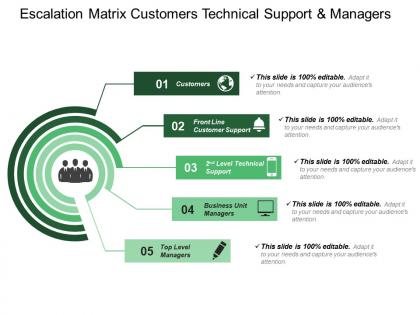
Escalation matrix customers technical support and managers




Try Before you Buy Download Free Sample Product
 Impress Your
 Audience
 100%
100% Editable
 Save Hours
 of Time


Our Escalation Matrix Customers Technical Support And Managers ensure you a good climate. All the dark clouds get blown away.
People who downloaded this PowerPoint presentation also viewed the following :
Escalation matrix customers technical support and managers with all 5 slides:
Circumvent hazards with our Escalation Matrix Customers Technical Support And Managers. They will keep you on the fairway.





FAQs for Escalation matrix customers technical
So an escalation matrix is basically your cheat sheet for who to bug when stuff breaks. Maps out the whole chain of command by issue type and how bad things are. Minor bug? Hit up your team lead. Server's on fire? Skip straight to the VP. Honestly, it's such a lifesaver because you're not sitting there wondering "wait, do I bother Sarah with this or is this a Mike problem?" Critical stuff gets handled by the right people without you playing guessing games. Seriously, make one now before things get crazy - you'll be so glad you did when everything's falling apart at 2am.
Look, an escalation matrix basically maps out who handles what when shit hits the fan. You'll know exactly who to call for different crisis levels without that awkward "um, should we wake up the CEO?" moment. Minor stuff stays with your team, major disasters go straight to the big guns. Honestly, the worst part of any crisis is wasting time figuring out the chain of command. Set this up beforehand with clear triggers and everyone's contact info. Trust me - you don't want to be googling your VP's cell number at 2am when everything's breaking.
You'll want to nail down four things: when to escalate (clear triggers), who handles what at each level, realistic timeframes, and everyone's contact info. Timeframes matter big time - nobody's waiting two days for a server fix! Always have backup contacts too since people get sick or whatever. Oh, and write short descriptions for each escalation level so your team isn't guessing if something's a Level 2 or 3 emergency. Keep the whole thing simple and put it somewhere obvious. Trust me, when everything's on fire, you don't want people hunting around for the escalation chart.
Think of it this way - your org chart just shows the basic hierarchy, but an escalation matrix is way more tactical. It maps out exactly when to escalate based on specific triggers, not just who's above who on the food chain. Like maybe your org chart shows Sarah runs support, but the escalation matrix tells you to loop her in for any billing dispute over $500 or complaints that hit the 24-hour mark. Totally different info, right? When you're putting one together, focus on those specific thresholds and scenarios rather than just job titles. Way more useful that way.
Honestly, the biggest thing is just getting some kind of automated system in place. Tools like ServiceNow or Jira can route tickets based on how urgent they are and ping the right people automatically. Smart escalation is where it gets cool though - if someone doesn't respond within your SLA, it bumps the ticket up the chain without you doing anything. Real-time dashboards help you spot where things get stuck (super helpful for identifying problem areas). But seriously, don't overthink it at first. Even a basic spreadsheet with email alerts is way better than having your escalation process hidden in some random wiki that people forget exists.
Look, you'll want to map your escalation matrix to whatever regulations and timelines matter most in your space. Healthcare? You're dealing with HIPAA notifications and patient safety - that stuff moves fast. Financial services is all about fraud response and regulatory deadlines. Manufacturing focuses on safety incidents and keeping production running (downtime = money bleeding). Honestly, just think about your absolute nightmare scenarios first. What would make your boss panic at 2am? Build your escalation triggers around those critical failure points. Then figure out who needs to know what and when based on your industry's specific compliance requirements.
Honestly, the worst thing you can do is overcomplicate it. I've seen companies with these insane 15-step flowcharts that everyone just ignores. Keep it simple - clear triggers for escalation and actual timeframes, not that "urgent" BS that means nothing. Make sure the contact info works too (can't tell you how many dead phone numbers I've seen). Oh, and don't skip levels just because you're buddies with the VP or whatever. Defeats the whole point, right? Test it with real situations first - you'll catch so many issues that way.
Quarterly reviews are the bare minimum, but honestly? Do it way more if your team's always changing. We learned this lesson when our escalation matrix had dead phone numbers during a major outage - absolute nightmare. Staff turnover, new services, org restructuring - any of that happens and you need to update immediately. After big incidents, check if the process actually worked or if people just winged it. Oh, and put a recurring reminder in your calendar because you'll totally forget otherwise. Make sure everyone knows where the current version lives too.
Honestly, skip the flowcharts and go straight to role-playing. Have your team practice the messy stuff they'll actually deal with - angry customers, billing disasters, figuring out what's truly "urgent." I love throwing in weird edge cases because that's where people freeze up. Make sure they get the reasoning behind each escalation level, not just the steps. Oh, and those little reference cards are lifesavers when things get crazy. You'll want to revisit this quarterly since policies change constantly.
Okay so basically an escalation matrix is like having everyone's actual useful contact info organized by department. You know those annoying situations where you're emailing random people in marketing or IT hoping someone will help? This fixes that mess. Each department has to pick specific people for specific problems ahead of time. Way faster than playing phone tag for days. I'd start with whatever cross-department headaches happen most often at your place and just map out who handles what. Honestly wish more companies did this - would save so much time chasing down the right person when stuff breaks.
Big companies have like 5+ escalation levels with all these different departments getting involved. Small businesses? Usually just 2-3 steps - team lead, manager, maybe the owner. What's cool about smaller places is you can sometimes just walk up to the person who actually makes decisions. Skip all the bureaucratic nonsense. Corporations make you document everything and follow these super strict protocols at every single step. If you're building an escalation matrix for a small company, honestly just keep it straightforward. Focus on who owns what and getting stuff resolved quickly instead of creating some complex hierarchy that'll slow everything down.
So an escalation matrix is basically your team's cheat sheet for when customer stuff hits the fan. Your agents know exactly who to call and when - like if someone's screaming about billing, they get 10 minutes before looping in finance. Angry customers? Straight to a supervisor. Honestly saves everyone from that awkward "umm, let me find someone" moment. Resolution times get way faster since nobody's scrambling around trying to figure out what to do next. Your frontline people will thank you for it too - takes tons of pressure off them. Just make sure you've got clear triggers and contact info ready to go.
Track how long stuff takes to resolve at each level, plus customer satisfaction scores. See how many tickets actually need escalating vs getting fixed right away - that's huge. The types of problems that keep getting bumped up will tell you exactly where your front-line team needs better training or tools. Honestly, the worst thing is when issues just ping-pong between departments because nobody knows who should handle what. Pull these numbers monthly and you'll spot the patterns pretty quick. Oh, and don't forget to check how many times the same issue bounces around - that usually screams "unclear process."
Dude, visual escalation matrices are a game changer. Instead of those boring text blocks nobody reads, make flowcharts with color-coded urgency levels and arrows showing who calls who. I swear people's brains just work better with pictures - especially when everything's on fire and they need answers fast. Lucidchart's solid for this, or honestly just PowerPoint works if you're not fancy. Add some icons for different team roles and boom, no more hunting through paragraphs during a crisis. Your coworkers will actually know the process instead of just pretending they do.
Check out Microsoft's Azure team - they've got this escalation matrix that auto-routes stuff based on how bad the issue is and what tier customer it affects. Cuts their resolution time by 40% because nobody's confused about when to step in. Toyota does something similar with their manufacturing, though that's obviously different territory. Both companies are smart about setting actual criteria instead of fuzzy terms like "major problems." They also nail the timing piece with hard deadlines. Where most teams screw up is matching the right authority level to the right type of problem. That's honestly the make-or-break part.
-
cool
-
Very well designed and informative templates.
-
The content is very helpful from business point of view.