

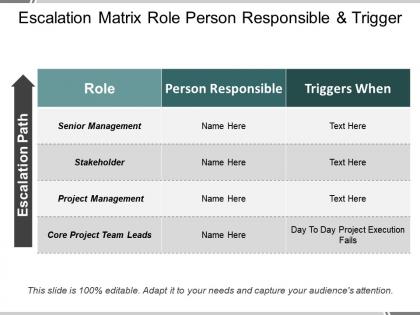
Escalation matrix role person responsible and trigger




Try Before you Buy Download Free Sample Product
 Impress Your
 Audience
 100%
100% Editable
 Save Hours
 of Time


Have the best of experiences with our Escalation Matrix Role Person Responsible And Trigger. Every event will be great fun.
People who downloaded this PowerPoint presentation also viewed the following :
Escalation matrix role person responsible and trigger with all 5 slides:
Fortify folks against fraud with our Escalation Matrix Role Person Responsible And Trigger. Increase their ability to identify any attempt.




FAQs for Escalation matrix role person
Oh, an escalation matrix! So it's basically your roadmap for when stuff goes wrong. You map out who gets called at different problem levels - like if something's 2 days late, ping the team lead. A week late? Time to bug the project manager. Honestly, I wish more teams used these because when things blow up, everyone just panics about who to tell. The whole idea is catching problems early before they turn into total disasters. Just make sure you actually set it up at the beginning (not when you're already drowning) and put it somewhere people can find it.
Think pyramid structure - frontline handles basic stuff, then it goes up through team leads, managers, executives. Each level should actually be able to solve problems at their tier, not just pass things along (learned this the hard way). Consider customer impact, money involved, and how urgent it is when you're setting up the levels. Honestly, the biggest mistake I see is giving people escalation authority without decision-making power. That just creates bottlenecks everywhere. Map it to your org's actual hierarchy and make sure fewer people at the top can handle the bigger, messier issues.
Start with your front-line support, then team leads, department managers, and senior leadership. Pretty straightforward chain there. Add technical specialists for the weird complex stuff that stumps everyone else. Oh, and definitely loop in legal or compliance people if needed - learned that one the hard way on a project last year. Each level needs clear decision-making power though. Otherwise you'll have issues just ping-ponging around forever while everyone asks "who can actually approve this?" Map out what each tier can handle. Saves everyone a massive headache later.
So basically an escalation matrix saves you from that panicked "who the hell do I call??" moment when everything's on fire. It maps out exactly who handles what decisions and when to bump things up the chain. No more wasting time wondering if you should bug your boss or go straight to the big boss. Plus it stops important info from getting stuck somewhere random in the org chart. Oh and definitely include phone numbers and how fast people need to respond - learned that one the hard way. Trust me, you'll thank yourself later when you're not scrambling around trying to figure out the contact chain during an actual crisis.
Start by figuring out your severity levels - like is the whole system down or just a tiny bug? Map out who gets called at each stage, plus their backups because someone's always out sick when stuff breaks. Response times matter too. How fast do you need people jumping on critical vs minor issues? Think about time zones if you've got remote teams, and pick your channels - phone, Slack, whatever works. Include outside people like vendors when they're relevant. Make it super clear what bumps something up to the next level. Honestly, run through a couple fake scenarios first to spot the holes before you actually need it.
So IT escalations happen crazy fast - we're talking 15-30 minutes max because downtime literally bleeds money. Healthcare's totally different though. They care more about who has the medical authority and patient safety stuff, so you'll see attending doctors, charge nurses, sometimes even ethics committees getting pulled in. IT just goes by technical skill level, but healthcare gets messy with all the specialties involved. Actually had a friend deal with this at her hospital - took forever to figure out who was supposed to make the call. My advice? Figure out your industry's key players and typical timing before you're stuck needing help.
Honestly, the worst thing you can do is make it too rigid. When people panic and can't reach their first contact, they'll just call the CEO directly - I've watched this happen so many times lol. Also figure out who's actually deciding what counts as each escalation level, because that gets messy fast. Don't set crazy tight timeframes either, or people will escalate everything just to be safe. Oh, and backup contacts are crucial - your matrix is useless if it assumes everyone's available 24/7. Test it with real situations first. Start simple and adjust based on what actually happens.
Honestly, automating your escalation stuff is a game changer. Set up notifications when SLA times get hit and connect everything to your ticketing system - it'll route problems to the right people without you babysitting it. Dashboards help you catch bottlenecks early too, which is clutch. The AI prediction thing is pretty cool actually, learns from old tickets to flag potential escalations. I'd start with whatever escalation scenarios happen most often at your place. Real-time visibility kills those annoying status check meetings. Way fewer things slip through once you get it running.
Oh definitely switch up your escalation setup for remote work! Skip the whole "find your manager" thing and get specific - which Slack channels, video protocols, async handoffs. Honestly, remote work makes everything feel like a fire drill, but you actually need longer response times. Build in timezone backup contacts for when your main person is asleep. Document everything digitally so nothing gets lost in translation (learned that the hard way). Short version: everyone needs crystal clear instructions on reaching the right person through the right channel. No confusion, no hunting around.
Honestly? Do it quarterly at minimum. But here's the thing - I'd actually check it after every major incident or when people change roles. Trust me on this one. Staff leaves, teams get reshuffled, phone numbers change... your matrix gets stale fast. Nothing worse than an actual emergency hitting and discovering half your contacts are useless. Just set a calendar reminder and make everyone verify their info - takes like 15 minutes tops. Way better than panicking when you really need it.
Honestly, start with resolution time - that's the biggest tell if your matrix is actually helping or just adding bureaucracy. Customer satisfaction scores matter too since people can usually tell when their issue gets handled properly vs getting the runaround. I'd also watch how often cases ping-pong between teams (nothing's more annoying than explaining your problem five times). Track your escalation volume monthly - if literally everything's getting escalated, something's off with your thresholds. Pick maybe 2-3 of these and check them monthly. You'll see patterns pretty quick.
Think of an escalation matrix like a phone tree for when stuff hits the fan. You map out who gets called at what point - team lead first, then manager, then director. No more chaos where someone bypasses three levels and calls the VP because the printer's broken (seriously happened at my last job). Clear thresholds mean risks don't sit around because everyone thinks it's someone else's problem. Decision-making gets way faster too. Just build it before you actually need it - you'll thank yourself later.
Definitely do hands-on workshops where people practice with real scenarios - way better than just emailing a PDF and crossing your fingers. Role-playing escalation situations actually works surprisingly well. Get your team leads trained up so they can coach others through it. Quick reference cards are clutch too, maybe a simple flowchart they can stick by their desk. The whole thing should feel natural, not like more corporate BS to deal with. I'd start with like a 30-minute session, then check back in a few weeks to see how it's going in the real world.
Definitely do quarterly reviews of how your escalations actually went down. I always check which cases dragged on forever or got bounced to the wrong person - that stuff shows you exactly where things are breaking. Track your resolution times and satisfaction scores too. Oh, and actually ask the people dealing with escalations what's driving them crazy! They'll tell you if something's redundant or missing. Use all that to tweak your criteria and fix the paths that aren't working. Honestly, most teams just set it up once and forget about it, then act shocked when the same problems keep happening.
Look, your escalation matrix is basically worthless without leadership backing it up. People will just skip the whole thing when stuff hits the fan - which is obviously when you need it working. Your leaders have to actually USE the system themselves, not just talk about it. They also can't let people go around it or skip levels because they're buddies or whatever. I've seen this happen so many times. You need the right people empowered at each step to make real decisions. Get that leadership commitment locked down first, or you're just creating another useless process document.
-
Great product with effective design. Helped a lot in our corporate presentations. Easy to edit and stunning visuals.
-
Nice and innovative design.