


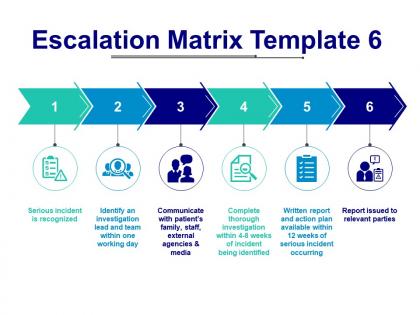
Escalation matrix serious incident is recognized report issued to relevant




Try Before you Buy Download Free Sample Product
 Impress Your
 Audience
 100%
100% Editable
 Save Hours
 of Time


Get this escalation matrix PPT template to recognize a serious incident. Display details involved in the complete process to create the report. Add all the steps of recognizing and investigating the incident using our escalation matrix PPT slide. Easily communicate with the audience all the information in relation with the incident. Depict the seriousness of the incident via the PPT report template. Share your action plan through the written report. Issue the relevant report for your incident with the help of this PPT report layout. Put forth your strategically planned report easily and effectively with this PowerPoint template. Make the procedure of investigating presenting your report simple with the help of our matrix PPT design. Get the audience have an idea of how your human resource work efficiently to bring about the required operations. Chalk the well organized functioning of your team members through this PPT report template. Make a hassle-free presentation with this ready to use escalation matrix PPT relevant to your report. Act impeccably with our Escalation Matrix Serious Incident Is Recognized Report Issued To Relevant. Flaws don't get a chance to emerge.
People who downloaded this PowerPoint presentation also viewed the following :
Escalation matrix serious incident is recognized report issued to relevant with all 5 slides:
Add to their growth with our Escalation Matrix Serious Incident Is Recognized Report Issued To Relevant. They will absorb your ideas better.



FAQs for Escalation matrix serious incident is recognized report
You need four main things: escalation triggers (what problems need escalating), escalation levels (who handles what), timeframes (how long before moving up), and contact info for each level. Picture it like a decision tree - if X happens and isn't fixed in Y hours, call Z person. Also include criteria for skipping levels entirely when something's really urgent. Most people way overcomplicate these things though! The ones that actually work are dead simple and specific. Oh, and make sure your whole team knows where to find it - maybe even do a quick practice run before you're scrambling during a real crisis.
So basically an escalation matrix just maps out who handles what problems and when to bump things up the chain. No more of that "uh, should I bother my manager with this?" overthinking. Your team knows exactly when something's escalation-worthy and who gets the heads up at each level. Honestly, half the battle is just getting people to actually use the thing once you build it. Short problems get handled fast, bigger stuff goes where it needs to go. Just don't overcomplicate it - work with your leads to set clear triggers for each level and you're good.
Think of an escalation matrix as your "who to call when stuff breaks" cheat sheet. You set up different risk levels - low, medium, high, oh-shit-critical - then match each one to specific people and how fast they need to respond. When things go sideways (and they will), you'll know whether to text your team lead or actually call the VP at midnight. Honestly, the worst time to figure out who's supposed to handle what is when you're already in crisis mode. Build yours now while you're thinking clearly - future stressed-out you will thank you for it.
So basically you want to set up escalation tiers based on impact and urgency - how many users are affected and how quickly it needs fixing. Frontline handles the routine stuff first. Complex technical issues go to specialists or team leads next. Only escalate to C-suite for major outages or revenue-threatening problems (seriously, nobody wants an angry CEO over a password reset). Set specific timeframes too - like if Level 1 can't crack it in 2 hours, it automatically moves up. Document clear criteria for each level so there's no confusion about when to escalate.
Honestly, the worst thing you can do is make it too rigid. People follow the chain religiously even when it's obviously dumb to wait three levels. Complex matrices are another trap - nobody remembers the fancy flowchart when everything's on fire. Half the time teams don't even define what triggers an escalation, so you get people either panicking over minor stuff or radio silence during actual emergencies. Oh, and definitely review it after real incidents happen. Train folks that sometimes breaking protocol is the right call. Those "emergency override" moments are pretty telling about whether your system actually works.
Honestly, automation is huge for escalation stuff. Set up workflows in Jira or ServiceNow that route tickets based on severity or how long they've been sitting there. No more issues falling through cracks or waiting for someone to remember to pass them along. The visibility aspect is probably what I love most - you can actually see where everything stands instead of guessing. Response time tracking happens automatically, and it'll bump things up when deadlines get missed. I'd start by sketching out your current process first, then find tools that hit those trigger points. Way less headache than doing it all manually.
So escalation matrices are totally different depending on your industry. Healthcare has crazy strict regulatory steps and patient safety stuff baked right in. Financial services? They're obsessed with fraud detection timelines and those non-negotiable compliance deadlines. Tech companies can move way faster since they push fixes quickly - honestly kind of jealous of that flexibility. Manufacturing throws in quality control checkpoints and supply chain considerations that others don't deal with. I'd grab some industry-specific templates and tweak the timing and stakeholders to fit your sector's specific chaos.
Track three main things: how fast tickets get resolved, how often stuff gets escalated, and your customer satisfaction scores. Resolution time shows if the matrix is actually speeding things up. Escalation frequency tells you whether issues are landing with the right people from the start. Also keep an eye on "false escalations" - when tickets get bounced back down because they went to the wrong team initially. Those are annoying for everyone involved, honestly. CSAT scores are the obvious one but super important since they show real customer impact. Do a monthly check-in on these numbers and tweak your matrix based on what you're seeing.
So basically you set up this matrix thing that maps out exactly where different problems should go. Your team won't waste time guessing who handles what anymore. Urgent tech stuff goes straight to the senior engineers, billing questions hit finance directly - no more playing phone tag. Honestly, it's like having a GPS for customer complaints. The whole point is cutting out those annoying "hold on, let me transfer you to someone else" moments that make people want to scream. Just create triggers so everyone knows the drill when things need to get bumped up.
Skip the boring lecture stuff and get them practicing real scenarios. Role-play different situations so they can actually walk through your escalation matrix step by step. I always use old incidents (with names removed obviously) because fake examples just don't hit the same way. Everyone needs to get the reasoning behind each level, not just memorize the steps. Run quarterly drills with curveball scenarios thrown at them. Honestly, the whole point is making it second nature so when everything's going sideways, they won't panic or accidentally skip something important.
So basically, escalation matrices keep the right problems flowing to the right people. Your CEO shouldn't be dealing with password resets, you know? It's like having a good triage system - catches issues early and sends them where they need to go. This frees up your executives to actually focus on strategy instead of getting dragged into every little operational mess. Here's what I'd do: map out your current escalation paths and check if they match your company's top 3 priorities. If not, you'll probably find some weird gaps where important stuff gets stuck.
Zappos has this thing where customer service can bump billing issues to supervisors in 2 minutes, and anything over $500 goes straight to management. Their satisfaction scores went up 40% after that! Amazon does something similar with delivery delays - structured path from dispatchers to regional managers to corporate. The real trick is how they set up their trigger points and response times. That's what makes escalation smooth instead of a total mess. I know it sounds kinda dry, but these systems actually work really well once you get them dialed in.
Check it quarterly for sure, but honestly? Do it whenever someone leaves or you have a big incident. I learned this the hard way when we escalated to someone who'd quit months earlier - so awkward. Your team should help with reviews since they actually use the thing daily. Set a calendar reminder to update contact info and double-check response times. People switch roles constantly, so what worked in January might be totally off by summer. Oh, and don't just update it and forget - actually test it occasionally. Nothing worse than discovering your escalation path is broken during an actual emergency.
Yeah, cultural stuff can really screw up escalation processes. Some cultures see escalating as failure or disrespect, so people just... don't. Others skip straight to the CEO over minor issues - super awkward when that happens. Communication styles are all over the place too. Direct vs. subtle, you know? What's worked for me is building cultural awareness into the actual process. Maybe create region-specific guidelines that account for these differences. It's honestly one of those things that sounds simple until you're dealing with it across like 15 different countries.
Honestly, your stakeholders are gonna be your best resource here. Ask them about response times they expect and who they actually want to escalate stuff to - not who you think they should escalate to. Communication channels matter too. I've seen so many matrices fail because nobody bothered asking what people preferred. Survey them first about what triggers should kick off escalations and realistic timelines. They'll probably give you insights about decision-making authority that you didn't even think of. Sometimes the surprises are the most valuable part. Don't finalize anything until you get their input though.
-
Commendable slides with attractive designs. Extremely pleased with the fact that they are easy to modify. Great work!
-
Easily Understandable slides.