


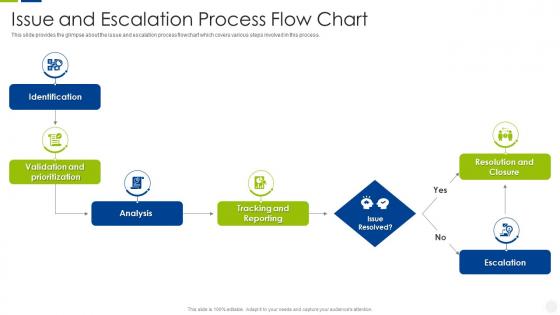
Escalation management system issue and escalation process flow chart




Try Before you Buy Download Free Sample Product
 Impress Your
 Audience
 100%
100% Editable
 Save Hours
 of Time


This slide provides the glimpse about the issue and escalation process flowchart which covers various steps involved in this process.
People who downloaded this PowerPoint presentation also viewed the following :
Escalation management system issue and escalation process flow chart with all 6 slides:
Use our Escalation Management System Issue And Escalation Process Flow Chart to effectively help you save your valuable time. They are readymade to fit into any presentation structure.





FAQs for Escalation management system issue and escalation
Honestly, you'll feel it when your normal fixes just aren't working anymore. Multiple attempts and the problem keeps coming back? Time to escalate. Critical stuff breaking or tons of customers complaining? Same thing. I always look at the clock too - if you're running out of SLA time without making real progress, don't be a hero. Higher-ups getting impatient is another dead giveaway. Oh, and when the problem starts spreading into areas your team doesn't really handle - that's usually my cue to pass it up the chain before things get messy.
First thing - figure out who decides what and when stuff gets kicked upstairs. Set dollar limits, customer tiers, whatever makes sense for your business. Most places just make this up as they go (trust me, it's messy). Draw up some basic flowcharts your team can actually use when things get crazy. Test it with real situations though - what looks good on paper doesn't always work. Get feedback from everyone, not just management. Oh, and don't forget to actually update the process when you find better ways to do things. Sounds obvious but you'd be surprised how many companies never revisit this stuff.
Honestly, communication makes or breaks the whole thing. Keep everyone updated on what's going down, who's handling it, when stuff's happening - you know the drill. Customers hate that black hole feeling when their problem just vanishes, right? Your team needs to stay in sync too or you'll end up with three people tackling the same issue. Or even worse - nobody touching it at all. Don't wait for people to bug you for updates either. Be the one reaching out first. Trust me, it saves so much headache later.
Honestly, you've gotta bake this stuff into your weekly routine instead of waiting for disasters. Start doing regular check-ins with stakeholders and watch those metrics that usually predict trouble. Make it easy for your team to speak up about concerns - I've seen way too many projects where everyone sensed something was off but nobody wanted to be the bearer of bad news. Train people to catch red flags early: missed deadlines, scope creep, communication falling apart. Oh, and try adding a "what could go wrong" segment to team meetings. Sounds pessimistic but it works.
Track resolution times first - how fast do escalated tickets get fixed vs regular ones? Then check your escalation rate (what percentage actually need to bump up) and customer satisfaction for those cases. The repeat escalation thing is honestly the most telling metric though - same problems keep coming back means your process sucks. Also look at whether escalations go to the right person from the start, because that's annoying for everyone. I'd throw these in a monthly dashboard and review with your team to catch issues early.
Oh man, cultural stuff really messes with escalation processes. Some cultures hate conflict so they'll sit on problems way too long, others escalate literally everything. Then you've got the hierarchy thing - people from certain cultures absolutely won't go around their boss, even in emergencies. Super annoying when you need fast answers. Direct communicators will just tell you what's broken, but indirect ones drop hints and expect you to figure it out. You basically need different escalation paths for different comfort levels, plus training that covers all this cultural awareness stuff.
Dude, automated alerts are where you want to start - they'll catch issues before they blow up. Real-time dashboards show you exactly where things are getting stuck (honestly changed my life when I could finally see the mess visually). AI helps rank problems by how bad they actually are. Oh and collaboration tools instantly pull in whoever needs to deal with it. The reporting side is solid too - you can spot patterns in what keeps breaking. I mean, if you're still doing this stuff by hand, alerts alone will save you so much headache.
Honestly, I'd focus on a few big things - how complex it is, whether you're running out of time, and who's getting hurt by the problem. Multiple departments involved? High-tier customer screaming? Don't wait around. Also, if your team's already burned like 2 hours with zero progress, just escalate - nobody's judging you for getting help early. Business impact is huge too, obviously. Resource constraints matter. But here's the thing - set up clear rules for when to escalate so your team isn't winging it every single time something breaks.
Honestly, just build escalation triggers right into your project planning from day one. Define specific thresholds - like if budget hits 80% or timeline slips by two weeks, boom, stakeholders get notified automatically. Works with any methodology you're using. Document who needs to know what and when in your project charter. I learned this the hard way on a project that went sideways fast because we didn't have clear escalation paths. Pro tip: add this stuff to your templates so you don't forget next time. Way better than scrambling when things inevitably go wrong.
Honestly, the worst mistake is thinking you can handle everything solo and waiting way too long to ask for help. Been there! You just dig yourself deeper while time's running out. People also escalate to random managers instead of the right person, or they finally reach out but give zero context - super annoying for everyone involved. Oh, and then they disappear afterward instead of following up. Set some rules ahead of time, like "if this takes more than X hours, I'm escalating." Include the timeline and key details when you do. Don't make it personal either - you're solving problems, not waving a white flag.
Honestly, stakeholder engagement can totally make or break your escalation. Get the right people on board early and they'll actually help when stuff hits the fan. Nobody wants to be surprised by problems they could've prevented - trust me on that one. Map out who has real influence over your situation first. Then keep them updated regularly so they become your allies instead of roadblocks. Oh, and start building those relationships way before you need them. It's basically impossible to get someone's attention when you're already drowning in crisis mode.
Start with de-escalation training - that's your bread and butter for dealing with angry people. Communication workshops are clutch too, especially the active listening stuff. Learn your company's escalation process inside and out. Role-playing scenarios sound cheesy but they actually work way better than you'd think. If you're constantly putting out fires, maybe look into crisis management courses. Oh, and conflict resolution basics are a must. The whole point is practicing before things go sideways - trust me, you don't want your first rodeal to be the real deal.
Start with monthly team retrospectives to dig into what went wrong with recent escalations. Quick post-incident reviews work great too - honestly, even the small stuff teaches you something. Track your resolution times and how often things get escalated, but don't obsess over spreadsheets. The real insights come from actually talking to people. Ask your team where they're struggling, ask the folks escalating issues what's frustrating them. Oh, and this is crucial - you've got to act on what you learn. People will stop giving feedback if nothing ever changes.
Honestly, start with the basics: escalation volume, resolution time, and customer satisfaction scores. Track which issues get escalated most - that'll show you where your front-line support is struggling. Don't forget employee satisfaction either because constant escalations burn people out fast, and burnt-out staff perform terribly. Also look at how many escalations actually get resolved at each level versus just getting bounced around between teams (so frustrating for everyone). Set up automated reporting so you're not stuck pulling these numbers manually every month. My advice? Start with just 3-4 metrics. More data sounds great in theory, but you won't act on it anyway.
Look, when escalations blow up, that's actually where the real learning happens. Way better than success stories, honestly. You can see exactly what broke down - maybe communication sucked, timing was off, or your criteria were garbage. I always tell people to make it safe for teams to spill what went wrong without getting blamed. Document the mess and turn it into training material later. Once people know the warning signs from these horror stories, they'll catch problems way earlier next time. It's like... learning from other people's mistakes but they're your own mistakes, you know?
-
Really like the color and design of the presentation.
-
Excellent products for quick understanding.