


Escalation process for projects risk management escalation process




Try Before you Buy Download Free Sample Product
 Impress Your
 Audience
 100%
100% Editable
 Save Hours
 of Time


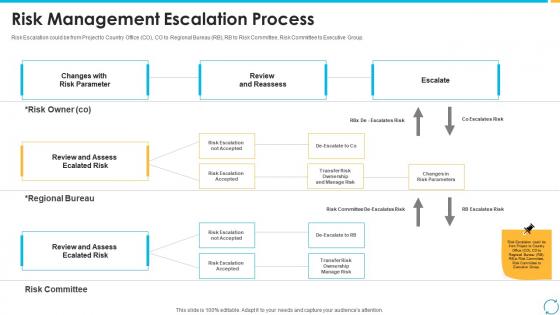
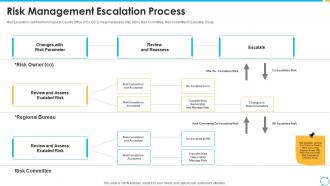
Risk Escalation could be from Project to Country Office CO, CO to Regional Bureau RB, RB to Risk Committee, Risk Committee to Executive Group.
People who downloaded this PowerPoint presentation also viewed the following :
Escalation process for projects risk management escalation process with all 9 slides:
Use our Escalation Process For Projects Risk Management Escalation Process to effectively help you save your valuable time. They are readymade to fit into any presentation structure.








FAQs for Escalation process for projects risk
Key components include clear escalation triggers, defined authority levels, standardized reporting templates, predetermined timelines, and established communication channels. These elements streamline decision-making by ensuring rapid information flow, appropriate resource allocation, and timely executive involvement, with many organizations finding that structured escalation processes significantly reduce response times and enhance overall risk mitigation effectiveness.
Organizations determine escalation thresholds by assessing risk impact levels, probability scores, regulatory requirements, business continuity factors, and stakeholder concerns. Through structured risk matrices and clear criteria, companies in sectors like banking, healthcare, and manufacturing establish automated triggers that streamline decision-making, enhance response times, and ultimately deliver consistent risk governance while enabling faster resolution of critical threats.
Communication serves as the backbone of effective risk escalation, enabling timely information flow, stakeholder alignment, and coordinated response across organizational levels. Through structured reporting protocols, real-time alerts, and cross-functional collaboration channels, organizations streamline decision-making processes, minimize response delays, and ensure comprehensive risk visibility, ultimately delivering enhanced operational resilience and strategic risk mitigation.
Companies ensure escalation procedure awareness through comprehensive training programs, regular communication updates, accessible documentation systems, and integration into standard operating procedures. These approaches work by embedding escalation protocols into daily workflows, conducting periodic drills and assessments, and maintaining clear visual reminders, with many organizations finding that multi-channel communication and routine practice ultimately deliver faster response times and improved risk mitigation outcomes.
Risk escalation management tools include GRC platforms like MetricStream and ServiceNow, project management software such as Jira and Asana, enterprise risk systems like Resolver and LogicGate, and workflow automation tools. These technologies streamline escalation tracking by automating notifications, centralizing risk documentation, and providing real-time dashboards, with many organizations finding that integrated platforms significantly reduce response times while enhancing transparency across departments.
Risk assessments for scalability needs should be conducted quarterly at minimum, with continuous monitoring for high-growth organizations and annual comprehensive reviews for stable enterprises. Many technology companies and financial institutions perform monthly assessments during expansion phases, enabling proactive resource allocation, infrastructure planning, and strategic capacity management, ultimately delivering competitive advantage through seamless scaling capabilities.
Common pitfalls include delayed reporting, unclear escalation criteria, inadequate stakeholder communication, insufficient documentation, and lack of defined ownership responsibilities. These challenges often result in missed critical risks and poor decision-making, with many organizations finding that streamlined escalation frameworks, regular training, and automated monitoring systems significantly enhance response times and ultimately deliver better risk outcomes across all operational levels.
Risk management teams prioritize escalation by assessing impact severity, probability of occurrence, regulatory implications, timeline urgency, and organizational vulnerability. Through risk scoring matrices and automated monitoring systems, teams in financial services, healthcare, and manufacturing can systematically rank threats, enabling faster response to high-priority risks while optimizing resource allocation and maintaining operational continuity.
Best practices for documenting the risk escalation process include establishing clear escalation criteria, defining stakeholder roles and responsibilities, creating standardized reporting templates, setting specific timeframes for each escalation level, and maintaining comprehensive audit trails. These documentation frameworks streamline decision-making by ensuring consistent communication, reducing response delays, and enhancing regulatory compliance, with many organizations finding that structured documentation ultimately delivers greater transparency and more effective risk resolution across all business units.
Cultural factors significantly influence risk escalation decisions through communication styles, hierarchy respect, blame avoidance tendencies, and decision-making approaches within organizations. In many financial services and healthcare institutions, risk-averse cultures encourage proactive escalation while preserving relationships, whereas entrepreneurial environments may delay escalation to maintain autonomy, ultimately affecting response times and organizational resilience.
Essential training includes risk identification techniques, escalation criteria assessment, communication protocols, documentation standards, and decision-making frameworks. Through structured workshops and scenario-based simulations, employees develop critical skills in recognizing threshold triggers, crafting clear incident reports, and understanding organizational hierarchies, ultimately enabling faster response times and more effective risk mitigation across departments.
Effectiveness metrics include response time to escalation triggers, resolution timeframes, stakeholder notification accuracy, decision-making speed, and cost impact reduction. These measurements enable organizations to streamline their escalation protocols by identifying bottlenecks, enhancing communication workflows, and optimizing resource allocation, with many financial institutions and healthcare systems finding that systematic tracking ultimately delivers faster risk mitigation and improved operational resilience.
Lessons learned from past risk escalations enhance future processes by identifying communication gaps, refining escalation triggers, and strengthening decision-making protocols through systematic analysis and documentation. Organizations across sectors like healthcare, finance, and manufacturing leverage these insights to accelerate response times, improve stakeholder coordination, and minimize operational disruptions, ultimately delivering more resilient risk management frameworks and competitive operational advantage.
Stakeholders serve as decision-makers, risk assessors, and communication channels within the escalation process, with executive leadership making final decisions, department heads evaluating impact, and project managers coordinating responses. Through strategic involvement at different escalation levels, organizations streamline risk resolution, enhance accountability, and ensure appropriate resource allocation, with many finding that clear stakeholder roles significantly reduce response times and improve business continuity.
Organizations balance speed and thoroughness in risk escalation by implementing tiered response protocols, automated alert systems, and predefined escalation criteria that trigger immediate action. Through structured frameworks, companies streamline decision-making while maintaining comprehensive risk assessment, with many financial institutions and healthcare organizations finding that standardized escalation matrices ultimately deliver faster resolution times and improved risk mitigation.
-
Easily Editable.
-
Excellent Designs.
-
Colors used are bright and distinctive.
-
The content is very helpful from business point of view.
-
Best Representation of topics, really appreciable.