


Risk management escalation process escalation project management ppt designs




Try Before you Buy Download Free Sample Product
 Impress Your
 Audience
 100%
100% Editable
 Save Hours
 of Time


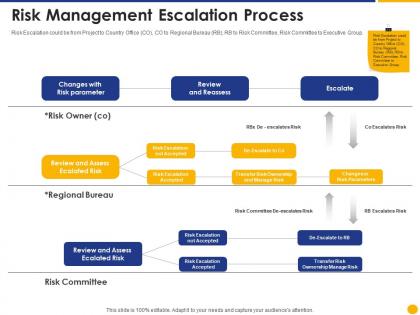
Risk Escalation could be from Project to Country Office CO, CO to Regional Bureau RB, RB to Risk Committee, Risk Committee to Executive Group.
People who downloaded this PowerPoint presentation also viewed the following :
Risk management escalation process escalation project management ppt designs with all 2 slides:
Use our Risk Management Escalation Process Escalation Project Management Ppt Designs to effectively help you save your valuable time. They are readymade to fit into any presentation structure.

FAQs for Risk management escalation process escalation project
So basically you've got four main steps: spot the risk, figure out how bad it is, do something about it right away, then escalate when needed. Use whatever risk matrix your company has to gauge severity. If it hits certain thresholds - money, legal stuff, operations getting screwed up - that's when you bump it upstairs. Here's the thing though: people always wait too long because they think they can fix it solo. Don't be that person. When you do escalate, give them the full picture - what happened, how bad it is, what you already tried. Oh and document literally everything, trust me on this one.
Honestly, most companies screw this up by being way too vague about when to escalate. You want specific triggers built right into your risk framework - actual dollar amounts, customer impact numbers, regulatory deadlines. Not wishy-washy stuff. When risks cross departments or could mess with your reputation? Those definitely need senior leadership involved. Set clear probability levels and impact thresholds that automatically flag issues for escalation. The whole point is documenting these triggers ahead of time so your team isn't stuck guessing when things get crazy. Oh, and timeline constraints work great too - if something's moving fast, it probably needs to go up the chain.
So basically you've got three groups handling risk escalation. Risk owners spot problems and kick them upstairs when they hit certain triggers. Management takes those escalations and decides what to do about them. The big executives deal with the really scary stuff and set how much risk the company can stomach. The whole thing works way better when everyone knows exactly when to escalate - like if a risk score goes red or potential losses hit $500k or whatever. Document your escalation paths clearly so people aren't scrambling around wondering who to call. Though honestly, half the time it still ends up being a mess anyway.
So basically it comes down to what kind of risk you're dealing with. Project risks threaten your deadlines and deliverables - those go up the project chain to your PM, then program manager, etc. Way more urgent usually since you've got hard deadlines breathing down your neck. Operational risks are different though. They mess with day-to-day business stuff, ongoing processes, compliance issues. Those get escalated through your regular management hierarchy instead. Honestly the tricky part is just figuring out which bucket your risk falls into so you don't waste time pinging the wrong people.
Look at impact first - could this mess up your timeline, budget, or what you're delivering? Next is probability. A 70% chance of moderate damage usually beats a 5% chance of total disaster, though honestly both need your attention. Time matters too since some risks snowball if ignored. Here's what I've learned: if it's keeping you up at night or might blow your key milestones, don't wait around hoping it fixes itself. Escalate now. Better to look overly cautious than explain later why everything went sideways.
Honestly, most people mess this up by getting way too into the weeds with technical stuff. Three things that actually matter: be crystal clear about the risk and timeline, know who to contact before you're panicking, and move fast. Don't dance around it with corporate BS - just say what's broken and how it'll hurt the business. I'd set up some basic templates for different emergency levels so you're not writing essays when everything's on fire. Speed beats perfection here. Oh, and figure out your escalation chain when things are calm, not during a crisis.
Honestly, risk matrices are your best friend here - just plot probability against impact and you'll instantly see what needs attention. Set up clear scoring thresholds first so everyone knows when to escalate. RACI matrices work great for figuring out who handles what. For tracking, risk registers with consistent scoring keep things organized. Monte Carlo simulations are amazing for complex stuff, though probably overkill if you're dealing with simple projects. Oh, and automated dashboards (Jira, ServiceNow, whatever) can flag risks automatically instead of you constantly checking. Saves so much time. Just make sure your team knows exactly when something hits "drop everything and escalate" status.
So basically you want a paper trail showing who decided what and when. Track the original risk assessment, who got notified, and what actions happened. Honestly? A simple shared spreadsheet does the trick for most teams - don't overthink it with fancy software unless you really need it. The main thing is everyone can quickly check status and see who owns what risk. Oh and actually update the damn thing regularly, especially when stuff hits the fan and people are scrambling to find info.
Honestly, waiting too long is the worst mistake - you think you've got it covered until boom, everything's on fire. I learned this the hard way last year. Set clear rules beforehand about what needs escalating and when. Write down what's happening so your boss isn't going in blind. Don't make it sound worse than it is, but don't downplay it either. Regular check-ins help too since escalating becomes normal conversation instead of panic mode. Oh, and some people escalate every tiny thing which just annoys everyone. When you're unsure though? Just do it early.
Culture totally controls whether people actually escalate risks or just hide them. I've watched companies where bringing up problems gets you blamed - so nobody says anything until it's a disaster. Really toxic pattern. The good places? They thank you for flagging issues early, even messy ones. Leadership actually celebrates when someone raises their hand about potential problems. Makes all the difference. Your team needs to feel safe speaking up without getting thrown under the bus. Otherwise you're just waiting for things to blow up later when they're way harder to fix.
Honestly, the right tech makes a huge difference here. Real-time dashboards beat the hell out of email chains that people ignore. You can set up automatic alerts that route issues to whoever needs to handle them based on how serious they are. Response tracking is clutch too - you'll actually know if someone saw your escalation instead of just hoping. Oh and the audit trail thing? Total lifesaver during reviews. I'd map out how you currently escalate stuff first, then look for software that can handle those handoffs automatically. Way less stressful than chasing people down manually.
Look at Toyota in 2010 - when their acceleration crisis hit, they got executives involved immediately and coordinated worldwide. But honestly? Johnson & Johnson's Tylenol thing is still the best example. They escalated straight to the CEO in hours and pulled everything from shelves nationwide. Ballsy move that paid off. Facebook does this now with data breaches too, getting the board involved super fast. The pattern is simple: bad news doesn't fix itself. Get the right people looped in early, even if it feels overdramatic. Way better than getting blindsided later because you waited too long.
Ugh, risk escalation is the worst for project timelines and budgets. Suddenly you've got way more people involved who all need updates and approvals - everything just crawls. Plus escalated risks usually mean you'll need extra resources or new mitigation plans, which obviously costs more. The really annoying part? Senior management might freeze your whole project while they figure things out. Honestly, I learned this the hard way - always build in buffer time and extra budget from the start. Complex projects almost always have escalations, so you might as well plan for it.
Honestly, start with tabletop exercises every month - they're absolute game-changers. Three things matter most: solid decision-making frameworks, clear communication protocols, and realistic training scenarios. Cross-train everyone on different roles too, because Murphy's law guarantees your key person will be sick during the actual crisis. I've watched so many teams completely freeze when stuff hits the fan because they'd only read about it in manuals. Get people hands-on practice with your escalation tools and templates. Oh, and make sure everyone knows the triggers for escalating and exactly who to call. Real simulations build that muscle memory you'll desperately need.
Start a simple database tracking what triggers each escalation and how you actually fixed it. Sounds tedious, I know, but it's a lifesaver when chaos hits again. Document response times and where communication broke down. Review the patterns every few months with your team - you'll spot trends that aren't obvious day-to-day. Here's the thing though: make sure new hires actually go through these old cases during training. Those real-world examples teach them way more than any generic handbook ever could.
-
Content of slide is easy to understand and edit.
-
Really like the color and design of the presentation.
-
Innovative and attractive designs.
-
Professional and unique presentations.
-
Great product with effective design. Helped a lot in our corporate presentations. Easy to edit and stunning visuals.