

Project raid analysis escalation project management ppt introduction




Try Before you Buy Download Free Sample Product
 Impress Your
 Audience
 100%
100% Editable
 Save Hours
 of Time


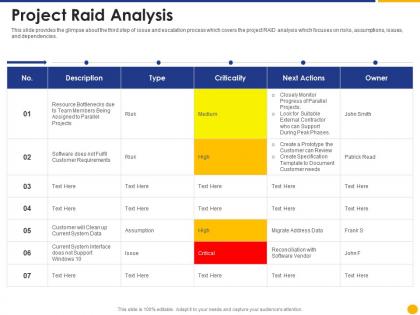
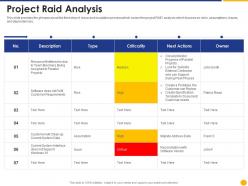
This slide provides the glimpse about the third step of issue and escalation process which covers the project RAID analysis which focuses on risks, assumptions, issues, and dependencies.
People who downloaded this PowerPoint presentation also viewed the following :
Content of this Powerpoint Presentation
Ever felt like your projects are caught in a maze, and your business is struggling to tackle uncertainties and risks? If you agree, then you are not alone. The world of project management is such that every decision counts, and every risk can make or break your success.
But fear not, for amid uncertainty lies the opportunity for mastery. Introducing SlideTeam’s Project Raid Analysis Template – your compass in the maze of project complexities.
What exactly is a RAID analysis, you might ask? RAID stands for Risks, Assumptions, Issues, and Dependencies – the four pillars of project evaluation and mitigation. It is not just about identifying what could go wrong but about strengthening your project against potential pitfalls and seizing opportunities hidden within challenges.
Our template is not just another set of bland forms and charts; it is your strategic arsenal, crafted to:
-
Identify Risks: Pinpoint potential threats lurking in the shadows of your project plan.
-
Address Assumptions: Challenge assumptions that might be steering your project off course.
-
Resolve Issues: Tackle problems head-on with clear, actionable strategies.
-
Manage Dependencies: Untangle the web of interdependencies that can stall your progress.
The 100% editable and customizable nature of SlideTeam’s PowerPoint Templates provides you with the structure and the desired flexibility to edit your presentations.
Let’s explore!
If you need a raid log for project issues and risk management, you are at the right place. Click here to explore our Premium PPT.
Template 1: Project Raid Analysis
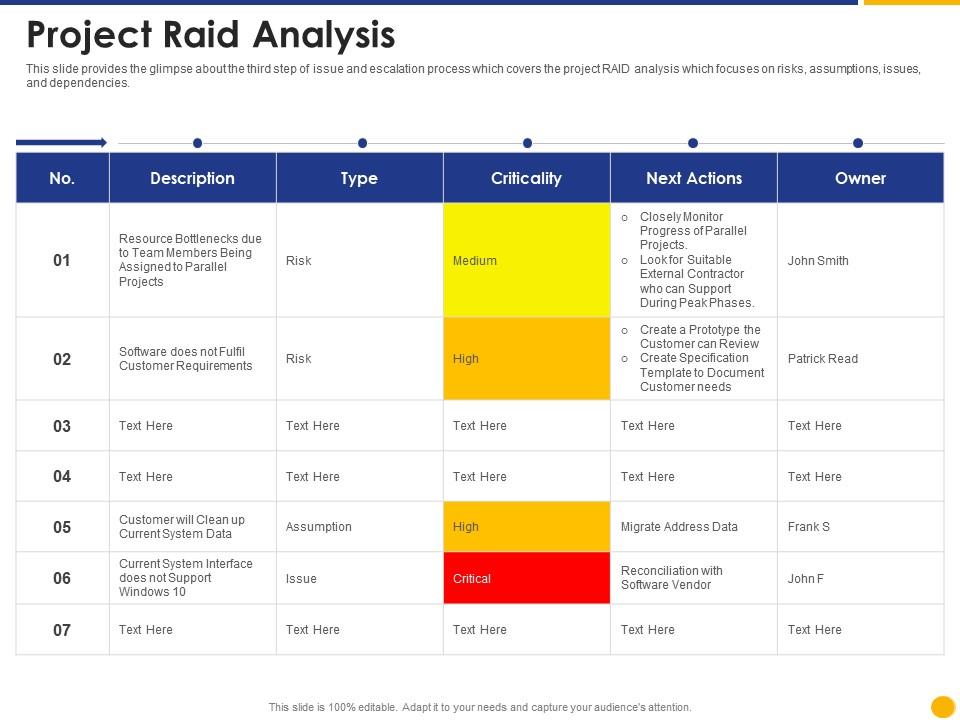
This PPT, with its tabular format, helps address potential risks that can derail your projects. Its layout helps explain and manage up to seven risks in a comprehensive manner. The table comprises columns for risk description, type (risk, assumption, issue, etc.), criticality (high, medium, critical), next actions, and owner. This holistic approach ensures everyone is aligned and working toward resolving risks and issues within the project. Download this PPT today!
Before We Bid Adieu
In project management, where every decision carries weight risks are aplenty, the power of strategic analysis cannot be overstated. With SlideTeam’s Project Raid Analysis Template, you have the right intel to combat the complexities of your projects. From identifying risks to managing dependencies, our PPT helps you fortify your projects against uncertainty and seize opportunities for success. Get it today!
Project raid analysis escalation project management ppt introduction with all 2 slides:
Use our Project Raid Analysis Escalation Project Management Ppt Introduction to effectively help you save your valuable time. They are readymade to fit into any presentation structure.
FAQs for Project raid analysis escalation project
So there are five main phases: initiation, planning, execution, monitoring, and closing. But honestly? It's way messier than it sounds - more like organized chaos than a neat checklist. Start by nailing down your scope and who's involved during initiation. Planning is where you map out timelines and resources (and trust me, spend extra time here because it saves your butt later). Then you're executing while constantly monitoring progress. The thing is, these phases totally overlap. You might still be planning one piece while executing another. Oh, and monitoring isn't really its own separate thing - it happens throughout everything else.
Dude, honestly? Write down EVERYTHING upfront - what you're doing, what you're NOT doing, deadlines, all of it. Get people to actually sign off on this stuff before you touch anything. Trust me, I got burned so bad on my last project because I skipped this step like an idiot. Make them go through a formal process if they want changes later. They need to explain why they want new features and how much extra time/money it'll cost. Being super specific about boundaries from the start will save your sanity. That scope doc becomes your bible.
So stakeholder analysis basically saves your butt on projects. First thing - list everyone who could mess with or get affected by what you're doing. Then figure out who's got real power versus who just thinks they do (there's always one of those). Map their interests and influence levels so you know who needs the VIP treatment. I've watched projects completely implode because someone brushed off a "small" stakeholder who secretly had kill switch authority. Wild stuff. Don't just do this once either - people's roles shift constantly. Communication strategy flows from there once you know who matters most.
Dude, risk management can totally save your project from disaster. You don't want to be that person scrambling when everything goes sideways (and trust me, something always does). I learned this the hard way on a project last year - budget got crazy tight because we didn't plan for vendor delays. Anyway, here's what works: identify your biggest threats upfront, make backup plans, and keep everyone in the loop about potential problems. Honestly, most teams skip this step thinking they'll wing it. Bad idea. Just write down your top 5 risks and figure out what you'll do if they happen. Takes like an hour but saves weeks of headaches later.
Honestly, just pick Scrum or Kanban to start - Scrum's good if you like structured sprints, Kanban flows better for ongoing stuff. Jira's supposedly the best but ugh, it's such a pain to set up for small teams. I'd go with Trello or maybe Azure DevOps instead. Way less headache. You'll need something for standups too - Zoom's fine, though Miro's actually pretty cool for planning sessions if you're into that visual stuff. Don't overthink it. Pick one method, one main tool, then add more later once everyone stops complaining about change.
Honestly, communication is everything. Set up your channels early and actually use them - weekly check-ins, consistent reports, the whole deal. Make sure people know who handles what because I swear half of project disasters happen when everyone assumes someone else is on top of things. Write stuff down as decisions happen, not weeks later when you're scrambling to remember why you chose option B. Oh, and this might sound obvious but create an environment where people feel safe bringing up problems. Nobody wants to be the bearer of bad news, but catching issues early beats pretending they'll fix themselves.
Honestly? Good teamwork is what makes or breaks projects. Poor communication leads to that nightmare scenario where everyone thinks someone else handled the important stuff - then suddenly you're scrambling to meet deadlines. But when people actually talk to each other and share what they know, problems get solved faster. Less drama, better decisions, way fewer nasty surprises. Plus nobody wants to feel lost or isolated on their own team (been there, it sucks). Set up regular check-ins from the start and make sure everyone knows how to reach each other. Sounds basic but you'd be surprised how often teams skip this.
Honestly, focus on the basics first - SPI and CPI will tell you if you're hitting deadlines and staying on budget. Track scope creep too because that stuff sneaks up on you. Quality metrics like defect rates matter, plus how happy your stakeholders actually are. If you're doing agile, velocity is clutch but more for individual sprints. My advice? Don't track everything under the sun - pick maybe 5 metrics that actually move the needle for your specific project. Set up something simple you can check weekly. Way better to catch problems early than scramble later when everything's on fire.
Think of it like a triangle - tweak one side and the others have to move. Want better quality? You're gonna need more time or cash, period. I always tell stakeholders this upfront so nobody's shocked later. Too many PMs just say "sure, we can do everything!" which is honestly just setting yourself up to fail. Figure out which constraint has wiggle room first - maybe your deadline's flexible, maybe budget isn't. Then be super clear about those limits with everyone involved. Write it down too because scope creep will definitely happen and you'll need receipts.
Honestly, I learned this the hard way - always build in like 10-15% extra time and budget from the start. Stuff WILL go wrong, it's just reality. Set up a proper change process so people can't keep adding random tasks without thinking through what it means. Check in regularly with everyone so small problems don't turn into disasters. Oh, and document everything! I know it's boring but seriously - when things go sideways (and they will), you need that paper trail. Communication is huge too. Be upfront about trade-offs when issues pop up. Review what went wrong after each project wraps up.
Oh man, this stuff is tricky at first! Some cultures are super direct with feedback, others beat around the bush completely. Deadlines? Total minefield - I've seen people treat them like suggestions while others stress if they're five minutes late. Hierarchy plays into it too. Like, in some cultures junior people just don't speak up in meetings, period. What really helped me was setting communication rules early on and actually asking people how they prefer feedback. Sounds obvious but I definitely learned this the hard way on a few projects that went sideways.
Honestly? Just pick one spot where everyone dumps project docs and stick with it. I'm talking Google Drive, SharePoint, whatever - just stop the email attachment madness. Update stuff as you go instead of waiting until the last minute when you can't remember what you did yesterday, let alone last month. Someone has to own this process or it'll turn into a graveyard of outdated files. Use decent file names and version numbers so people don't have to play guessing games. Trust me, I've watched projects crash because nobody could find the current specs.
Make a lessons learned doc that people will actually open - not another file graveyard situation. Do quick retrospectives after projects to grab what worked and what bombed. Tag everything by project type or team size so it's searchable later. Here's the thing though - you've got to check past similar projects BEFORE starting new ones. I know it sounds obvious, but everyone forgets when deadlines are breathing down their neck. Keep it simple and accessible. Otherwise you'll just repeat the same mistakes over and over, which honestly drives me crazy when I see teams do it.
Look, just be straight with everyone from day one. Don't sugarcoat timelines or budgets - I've seen too many PMs crash and burn doing that. Be fair with your team and don't play favorites. Also, never promise stuff you can't actually deliver. That's like PM suicide right there. Keep good records of your decisions so you can defend them later. Oh, and don't steal credit from your teammates - people remember that kind of thing. Set some ground rules early on about how you'll handle tricky situations. Transparency really is your best friend here, even when it sucks to deliver bad news.
Dude, AI's about to change everything with project management. You'll have bots doing your scheduling automatically, and predictive stuff will spot problems way before they become disasters. The VR thing is actually insane - your team can literally walk through buildings that don't exist yet. Machine learning crushes humans at figuring out who should work on what (sorry, not sorry). Real-time collab tools are finally getting decent too. Oh, and no more boring status reports since automation handles that now. Honestly, start playing around with AI tools today or you'll be kicking yourself later when everyone else is already ahead.
-
The Designed Graphic are very professional and classic.
-
It saves your time and decrease your efforts in half.