


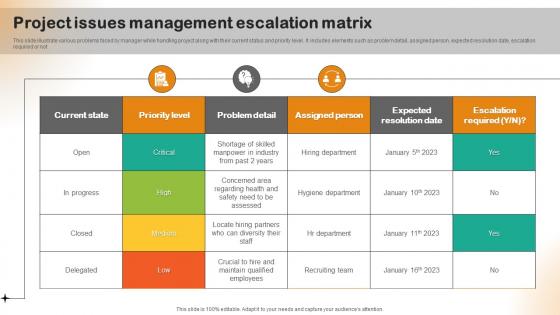
Project Issues Management Escalation Matrix




Try Before you Buy Download Free Sample Product
 Impress Your
 Audience
 100%
100% Editable
 Save Hours
 of Time


This slide illustrate various problems faced by manager while handling project along with their current status and priority level. It includes elements such as problem detail, assigned person, expected resolution date, escalation required or not.
People who downloaded this PowerPoint presentation also viewed the following :
Project Issues Management Escalation Matrix with all 6 slides:
Use our Project Issues Management Escalation Matrix to effectively help you save your valuable time. They are readymade to fit into any presentation structure.





FAQs for Project Issues
Think of an escalation matrix like your emergency contacts but for work disasters. Basically, it maps out who gets called when shit hits the fan at different levels - from your regular support team up to the big bosses. You set specific triggers and time limits so people know exactly when to bump something upstairs. Honestly, it's a lifesaver because nobody's left wondering "wait, who handles this?" when something breaks. Clear roles mean faster fixes and less finger-pointing later. Just make sure you define what counts as "urgent" vs "the building's on fire" level stuff.
So basically, an escalation matrix is your lifesaver when shit hits the fan. You know how during incidents everyone's running around like "who do I call??" This thing maps out exactly who to contact at each level - no more hunting down decision makers or the one person who actually knows how to fix stuff. Think of it as your emergency contact list but way more organized. Different severity levels trigger different people getting pulled in. Trust me, set this up before you actually need it (learned that the hard way). Also make sure your whole team knows where to find it, otherwise what's the point? It'll save you so much headache when everything's breaking.
So for your escalation matrix, start with what actually triggers an escalation - like specific issue types or severity levels. Map out who gets contacted at each stage with their actual phone numbers and emails. Set realistic timeframes too, because nobody responds in 15 minutes like these templates always claim. Oh, and definitely include backup contacts since the main person will somehow always be in a meeting or on vacation when everything's on fire. Make sure you're clear about who can actually make decisions at each level. The whole thing should be dead simple to follow when you're stressed and just need to know what to do next.
So escalation matrices are way more targeted than regular org charts. Your org chart shows who reports to who for day-to-day stuff, but an escalation matrix is like your emergency contact list - it cuts across departments and tells you exactly who has the right expertise for specific problems. Budget issue? Hit up your manager. Data breach? Skip straight to IT security, don't waste time going through your boss first. Honestly, I wish more teams had these mapped out because nothing's worse than bouncing between three different people when something's actually on fire. Just make one for your most common disasters and save yourself the headache later.
So an escalation matrix is basically your game plan for when stuff hits the fan. You map out who gets called at what point - like team lead after 2 hours, then PM after 4 hours, that kind of thing. It's super helpful for risk assessment too since you can sort threats by how bad they'll mess things up. Honestly, the hardest part isn't making the matrix - it's getting people to actually use it instead of just panicking. But once everyone's on board, you won't have issues sitting around getting worse while people figure out who to bug about it.
First thing - map out how your team actually works right now and where stuff gets stuck. Don't just steal someone's template. Set clear triggers for escalating, like "customer ghosted us for 48 hours" or "deal's over $50k." Teams love overcomplicating this but honestly? Start simple. Name specific people for each level, not just "a manager" - which manager exactly? Run it through some real situations first, then tweak it. Oh and make sure everyone actually knows when to kick things upstairs, because that's where most of these systems fall apart.
Ugh, the worst thing you can do is overcomplicate it - nobody wants to decode some crazy flowchart just to report a bug. Most places screw up by not being clear about WHEN to escalate, so stuff either sits forever or someone bothers the VP about printer issues. Also? Update your contact list! Nothing's worse than calling someone who left six months ago. Don't create a million approval steps that just slow everything down. Honestly, I've seen matrices that look like org charts from hell. Test it out with real problems first, and actually tell people it exists - sounds obvious but you'd be surprised.
Check it quarterly at minimum, but honestly? More often if your team's always changing. New people join, roles shift - that's when you gotta update it. I learned this the hard way when I spent 20 minutes trying to reach someone who'd quit like 6 months earlier. Super annoying when you're dealing with something urgent. Just throw a calendar reminder on there and spend 15 minutes reviewing it. Way better than scrambling around later trying to figure out who actually handles what anymore.
Definitely grab your PM and key people from each department that'll be affected. Leadership needs to be there too - someone who can actually make those big escalation calls when things hit the fan. Oh, and learn from my mistake - we totally forgot to include ops once and it was a mess. Customer service folks are clutch since they catch problems first. IT should probably sit in if there's any tech stuff involved. Legal reviewing it might seem overkill but honestly not the worst idea. Start by mapping out who has decision power at each level - saves you headaches later when you're scrambling.
Dude, just automate the whole thing - trust me on this. Set up alerts before your SLAs get blown and route tickets by severity automatically. ServiceNow and Zendesk both have workflows built in that'll handle most of it. Real-time dashboards are clutch because you can catch problems early instead of scrambling later. I learned this the hard way doing everything manually (never again). Map out what you're doing now first, then just... digitize it. Oh, and tracking escalation patterns over time actually helps you fix root causes too.
Try role-playing different scenarios with your team first - honestly, it's a game changer when actual problems pop up. Everyone should know the exact triggers for escalating, not just some wishy-washy guidelines. Keep updating the training since stuff changes constantly. Oh, and hammer home that escalating isn't failing - it's literally what they're supposed to do. Those little reference cards with contacts and decision trees? Total lifesaver. You want escalation to feel normal, not like some terrifying last resort they'll avoid at all costs.
Look, an escalation matrix is just a game plan for who deals with what drama. When conflicts pop up, your team knows exactly where to take them instead of freaking out and emailing everyone. Different problems go to different people based on how serious they are. Honestly? The best part is it removes all the emotional chaos from the situation. Conflicts get solved faster because there's no confusion about next steps. Oh, and definitely set this up beforehand - I learned that one the hard way. Trying to figure out your process while you're already dealing with team drama is basically impossible.
Honestly, no escalation matrix is a recipe for disaster. Your team won't know who to call when stuff hits the fan or what even counts as urgent vs. something that can wait. Junior people get stuck handling critical issues they can't actually solve, while your senior folks waste time on random minor problems. Customers get pissed off waiting around, and everyone's stressed because there's no clear process. I've seen this mess before - you really need those escalation paths mapped out with contact info and criteria for each level. Makes such a huge difference when things actually work smoothly.
Yeah, escalation matrices work great for customer service! Map out your issue types - billing stuff, tech problems, complaints - then match them to support tiers. Password resets? Tier 1 handles those. But when someone's furious and threatening to leave, that goes straight to senior reps or management. Honestly, it saves so much time because your team won't be guessing who should handle what. Set clear triggers and you'll see faster resolution times. Your customers stay happier too since they're not getting bounced around between the wrong people.
Flowcharts are seriously a game-changer for escalation stuff. When you're panicking about an issue, having that visual roadmap beats scrolling through some random spreadsheet of names and phone numbers. You can actually see where decisions happen and how long each step should take. Plus - and this might sound weird - but drawing it out helps you catch weird gaps in the process that you'd totally miss otherwise. I swear it's like the difference between having directions written on a napkin versus actual GPS. Just grab a whiteboard and sketch your current process. You'll probably find at least one confusing spot right away.
-
I was mind-blown by the services that SlideTeam provided me. Thanks a ton!
-
I discovered some really original and instructive business slides here. I found that they suited me well.