


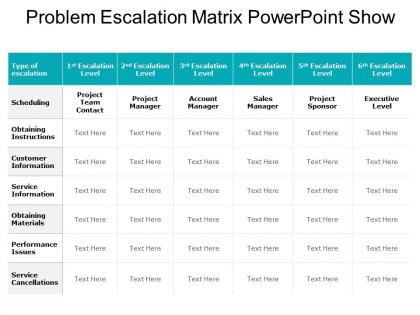
Problem escalation matrix powerpoint show




Try Before you Buy Download Free Sample Product
 Impress Your
 Audience
 100%
100% Editable
 Save Hours
 of Time


Discover an expanse of avenues before you with our Problem Escalation Matrix Powerpoint Show. Break out into freedom.
People who downloaded this PowerPoint presentation also viewed the following :
Problem escalation matrix powerpoint show with all 5 slides:
Come hell or high or high water. Our Problem Escalation Matrix Powerpoint Show will stick with you.





FAQs for Problem escalation
A problem escalation matrix is your game plan for when projects hit the fan. It shows exactly who to call based on how bad things get - team lead for small stuff, project sponsor for bigger issues, executives when everything's on fire. Honestly, most people skip this step and regret it later. When you're already stressed about a major problem, the last thing you want is scrambling around trying to figure out who can actually make decisions. Some problems need quick fixes, others require budget approval or executive sign-off. Set it up early so you're not guessing during a crisis.
So you need clear triggers for each level - like "over 100 customers affected" or "revenue loss above 10K." One user can't log in? Tier 1 handles it. Payment system crashes on Black Friday though? That's an instant tier 3 situation. Define your severity levels around business impact and how urgent stuff actually is. Low, medium, high - but be specific about what each means. Customer count, money lost, time pressure. The whole point is avoiding judgment calls when everyone's freaking out at 2am about whether to call the boss. Make it measurable, not just someone's gut feeling.
Start by figuring out what's actually critical vs just annoying for your team. Map out who's good at what and available when - you don't want your frontend person stuck debugging database issues at midnight. Set clear time limits too, like if something isn't fixed in 2 hours, bump it up. After-hours coverage is honestly the worst part but someone's gotta do it. Figure out how you'll actually notify people - Slack, calls, whatever doesn't get ignored. Try running through a couple real scenarios first. Trust me, you'll find gaps you didn't think of.
So basically it's like having a contact list for when stuff hits the fan - no more running around asking "who handles this??" Map out who gets what problems and when to bump things up the chain. Response times get clearer too, which honestly saves so much drama. People stop panic-messaging the entire team (you know how that goes). The hot potato thing with problems bouncing around? Gone. I'd start by looking at how you currently handle issues - bet you'll spot some obvious gaps pretty quick. Makes ownership way less confusing.
Honestly, the worst mistake is making your escalation rules way too vague - nobody knows when to actually pull the trigger. Time limits are huge too. Without clear deadlines, issues just sit there rotting forever. Keep your contact info current (trust me on this one - our VP's phone was dead for like 3 months and we had no clue). Don't overcomplicate it with a million different paths either. Simple beats fancy every time. Oh, and drill it into your team's heads that escalating early isn't a failure. Better to flag something too soon than let it blow up later.
So basically, regular issue tracking is just logging tickets and assigning them to people. An escalation matrix actually tells you WHO to bug and WHEN based on specific triggers. Like if a server's down for 30 minutes, the matrix automatically kicks it up to your manager. Or if it's a P1 issue, boom - straight to the director. You're not scrambling around during a crisis wondering who needs to know what. Honestly, most teams just wing it until something explodes. Way better to map out those "when do I panic and call someone" rules ahead of time.
Honestly, you HAVE to document your escalation stuff or it becomes a total mess. When issues don't get fixed, everyone starts blaming each other because there's no record of who did what. Track the basics - what got escalated, when, who handled it, what happened next. Your team needs to log triggers and outcomes in whatever system you're using. The cool part is you'll start seeing patterns emerge, like realizing you escalate the same types of problems constantly. Without good records, you're just crossing your fingers and hoping things work out. Documentation actually lets you fix the process.
Honestly, every quarter is the bare minimum. I update mine whenever someone leaves or we get new systems - which feels like constantly these days lol. Contact info goes stale so fast it's ridiculous. After big incidents, I'll check if the escalation actually worked or if we just hit dead ends. Mine's basically a living doc at this point. Set a calendar reminder for every 3 months and treat it like regular maintenance. Way better than scrambling during an outage because half your contacts don't work anymore.
Honestly, start with escalation response time and resolution rates at each tier - those are your bread and butter. Track your escalation rate percentage too. Customer satisfaction after escalations is huge (angry customers = bad reviews). I'd definitely watch for ping-pong issues where tickets bounce between teams - that stuff drives everyone crazy. First-contact resolution tells you if tier 1 is actually equipped to handle what's coming their way. Oh, and repeat escalations from the same customer? That's your canary in the coal mine for broken processes. Pick maybe 3-4 that match your worst headaches right now.
Just start with what "critical" actually means for your company, then build backwards from there. Healthcare needs crazy fast response times - like 15 minutes for emergencies. Manufacturing focuses more on production impact levels. Financial services have all that compliance stuff baked in (such a pain honestly). Retail companies prioritize customer-facing problems way differently than B2B software does. Map out your real business risks first - not some generic template. Then figure out who needs to be involved and when. Different industries need totally different timeframes and severity levels. The whole thing should match how your business actually operates, not some textbook version.
Honestly, you should just automate the whole thing. Get a ticketing system like ServiceNow or Jira that can route issues automatically and track response times. Set up alerts before SLA deadlines hit. The AI categorization stuff is pretty solid now too - saves time sorting by severity. Map out what you're doing manually first, then find software that handles the handoffs for you. No more confusion about who's supposed to deal with what. I mean, we've all been there with the "wait, I thought YOU were handling this" drama. Complete audit trail keeps everyone honest too. Trust me, it'll save your sanity.
Honestly, start with training everyone on severity levels - that's where most teams mess up. People either freak out over nothing or brush off actual emergencies. Make sure they know exactly who to call and when, plus what timeframes to expect. Role-playing different scenarios is clutch for getting this stuff to stick. Oh, and definitely cover when it's cool to skip levels if something's really hitting the fan. The documentation requirements matter too, though nobody loves that part. I'd do quarterly refreshers since this isn't stuff people use daily and they'll forget the details otherwise.
So your escalation matrix needs to spell out exactly who gets called when stuff hits the fan. Map out which stakeholders need to know what at each level - customers, leadership, partners, whoever. Some people want instant alerts, others just want a daily summary (honestly, I prefer the summary people). Don't forget to include their preferred contact methods and what triggers each escalation tier. The worst thing? Scrambling around trying to figure out who to notify when everything's already broken. Oh, and make sure you've got both internal and external contacts covered - nothing worse than forgetting to tell a key client about an outage.
Oh totally! Remote teams need this even more than in-person ones. You know how you'd normally just grab someone in the hallway to ask "hey, who deals with X?" Well, that doesn't exist when everyone's scattered across different time zones. Without clear escalation paths, problems just sit there forever while people send emails back and forth trying to figure out whose job it is. Nothing's worse than the whole "wait, I thought Mike was on this" situation. Set up triggers, timeframes, who to contact - then actually follow it when stuff breaks. Trust me, it'll save you so much headache.
Dude, lead with business impact right away - they don't have time to hunt for why this matters. What's broken, how it hits customers/revenue, what you tried, what you need. I swear, half these escalations die because people write essays instead of bullet points. Your subject line should scream urgency: "URGENT: Payment system down - needs vendor X approval." Always bring solutions, not just problems. Actually, that's probably the biggest thing - make it stupid easy for them to approve your plan. Don't make them think too hard about next steps.
-
Illustrative design with editable content. Exceptional value for money. Highly pleased with the product.
-
Best way of representation of the topic.